

American costume designer Vera West (1897-1947) was PROLIFIC. In addition to designing a literal GAZILLION films, serving as chief costume designer for Universal Pictures from 1928-47, she also launched a fashion line in the year of her death… which happened under intriguingly suspicious circumstances! Apparently she was found dead in her swimming pool with a note that suggested she’d committed suicide because she was being blackmailed, but her husband denied it (and said she wanted a divorce). Sad! After our interview about the necklace in The Bride of Frankenstein, I of course had to look up the costume designer and see what else she had done. A LOT, let me tell you!
The Man Who Laughs (1928)
A German “synchronized sound” film: “When a proud noble refuses to kiss the hand of the despotic King James in 1690, he is cruelly executed and his son surgically disfigured” per IMDB.


Dracula (1931)
THE original Dracula film, starring Bela Lugosi. And having never seen it, I can’t tell if it’s costumed contemporaneously or if this is just 1930s-does-1890s?


The Mummy (1932)
Set in 1921, this horror film is about an ancient Egyptian mummy coming back to life and trying to resurrect his dead lover, who is in “Ancient Egyptian” costume.

Great Expectations (1934)
The first sound adaptation of the Dickens novel. Clearly “attempts” were made at mid-19th century costume…


Bride of Frankenstein (1935)
Set in both the period the Frankenstein novel was created (1818) and whenever the hell the actual story is supposed to be set. Interestingly, the monster’s costume from this is still preserved at the Victoria & Albert Museum!


Diamond Jim (1935)
A biopic about James “Diamond Jim” Brady (1856-1917), a businessman, financier, and philanthropist of the Gilded Age.


The Great Impersonation (1935)
Set before World War I, a German man kills a British lord in order to impersonate him and spy.


Destry Rides Again (1939)
A Western in which a man is framed for a crime he didn’t commit and “returns to wreak havoc following his release from prison” (IMDB).


My Little Chickadee (1940)
A comedy Western set in the 1880s.


The House of the Seven Gables (1940)
An adaptation of the 1851 Nathaniel Hawthorne novel, about a New England family and their home.


When the Daltons Rode (1940)
Get ready, because West CLEARLY specialized in Westerns! “Fictionalized story of how the Dalton brothers were wronged by a crooked development company and became outlaws when the corrupt local courts offered them no justice” (per IMDB; you can look up whoever the Daltons were if you care!)


The Boys from Syracuse (1940)
An adaptation of a musical adaptation of Shakespeare’s The Comedy of Errors, set in the ancient Greek colony of Syracuse.


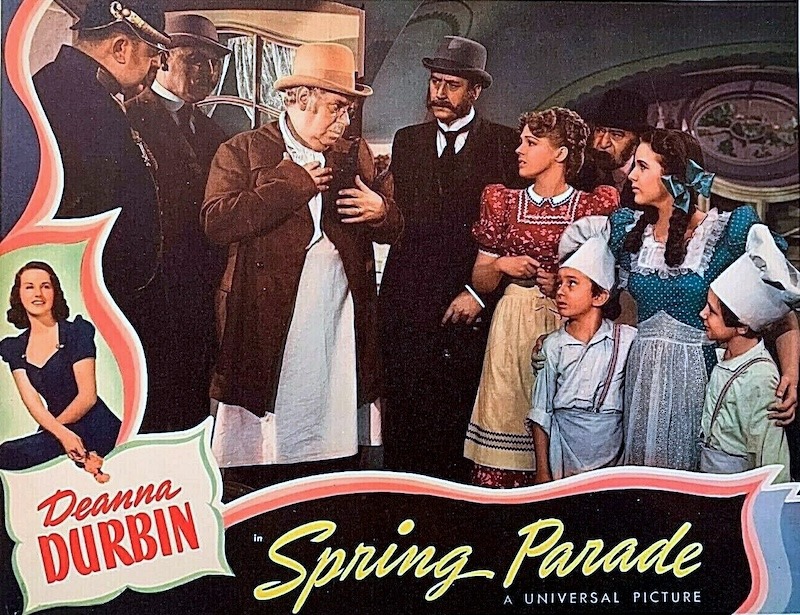
Spring Parade (1940)
A musical comedy: “A young Hungarian woman whose fortune card predicts that she will marry, may find it coming true after she meets an army drummer” (IMDB).



Diamond Frontier (1940)
“A man tries to enforce the law in a rowdy South African diamond-mining town” (Wikipedia).


The Lady from Cheyenne (1941)
A comedy Western set in the 1860s.


Law of the Range (1941)
A Western about warring families.

Badlands of Dakota (1941)
Another Western, in which a couple encounter Wild Bill Hickok and Calamity Jane.


The Masked Rider (1941)
Another Western! “The beautiful owner of a silver mine in Mexico asks an employee for help when bandits keep robbing her shipments” (IMDB).
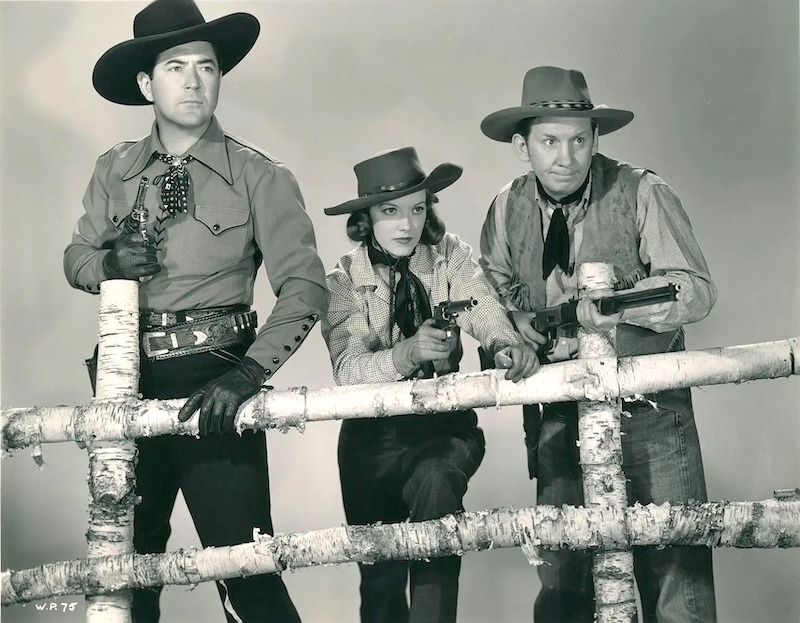

Arizona Cyclone (1941)
Another Western with a convoluted plot description on IMDB.


Fighting Bill Fargo (1941)
Western! Man faces corruption when he helps his sister run a newspaper.

Road Agent (1941)
Another Western!

North to the Klondike (1942)
A “Western” set during the Alaska (right? or Canada?) gold rush.


Stagecoach Buckaroo (1942)
Western! A cowboy is saved by two girls and then protects a gold shipment.


The Spoilers (1942)
“In Nome, Alaska, miner Roy Glennister and his partner Dextry, financed by saloon entertainer Cherry Malotte, fight to save their gold claim from crooked commissioner Alexander McNamara” (IMDB).


Mystery of Marie Roget (1942)
NOT a Western! An adaptation of an Edgar Allen Poe mystery, set in 1889 Paris.


Men of Texas (1942)
But wait, we’re back to Westerns! Two newspaper writers try to track down Sam Houston, not realizing he’s dead.


Sin Town (1942)
Set during the Texas oil boom in 1910.


Tenting Tonight on the Old Camp Ground (1943)
W.E.S.T.E.R.N.

Frontier Badmen (1943)
Western. Cattle ranchers break up a monopoly.


Phantom of the Opera (1943)
Wait, not a Western! An adaptation of the novel, set here in the mid-19th c.?


Ali Baba and the Forty Thieves (1943)
An adaptation of One Thousand and One Nights, and specifically set in Baghdad, A.D. 1258.


Trigger Trail (1944)
Western! A cowboy saves homesteaders’ land from Evil Businessmen.


Gypsy Wildcat (1944)
“A king’s messenger protects a Gypsy dancer from a wicked baron who knows her secret” (Wikipedia).


Trail to Gunsight (1944)
Western. Bank robbers. zzzzz.

The Climax (1944)
Sadly a riff on Phantom of the Opera and not about orgasms.


The Suspect (1944)
A film noir set in 1902 London.


Under Western Skies (1945)
We’re back to Westerns, this time a musical.


Frisco Sal (1945)
Set in the “Barbary Coast” (“old west” San Francisco), a singer thinks a saloon owner may have murdered her brother.


Sudan (1945)
Set in ancient Egypt, too long of a plot summary to read!


Salome, Where She Danced (1945)
A Western loosely based on Lola Montez.


The Naughty Nineties (1945)
An Abbott & Costello movie set in the 1890s.


The Daltons Ride Again (1945)
Oh god, we’re back to the Daltons!

So Goes My Love (1946)
A country girl marries an inventor.


Night in Paradise (1946)
“Storyteller Aesop tries to help loony King Croesus and manages to fall in love on the way” (IMDB).


She-Wolf of London (1946)
A young heiress thinks she may be turning into a werewolf at night…

Magnificent Doll (1946)
A biopic about first lady Dolley Madison.


Which of these Vera West films have you seen? Did you enjoy the costumes?


I have seen Bride of Frankenstein, Dracula, and the Claude Raines version of Phantom. I don’t recall any of the costumes being particularly memorable. I vaguely remember Dracula’s undead brides having some sort of Lily Munster gowns, but that’s about it. Ginger Rogers as Dolly Madison. Yikes. I’m having a moment cursing my standards, taking two years worth of theatrical costume design courses with a professor who insisted on period correct clothing, including undies from the inside out. I can’t look at most of the photos here without lamenting the lack of stays or other supporting garments, and we won’t touch the hair or makeup. I’d never heard of most of those Westerns other than Destry Rides Again. I know I started to watch My Little Chickadee and it was a little too old fashioned for my taste (sorry Mae). I will say that Vera West was prolific and she must have had excellent professional relationships, since she seemed to work steadily. Good for her. It’s too early in the morning, and I feel like if I start snarking now I’ll be extra mean without caffeine.
If your old Professor can look at the image of Ginger Rogers dressed to the nines in gorgeous splendour without hearts in his eyes then the man is either cold as ice or dead dead dead to Truth & Beauty.
Holy Moley, that might even be the prettiest single picture I’ve seen on a website full of them: good grief, if the historic Mrs Madison looked anything like that, it’s no wonder Little Jimmy Foyle’s up the War of 1812 so badly Great Britain seized the White House: he’d be waking around in a loving haze, quite infatuated.
Why presume that my professor was a male? Seriously. She retired recently, after a long fruitful career of not just teaching, but being a union costume designer and making pieces to order that were featured in a number of well known period films, commercials, cruise line shows, trade shows, and amusement parks. She would even bring some of those film costume pieces in from time to time so that students could handle them and see what went into a piece that was projected at the size of an automobile. I don’t dispute that Ginger Rogers was a lovely and talented actress, but that costume has about as little to do with Federal period styles in America (and Dolly Madison was nothing, if not fashionable, getting gentle jibes from old Quaker friends that she’d forgotten her kerchief) as Adrian’s sequin and chiffon starburst costumes had to do with the historical Marie Antoinette. Comparing 20th century taste to 18th/19th century taste is a stretch. It’s all perceptions, and IMO (after taking the two years of our course to deeply dive into the Georgian/Regency era), I’d say that our bright and shiny show business embellishments might be a bit much for a culture that was looking to the sober dignity of the Classical era to represent a new age of democracy – which was an experiment at the time. Just for contrast, here is the real Dolly Madison in 1817. Not nearly as sparkly as Ginger. https://www.britannica.com/biography/Dolley-Madison
As a hella Bay Area-ian: we are blessed with several movie houses that show the classics on the big screen with original prints. Not to mention film festivals like Noir City. I got lucky and saw Bela Lugosi’s Dracula on big screen at Stanford Theater. Not good for screen caps for review for this website but you are seeing the costumes in the same and perspective that the design teams were working towards. The Universal Dracula doesn’t attempt period looks but plays with contrast between light reflection and light absorption in fabric choices. There are a tons of films that skew period for subtle cinematic effects and seeing them in the media they were created highlights era limitations or directorial style choices. An off topic example: I recently stumbled across a 1950s makeup guide for early day time TV where the highlight color was Yellow and the shadow color was Black. I still wonder about early soap actors wandering around with makeup that resembled bees.
For Dracula, the costumes are very much based in the 1930’s/1920’s. The only people who aren’t dressed for that era are basically Dracula’s three women at his castle. I have seen this movie, many, many, times just like Bride of Frankenstein and The Mummy.
Is Deanna Durbin in Spring Parade a fan of Dorothy’s pigtails and her gingham dress? They had a sale on Gingham?
And Dracula was definitely dressed modern to fit in, hence the formal 1930 evening wear. (I will never forget watching this movie and staring at an armadillo trundling its way through Castle Dracula!)
I’m sure I’m not the only reader to recognize Spock’s mother in that version of Great Expectations. That novel has been filmed approximately one million times. I guess filmmakers can’t resist that rotting wedding dress.
That’s quite the career!
If I remember correctly, “The Man Who Laughs” inspired the character of the Joker in the Batman comics.
The plot of “Destry Rides Again” sounds like it might have been inspired by Dumas’ The Count Of Monte Cristo…
Between “Tenting Tonight on the Old Camp Ground”, “The Climax”, and “Night In Paradise”, I’m seeing several titles which sound like innuendos…
Re: Sudan- Love those Ancient Egyptian shoulder pads! :)
The man who laugh , is an american movie, by Universal. Only his director and his main star are german.
It’s a great epic movie, based on the weirdest Victor Hugo’s novel.
Conrad Veidt’s make up is said to have inspired the Joker.
I don’t think I have seen any of her FF! From your screen caps, I just came here to say it was worth the read to see John Wayne in marabou feathers from Spoilers! And I do like the leather fringe dress on the gal in Trigger Trail.
She did have quite a career!
R.E. Your question about which period DRACULA was aiming for, I’d argue “Both!”.
“This looks very 1940s Pride and Prejudice…”
I believe you’re off by a decade or two.