

Or, there’s nothing more motivating than “someone is wrong” — on the internet, in print, and more! Hello, my name is Kendra and I am a terminology geek. Someone somewhere sometime decided that the term “pouf” was the name for women’s high hairstyles of the 1770s and that’s been adopted by far too many. I don’t want to call anyone out, because MANY people use the term in this way, but I do want to clarify 1) what was the 18th-century definition of a “pouf” and 2) talk hairstyle terminology. Because I wrote a book about this stuff, which means I did a deep dive into the sources!

In the eighteenth-century, yes, something called a “pouf” was fashionable in the 1770s… and 1780s too!

Now, the “pouf” does come into fashion around the era of high hairstyles. But what are they referring to when they use this term “pouf”? Well, let’s look at more fashion plates:


And to be fair, some of the descriptions are confusing:


But when you read the detailed texts that accompany the fashion plates, I can tell you that 9 times out of 10, when they describe what the pouf is MADE OF, it’s made of gauze. Like this plate below, whose text reads:
[She] is dressed in an apple-green Peking dress, is frizzed in buckles, four of which, placed in two rows, float on either side of her head. On her frisure [a hard-to-translate term that basically means frizzed hair but here is more meaning hairstyle] is applied a “pouf à la Virginie,” made of gauze the color of fir and striped with violet. This pouf is adorned with a very wide pink ribbon, edged in black, forming a large bow in front and another large bow in back. This ribbon was entwined with a garland of artificial flowers: heliotrope, pink, and lilac, in various shades. On the left side of the pouf rose three large feathers: green mixed with pink, pink mixed with green, and black mixed with blue.

So, the “pouf” is the puffy cap, not the hairstyle. Especially because by 1786 (when the plate above was published), hairstyles had very much moved on from the high ‘dos of the 1770s!
I get it. We seem to want to name hairstyles (among many other things). But does YOUR current hairstyle have a name? Maybe, if it’s a bob or you’re still sporting The Rachel. But, probably not? So, similarly, in the eighteenth-century, people had hairstyles. And sometimes, especially when they were new, they were given names. But soon they just became a “coëffure” (hairstyle) or “frisure” (see above) or other generic term, with the description focusing on the accents.
Now, I’ve READ — in secondary sources (see for example) — that when high hairstyles were first introduced in the mid- to late 1760s, they were called “physiognomie/physionomie élevée [raised physiognomy]” which was related to the whole now-dated idea of a person’s physical appearance being an indication of their character/personality (you know, the whole “skull shape with a bump here meaning he’s a criminal” thing). This hairdressing manual talks about “physionomie” but in a way that seems to indicate the overall shape of the hair; and the Gallerie des Modes seems to use it the same way, but I’m now exhausted, so anyone who reads French and cares, feel free to peer at these and any other sources!
So let’s get to my top five ACTUAL poufs (as in the puffy caps) in frock flicks, because I need to shoehorn my geekery into the focus of this here blog. (Want some recommendations for great 18th-century HAIR movies? Check out my Top Five 18th-Century Hair Movies!)
The Lady and the Duke (2001)
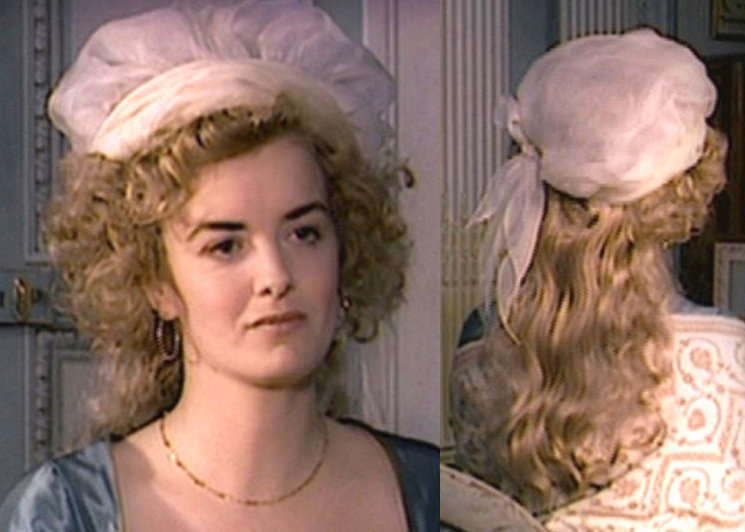
I’m sad to report that actually, the pouf isn’t something that many movies have gotten right! I really can’t find ANY set in the 1770s where they’ve got gauzy poufy bits on top of the high hairstyles. So we’re going to have to make do with 1780s-90s, and apparently filmmakers are even afraid of poufs (which is ridiculous given they don’t even have a brim to “get in the way of the actors’ faces”). In fact, I have to scrape the bottom of the barrel SO deep to even find five! So I can report that in The Lady and the Duke, there is all of ONE decent pouf. (Note to self: do a TBT on this film!)
Franklin (2024)
Similarly fishing around the bottom of the barrel, while the hair in this series was fabulous, there wasn’t a TON of headwear:


La Révolution Française (1989)
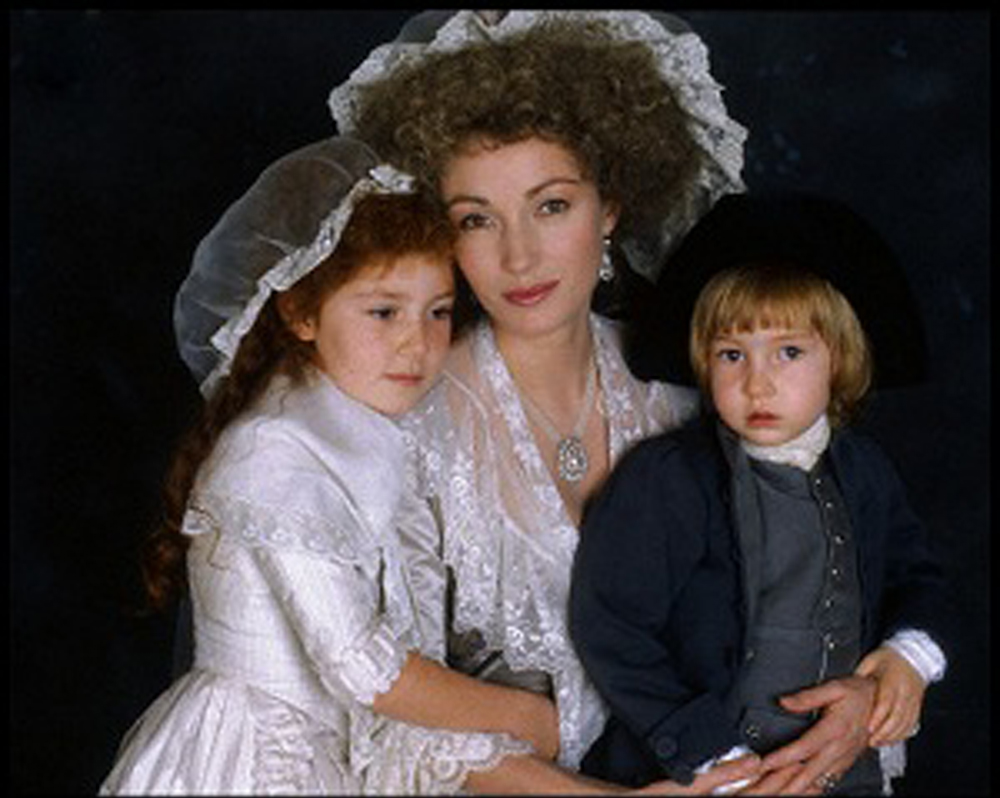
I’m not OVERWHELMED by the poufs in this film, but at least they’re there?


The Affair of the Necklace (2001)
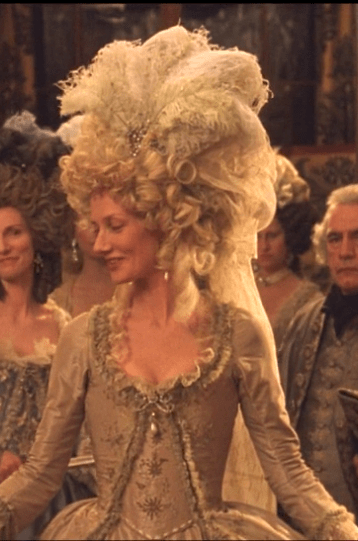
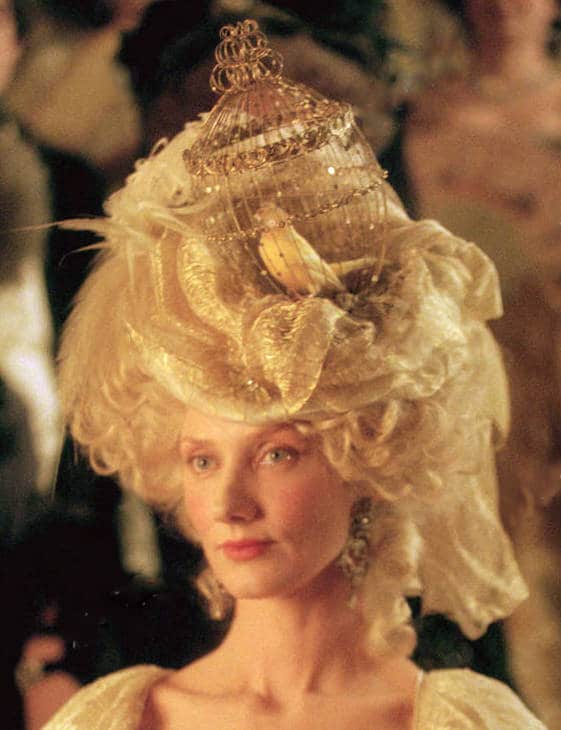
Thankfully, designer Milena Canonero went to TOWN on the costumes in this 1780s-set film, and even better, she did the headwear up to the NINES. Probably the standout pieces are really the hats, but there are a lesser number of honest-to-goodness poufs in the film as well:




Marie Antoinette (1975)
Alright I’m shocked to say this now-dated bio-series actually has a STRONG number of poufs in the 1780s scenes (but none in the 1770s, which is dumb).


Can you think of ANY 1770s films that gets the actual historical pouf — the gauzy, white puff on top of the hairstyle — right??


A year or two ago, I made what American Duchess called a “proto pouf.” It’s a small triangle of dimity I covered in ribbon, voile, and lace. The best parts were how quick it was as a project, and everythign came from my stash.
I don’t have any 1770s or 1780s wigs, and thus have no occasion yet to make an actual pouf.
Man, the Eighties were associated with Big Hair in two separate centuries? Makes you wonder why the 1880s missed out on all the fun!
FYI: more recently, the very similar “poof” (though I’ve also seen it written “pouff”) is also an old British term for gay men, usually a slur (so used in a similar way to “faggot” or “fag” in the US), though “poofy hairstyles” is also used to describe the type of hairstyle discussed here. So when I saw the article title, I thought it was going to be about the top 5 flamboyant gay men in 18th-century frock flicks (in a non-derogatory “reclaiming the term” way).
That would be awesome! :)
Can’t help thinking that there must have been a few fires with these highly combustible dos. It was an age of open fires, after all. Do you know of any?
I don’t know of any cases of this happen with pouf hairdos/headdresses, but there was a famous 14th-century case of several people being killed by their flammable costumes catching fire: the 1393 Bal des Ardents. From Wikipedia:
“The costumes, which were sewn onto the men, were made of linen soaked with resin to which flax was attached “so that they appeared shaggy and hairy from head to foot”.”
Totally off-topic, but have you seen the trailers yet for Wicker? Elizabeth Debicki, who is gorgeous as always, is wearing some very odd outfits given the time (mid-17th century) and place (poor village). Everyone else, except some of the men in suits, seem of a piece, but where the heck is Debicki getting her clothes?! The film looks like great fun, though.
When you look like an Elf-Queen of Ancient and Glorious days, costume designers know they must dress you accordingly or never show their face in showbusiness again.
Since burlap CHAFES, darling, and it’s either the sack or being condemned to complete obscurity (Actual flaying has been considered, but was dismissed for being tasteless and also gross) costume designers know to bring their A-game for la Debicki.
(Also, y’know, I’ll bet that when they were wee little boys and girls they had fashionista dreams of dressing somebody who looked strikingly like she who is the tallest drink of water of them all, so there’s that to fire their enthusiasm too).