

We previewed it, and we actually went to the theater to watch the new Sense and Sensibility (2026). Our collective opinion is that this isn’t the worst Jane Austen adaption, but it’s clearly not the best either. We have a podcast with our raw impressions right after seeing the flick (link below), and here’s the highlights of our observations…
The Costumes in Sense and Sensibility (2026)
This film is set between between 1795 to 1799, according to costume designer Grace Snell, and the gowns really nail that silhouette.


Note that because this film is still in theaters, we can’t get a lot of screencaps. But promo images show the high waist, fullness gathered to the back, trademarks of this period, it’s all there, like these extant examples:


There’s also a few gowns that appear to be in the chemise à la reine style:

Compare with these iconic gowns:


We particularly loved Mrs. Jennings’ wardrobe, which featured many of the Turkish-inspired robes/overrobes popular in the period. Sadly the only still we have so far of these is further down, so I’ll include Marianne’s one short-sleeved, cut away overrobe that SCREAMS Turkish (check out Kendra’s book Dressing à la Turque to learn more!):

Compare with one from a contemporary fashion plate:

We also spotted several extant garment reproductions, like Willoughby’s amazing spangle-embroidered waistcoat:

The original is in the John Bright collection, which makes sense because he assisted in the costume design/making:

There were even some hats, which the costume designer noted in an interview with Vogue:
“It’s not that she [director Georgia Oakley] didn’t like bonnets — it was that there had to be more than bonnets in this world. So then our milliner, the dress historian and I tried to find alternatives. We came up with mourning caps, and the cap hood that Elinor has.”
While Kendra derided these caps in her preview, hat-obsessive Trystan found them to be well-made and fitting the period.

It is a bit odd that both Mrs. Dashwood and Mrs. Jennings wear calashes — this type of structured hood was created in the 1760s to protect high hairstyles (and came back in fashion during the 19th century when hair got big again). Neither women have big hair at all, so the calashes seem like a waste.

The Color Palette of Sense and Sensibility (2026)
While we generally liked the costumes, we were NOT thrilled by the drab colors used for the Dashwoods and really the entire movie. In Vogue, Grace Snell said:
“The clothes were designed in chapters. The Norland chapter is our grief chapter — that’s where we had shades of black, which we achieved with our natural dyeing processes. I didn’t ever want to have true black — I wanted a varied palette. Then, our Barton chapter is a bit warmer in tone, there’s more colour coming in. And then our London chapter is more monochromatic – navies, browns, greys, and for the ball in particular, all whites, so that it does feel quite sparse and has a contrast to Barton, which has a bit more life to it.”
Also in a livestream interview at the V&A Museum, Snell talked about using natural dyes as much as possible for the costumes.

But as we’ve pointed out before, “natural” dyes doesn’t mean drab, muddy colors only! All dyes before the 1850s were made from natural ingredients, and plenty of pre-1850s clothes were in bright, clear tones.

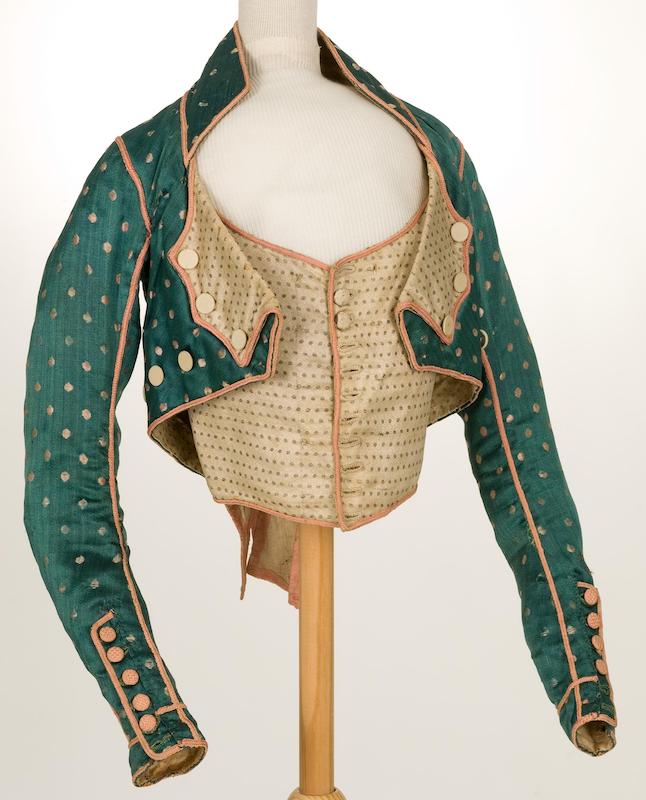
Bright colors show up still in extant garments:
And in period imagery:

What this movie shows is just dull.

In the Vogue interview, the costume designer said:
“A lot of her [director Georgia Oakley] references were from working-class Victorian and Regency England. When we saw the set for Barton Cottage … it’s gorgeous but it’s small and falling down. And that helped in thinking about money — how much money could they live on and what could they afford clothing-wise? There was a focus on practical clothing and not being too clean.”
Except there are plenty of scenes of the Dashwoods doing laundry/hanging up laundry, and getting whites very white was a priority in this (and most!) eras, so the dingy quality of their clothes is inaccurate and unattractive.
The one exception is Mrs. Jennings, who gets to wear a little bit of color in her wardrobe. Sure, she’s an extremely chatty, extroverted character and has a more wealth than the Dashwoods, but they’re of the same social class.

Of course, the costume designer’s “vision” for this movie was to make the characters “relatable” — and drab colors without much detail have been in popular modern fashion for decades now. Grace Snell told Country and Town House:
“I was trying to break down some of the laws that we associate with Austen’s work — that we have already seen onscreen — and try to give our audience a new angle to shape the material. I also wanted us to be able to see ourselves or our friends in these characters quite plainly. You know, things are more open and garments are put together in not the most coherent way. It’s almost self-styled, which I think is much more natural. I wanted to bring an audience into Austen’s world, approach it in a different way, and make us all fall in love with her work again.”
The Hair in Sense and Sensibility (2026)
Some on the internets are claiming that long, unstyled hair worn by the Dashwood sisters, especially Marianne, is an accurate representation of the romantic ideals espoused by Jean-Jacques Rousseau at this time period. Well maybe, but even that “romantic” hairstyle was still curled and arranged in this era, not just hanging wild and unkempt.

Yes, hairstyles of this time period could be loose, soft, and curly with some of it hanging down. But these images all show styled hair:

What the movie may have tried for does not look like what was worn by “romantic” ladies in the 1790s:


And even though YOUNG girls (which, yes, the two elder sisters ARE teenagers and Margaret is pre-teen or just barely a teen) could and did wear their hair entirely “down,” there was generally an attempt at some kind of curl.

These are just the highlights of our thoughts about the movie — check out our podcast for more!
Sense and Sensibility (2026) Podcast
Listen to our podcast recap of the episode here or on iTunes!
Podcast: Play in new window | Download (Duration: 35:38 — 32.6MB)
Subscribe: RSS


Thank you for shaeing thoughts on the hair in the latest Sense and Sensibility .
I think I know which online posts your are talking about when it comes to hair 😅😆😆😅.
When I watched and read them, I felt conflicted because I also respect the writer and their work on fashion history. I just have this feeling if you can get what I am trying to say, where like you said they are not wrong on any factual thing. Actually it is similar to how a while back I saw a post on Tumblr commenting how Elizabeth hair in 2005 Pride and Prejudice is more accurate than people think.
I dont know its like a gut feeling like they are correct about the history but not how the movie did it if you know what I mean.😅🥲
The idea, sure, but the execution? Not good!
I’m finding the whole reaction rather amusing, because all I said was that having hair down is more accurate in the 1790 than people are inclined to think. And that the ‘cult of sensibility’ is about wildness, so its a valid creative interpretation. Is it exactly as hair would have been in the 1790s? Of course not! Is it more historically grounded than people had previously been claiming? Absolutely. But people will hear what they think they hear!
Nope, as the costume designer said ‘mourning’ is only at Norland (the very start) & in the movie, there’s almost no reference to mourning.
The men’s waistcoats are heavenly. I would have liked to be a guy in a past life if I could have afforded such garments.
I say keep the indoor plumbing and modern antibiotics, but yourself a fancy Georgian waistcoat and bring the style into a new age!
Thank you for taking the time to review. I’ll listen to the podcast next. But I must say, I plan to skip seeing this film. I know I would not enjoy the film with that dreadful hair and the dull colors on the clothing.
You’re a lot nicer about the hair than I thought you would be – I thought you would rip it to shreds! I see what they were going for, but their hair just looks tangled and unkempt, not free-flowing but cared for.
Listen to the podcast! ;)
Look I’m just glad there was hats at all, sometimes! Looking @ U 05 Pride & Prejudice & Bridgerton! Alas, they can’t all be Emma 2020!
IMO, the costumes in 2020 Emma were absolutely divine, but the hair. 🤦🏼♀️ Curls too teeny and too lacquered. And ATJ has a face soooo suited to the 21st century. She didn’t strike me as anyone who had stepped out of an authentic 18th c. painting.
I suspect the same thing could be said about not a few natives of the Georgian era – just because you hail from an era doesn’t necessarily mean you epitomise it’s look.
I don’t even want to see the film considering all the blowback I’ve already heard since the previews. Didn’t want to see it based on stills with the ratty hair and muddy colors, so thank you for saving me $xx.xx at the box office. Still, loved the podcast ep – laughed out loud a number of times. I haven’t been to the Jane Austen Ball since 2011, but there is no “elbow sex,” no feel-y feel-y, and yes – good way to piss off your line is by stopping in the middle of the dance. This is where the 90s version of S&S, along with Gwynnie’s Emma, got the dancing right in the sense that some emotional sith was going down, but they kept on dancing. I doubt I’ll waste my time when the thing hits streaming. I don’t see the point of adapting something for the screen if the film makers don’t want to stick with the source material.
I admit the dearth of bright colours and casual hair bag at me too, but if nothing else Ms Daisy Edgar Jones looks like she could star in a portrait by Sir Joshua Reynolds, no questions asked (In fact she and her leading man make an admirably handsome couple in their costumes).
…
Also, it occurs to me that those calashes and their use could be interpreted as evidence that Mrs Dashwood the younger took a hand in making sure that whilst the in-laws wouldn’t be left naked and afraid they wouldn’t be taking the very best stuff with them (and that Mrs Dashwood the elder is either pragmatic or proud enough to prefer having an older hat to going out with a bare head).
Admittedly I have not seen the film and probably won’t, as the Emma Thompson-scripted Ang Lee adaptation is hands down the best possible, imo. But in seeing stills and reading accounts of the designer’s inspirations and interpretations, it seems they are missing the fact that while the Dashwoods are currently relatively impoverished (they are not actually poor), that does not mean that they have purged their wardrobes of their finery. They haven’t noted their new financial circumstances and said, “Well, let’s bin all our pretty silk frocks in the latest fashions that we’ve been able to afford up til now and invest in faded homespun more befitting of our new means.” They would have kept their current wardrobes and accessories, not converted to washed-out and limp linens, except for perhaps those days they needed to assist with easy work around the house. They were still gentry. And if they wanted to maintain any chance of good marriages they needed to present themselves in the best possible light. Simple day dresses, sure; perhaps even subdued colors for their mourning. But not gowns their former housemaids would’ve snubbed. I won’t even go into the interpretation of the soft, romantic, loose hairstyles.
We said exactly that in the podcast, heh!
Lol, I’ll be listening to it tonight 💗
LOL, I’ll be listening to it tonight as I work on a 1790s masquerade look.
I’m listening to the audiobook right now and noting that they take THREE servants with them to Barton Cottage.
I’m still not sure about the little caps. They seem too angular, too stiff, too small. In my (amateur, non-historian) mind, they should have more volume in the back, and larger, softer ruffles. Especially with the unstyled, uncurled hair, they give more Puritan than 1790s Georgian.
Just listened to the podcast – LMAO, especially when you talked about the veneers. :)
Some friends reviewed this for the video podcast. One of the complaints aside from the pores was the snot. You’ve already dubbed the 2005 film Pride and Prejudice and Pigs. I nominate this for Sense and Sensibility and Snot.
I am just so tired with that aesthetic. I am fed up with drab colours, nubby fabrics, stringy, greasy hair and cold, cold light in costume moves. Give me sun! Colour! Soft fabrics! Some finesse! People you are not filming Les Miserables, you are filming Jane Austen FFS!
I felt like Elinor had much better hair than Marianne at all points in the film (she at least looked like it had been brushed). I still absolutely do not believe Elinor would let anything “go” because of her inner turmoil. I’m a little annoyed at the way Georgia Oakley seems to have decided to pitch this as Marianne-forward, and then gave up on structure or tidiness as a way of expressing Marianne’s freer spirit. That’s really how it came off to me.
I loved the film! There was so much colour in the emotions and the costumes seemed a lot more practical than some previous productions of Jane Austen. Yes, maybe they did appear rather dishevelled around the head area.
Portraits are always going to be on the neat, tidy, hyper-fashionable end, aren’t they.
Small correction – the first photo should be captioned “Edward” rather than “Edgar.”
Haven’t seen the movie yet – hopefully tomorrow. Then I’ll listen to the podcast.