

Back when it originally aired, we sang the praises of Wolf Hall (2015). Specifically, we previewed the costumes and the news and then podcasted about the series (adding our costume resources, as we used to do). Plus we wrote about a very few costume inaccuracies and historical inaccuracies, we discussed Jane Seymour specifically and the gentry women’s costumes overall. But we never did a proper deep-dive blog post looking at all the costumes in this series. Now with part two, The Mirror and the Light, having premiered in the U.K. and coming to the U.S. on PBS in March 2025, well, it is time!
We crowned this first miniseries “99% perfect,” and the rating still stands in terms of the historical look. From being filmed mostly in candlelight in 16th-century buildings to hand-sewing the silk gowns, everyone on the production team aimed for authenticity as much as possible. They did the research, and it shows onscreen. Director Peter Kosminsky said in the BBC media pack:
“We’ve tried to make it pretty authentic, down to the food they eat, the way they eat, the way they use their napkins, and of course the costumes, which are authentic right down to the fastenings. Of course, although the timeframe is short, it’s still the best part of a 20 year period, so there was an evolution through the period, and through the six episodes. Throughout we’ve tried to be pretty accurate; we’ve shot in properties that are almost all period, or within the confines of television, you could believe that they were period. To take one example we were shooting in Penshurst Palace, using part of it as part of the set for York Place, which becomes Whitehall Palace. There’s no doubt that Henry VIII stood in the room where we had Damian Lewis standing, playing Henry VIII, 500 years ago.”
In the same media pack, production designer Pat Campbell talked about their research:
“Much of it was to do with the amount of etiquette involved in the way people lived. We had special advisers to tell us how things would have been. Also documentaries like Tudor Monastery Farm and others like that when they go into minute detail about how a swan was cooked or something were hugely informative. Our graphic designers spent a lot of time in the British Library in areas where you can’t take books out. And the Vatican Library, where they have Henry’s love letters to Anne, have also helped out. Because the books are so well known the amount of help we have received has been fantastic.”
Likewise, costume designer Joanna Eatwell tried to do things in a historical way, which she told British Heritage:
“As much as time and budget allowed, we used something called ‘original practice’ where you go back and make the clothes as much as possible the way they were made at the time. We did that with all the major players — Henry, Anne, Catherine, and Cromwell. To get those shapes you have to build up layer upon layer to get that bulk. Tudors were ingenious with their fastenings. Everything was tied together so if an arm wore out because the wearer did a lot of writing, you could untie that arm and it replace with something else. We tried to use that as much as possible, so dressing was quite a long process. With the women all their clothes are pinned together, so we did that as it would have been done at the time. The dressing process was quite important to the actors as they ‘built’ their characters. They quite enjoyed it.”
Eatwell had already worked on a number of frock flicks before Wolf Hall, though mostly 19th century and early 20th century. And after this series, she went on to do everything from 17th century with The Miniaturist (2017) to historical/fantasy in Carnival Row (2019-23). She’s back for Mirror and the Light, so it’ll be interesting to see how she shows the same characters evolving through time.
For this deep-dive, I’m going to go through the costumes character by character, starting at the top of the court.
Henry VIII‘s Costumes in Wolf Hall (2015)
As the king, Damian Lewis gets the most costume changes with about 14 separate outfits and several items (like coats) that are worn multiple times with different combinations. His wardrobe is obviously the richest and most elaborate. The actor told Buzzfeed: “[they] put me in these extraordinary clothes — he’s very much the peacock, always the most colorful man there.” He wears a lot of red, orange, yellow, and gold, all vibrant colors of wealth and status.
This is a mature Henry VIII, still closer to the youthful Renaissance prince than the old fat despot, in appearance anyways. Lewis noted in an interview with Assignment X:
“Henry had a thirty-two-inch waist. He had a waist like mine. He was a svelte guy into his forties, until he had this big jousting accident, when his horse rolled on him. He was unconscious for two hours and he came back from the dead. They proclaimed him dead. He came back after two hours. But after that, he then became slower, fatter, and he ended up with a fifty-four- or a fifty-six-inch waist, so you can only — I mean, he really ballooned.”
This Henry does take up visual space, however, and that’s due to the massive shoulders and sleeves that were fashionable in this early part of 16th-century menswear. The silhouette was a triangle with the top wide, narrowing down to a point. The costumes are built up in layers, with Henry wearing a shirt, doublet (like a jacket), tunic (a longer jacket, often open in front), hose (like snug breeches), and a large coat in most every scene. Lewis did say the costumes were heavy, though not particularly uncomfortable. In British Heritage, Joanna Eatwell discussed the issue of comfort and how the weight of these costumes help the actors:
“Period costumes are never going to be comfortable. The actors studied the portraiture as we did and studied the bearings. We are in quite a lazy state at the moment and throw ourselves around, but back then you gently propelled yourself forward. [The clothes] only become uncomfortable if you expect them to work in a way that suits the 21st century. When it’s an historical period like this, actors have to change the way they stand, the way they walk; their center of gravity might change. In these circumstances, you give up a certain amount of comfort.”
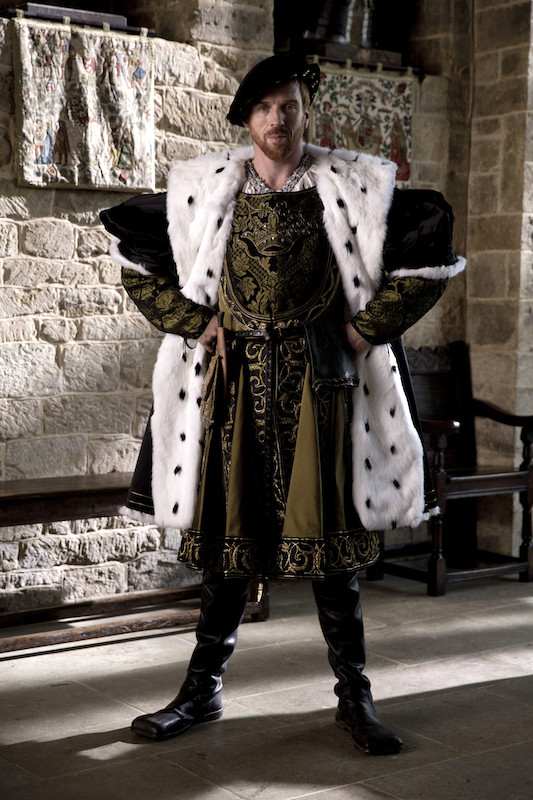
The shape is excellent, but I have to point out something that’s always been one of my (few!) complaints about this show’s costuming: Henry and so many of the other men at court constantly wear tall boots instead of shoes.

In the 16th century, boots were worn for specific tasks, like riding. Shoes were worn otherwise, and for court, shoes were very fancy made of fine leathers and highly decorated. Plus, for men, it was very fashionable to show off your legs.

Compare with this closeup from the Field of the Cloth of Gold. The event happened in 1520 and was a meeting between Henry VIII and King Francis I of France. Henry is on horseback in gold, wearing boots. But not all the other riders are wearing boots — Thomas Grey is carrying the Sword of State in front of the king, but he wears shoes. All the soldiers walking around the riders are wearing shoes.

Boots were not as common as frock flicks would have you think! It’s just a modern cliché to look manly or butch or whatever. In the Assignment X interview, Damien Lewis joked that the boots were to make his legs look better:
“Which is why Joanna Eatwell put me in thigh-length boots, to stop my pale, skinny English white legs poking out. No, I would definitely have had to use handkerchiefs or something to pad out my stockings if I was to have the exemplary calves that Henry the Eighth had. Henry the Eighth was a broad man with a big chest, and what’s so extraordinary about Joanna’s costumes is, she creates that size for me. She made me that size, and it looks natural. It looks like it’s me.”
OK, aside from that nit-pick, let’s look at Henry’s first outfit, which is used in many promo pix!

The black and gold brocade is highlighted with gold embroidery and beading, and the ermine fur reminds everyone he’s the king.

But he doesn’t really wear that black and gold outfit much again. Instead, he goes for red. This red damask slashed with yellow doublet and the red coat with HUGE sleeves plus fur collar show up many times in the series, together or in other combos.

While Henry’s outfits mostly are not exact reproductions of specific historical portraits, I feel like the red/yellow outfits are taking cues from this rare portrait of younger Henry (as opposed to the older, fat Henry painted by Holbein). In this painting, the king wears a red coat with big sleeves and a fur collar, and his doublet is slashed to show yellow contrast.

Another frequently worn item is this orange coat, also with HUGE sleeves and a fur collar. He wears it with many outfits.

All of these outfits have the typical shape for menswear of this period:

Henry wears the orange coat quite a lot, alternating between the red and orange throughout the series. The orange seems to be worn particularly when he’s outside of court and often over a burgundy leather doublet that’s slashed to show yellow contrast.


Here’s the doublet without the coat. It’s usually worn with this orange tunic.

A more casual outfit is what Henry wears for archery. This is the same general shape (the sleeves aren’t quite as big, but big enough that one sleeve has to be tied down so he can pull the bow), and the colors are muted. Still wearing rich materials, with velvet and embroidered silk.


Both the front of his doublet and sleeves show embroidery. Oh, and all of his shirts have blackworked edges — that was a very popular type of counted embroidery done on shirts and smocks.

In Calais, Henry wears this yellow outfit with red embroidery — seems to be the only time he wears that piece, although the yellow tunic is reworn, and of course he’s wearing it with the same red coat.

Henry and Anne Boylen’s secret wedding happens right after this scene, and while she wears the same gown she was wearing in Calais, Henry wears this white damask doublet embroidered and accented with pearls and gems. He repeats this outfit several times.


The red coat even gets paired with a red brocade tunic when the king and Anne go on procession.


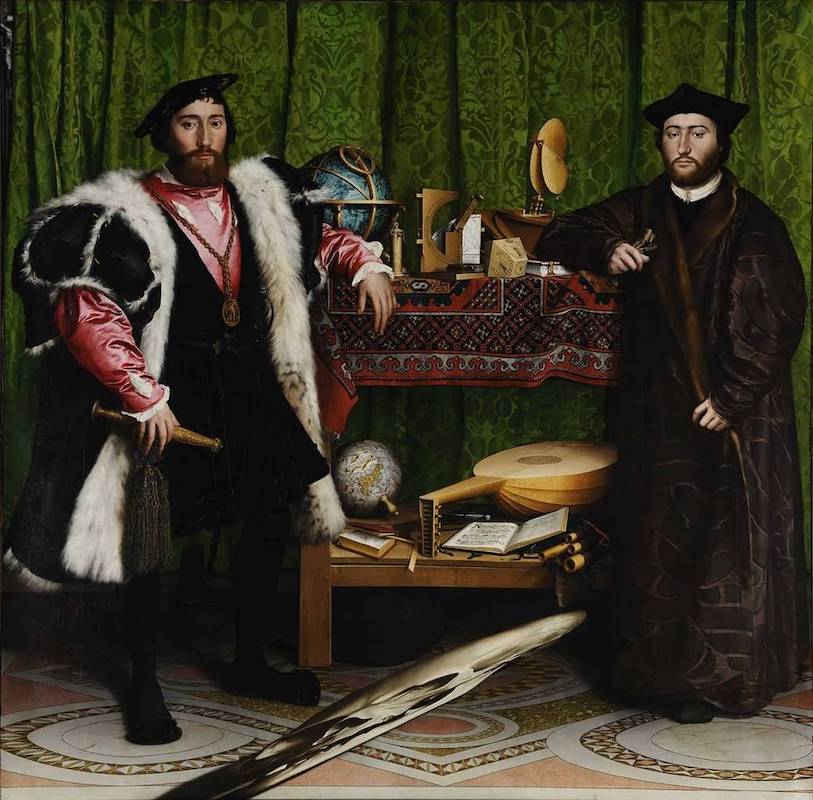
This gives a nice view of those enormous sleeves on his coat. Yep, they really could be that big or bigger — compare with this painting:
Recreating a much written about moment, Henry and Anne “celebrate” Katherine of Aragon’s death by wearing yellow. In Wolf Hall, this isn’t a big scene, and Anne’s wearing a dress she’s been shown in several times already. But Henry does get a new coat that he wears just this once (and he’s shown playing with his daughter Elizabeth).


I bet this costume was inspired by the extant ceremonial dress worn by Elector Moritz of Saxony! It was listed in the Elector’s estate inventory of 1553.

The museum description (using Google Translate) is:
“The doublet is made of silk satin, the trousers are made of slit silk velvet and “chopped” silk satin, and the stockings are made of yellow suede to create an ensemble effect with the skirt, the main piece of the costume. The skirt sleeves are 90 cm long and can therefore only be described as decorative hanging sleeves. The arm was led through an armpit hole or the horizontal slit on the upper arm below the sleeve puff. The skirt has a wide turn-down collar and — in keeping with the slit fashion — has free, i.e. unhemmed, edges throughout. There is no lining.”
Can’t tell if the TV series was trying to make an exact replica, but the similarity is strong!
Henry wears this burgundy velvet coat a couple times, but it’s best seen when he’s walking with Thomas Cromwell. There’s gorgeous bands of gold embroidery on the sleeves and hem, and it’s worn over a green damask tunic.


Something about the soft bulk of this coat makes me think of older Henry portraits. Probably because there’s no visible waist definiton?

Compare with this white embroidered doublet and tunic, which Henry wears with the red coat. A black sash helps define his waist.

Of course, that shape is similar to what old Henry wore, it just looks better on Damian Lewis!

The gold embroidery is exquisite…

And must be inspired by Holbein’s portraits.

Anne Boleyn‘s Costumes in Wolf Hall (2015)
Claire Foy had the most costumes of any woman on the show, though just a few less than the king himself. The actor said in the BBC media pack of her costumes:
“It’s the most amazing thing as an actor to have clothes made for you, because you’re so used to wearing something someone has already worn and has their name in. When you have costumes made, you are able to really make them unique, make them have a personality and stand out. Anne was incredibly interested in fashion and how she looked and she really paid attention to changing a particular detail about her outfit that would make her stand out. That’s what was such a breath of fresh air in English court — she came in saying she wanted it like this, or thinks it would look better like that. Like someone in the ’80s turning up their blazer sleeve.”
And costume designer Joanna Eatwell said in the BBC media pack of Anne costumes:
“Her journey is quite interesting, as she comes in as this rather fresh young thing, an opposite to Katherine who is old money, status, class — everything that Anne doesn’t have. She comes in wearing these light colours, frothy pinks, silks and gradually gets darker and she’s allowed to slowly move into those darker colours.”
Suitably, the first outfit we see Anne in is this pink silk gown and the veil on her French hood is gauzy white. She’ll wear this gown over and over again through the series, adding partlets (a piece that covers the chest and neck; could be worn tucked into the gown or over the top), and changing headgear.

OK, there are those dreaded bodice wrinkles. We debated them A LOT, and the issue is likely due to a combination of things such as building costumes in advance to a set of measurements with only one day of fitting, using more historical methods instead of theatrical (so less corsetry and more stiffened layers), and, of course, making dresses in satin, which shows every little place where the fit is off.
Claire Foy also said in the BBC media pack:
“When we were doing the fittings, it was just incredible that the structure and the way they put the dresses together was so accurate, everything was pinned on — nothing was sewn, it was done exactly as they would have done it in Anne’s time. In the first few weeks it was magical and amazing — but then it gets to July and you’re in a stately home not able to drink water, sit down, not really able to breathe and you’re regretting asking the corset to be so tight in the fitting! Then, of course, there was the baby bump, so I was grumpy on a couple of days…”
So maybe she was corsetted to high heaven and everything was fitted in perfectly in theory? IDK, the wrinkles are annoying, but after nearly a decade of staring at them, I’m over it.


This pink dress certainly reminds me of French fashions, which Anne is supposed to have picked up, and this series reminds us with her unique pronunciation of “Cromwell.”

She also adds a black partlet and a hood with a dark veil for going on progress with the king.


Love seeing that bit of embroidery on the collar of her partlet! It was definitely done at the time, for example:

Later on, she wears a simple white partlet, and she’ll continue wearing this pink gown even when she’s sent to the Tower.


While I may be over the bodice wrinkles, I’ll never get over the headgear! Please let me complain, AGAIN, about the shitty, shitty so-called French hoods in this show! It’s just shocking how bad these are when the costume and production teams were so focused on giving this series a historically accurate look. How does that thing on Anne’s head look like anything but a pathetic headband when compared with actual 16th-century images of French hoods? Also, look at how Anne is always wearing dangly earrings with these hoods — that should be impossible because proper French hoods cover the ears.

The French hood (also just called a “hood”) was a very popular form of headgear worn first by upper-class women and then filtered down to middling classes in Europe from about 1510 up to 1600. It’s sometimes said that Anne Boleyn first brought the style from France to England, which is probably not true, although she may have popularized wearing it.
The top part is a crescent-shaped cap that sits low, flat, and worn midway back on a woman’s head, with only the very front of her hair visible, if at all. The crescent may sit on top of a linen cap that’s snug up to the head and encases the woman’s hair — only a front edge, either straight or frilled, of this cap would show. The top part of the headgear can be highly trimmed with jewels, depending on the woman’s wealth and status. Key to the headgear is the hood itself, which is a fabric veil hanging down a woman’s back, covering her hair. I’ve looked at a ton of period imagery for hoods, and I can’t say I’ve seen any sheer veils. They’re typically opaque black or another solid dark color.
In addition to all the resources I’ve documented before (follow the links in this post), here’s a nice clear period illustration I found that shows hoods in detail from the sides. These are Germanic women of gentry or upper class, and they’re wearing very typical styles found during the first half of the 16th century. You can see the white layers under the hood, how the crescent portion (in red trimmed with gold) sits flat against the head, and the veil is sold black, hanging in the back. The veil is usually sewn into a tube, and it was also common for this to be flipped up on top of the woman’s head and pinned, sometimes in multiple folds. Because fashion! Also note how the women’s hair is entirely covered except for a small portion in the very front.

The fucking headband-with-sheer-scarf bullshit that Anne and the other court ladies wear are not French hoods. They are blasphemy. And it pisses me off even more when compared with the absolutely lovely job the show does with the far more complicated gable hoods on the older women — so at some point, Wolf Hall did have a milliner available, doing great historical work, but what, was the contract cut short? WTFrock happened?
While I’m being annoyed by things … I just don’t get this fantasy-medieval-iod wanna-be Tudor-esque thing Anne wears for archery. Sure, there’s a possible joke about Robin Hood and Maid Marian, but that makes zero sense because she’s the only one in “costume.”

Looking at it again, I notice everything wrong, including one of my perennial irritations: unnecessary lacing! Nooooooooooo.

Nearly forgot, one other annoying costume! It’s a flashback that Cromwell has, discussing Anne and Henry Percy’s relationship, when they flirted at a court masque. Both are wearing rather weak costumes for what would have been very elaborate productions in the period. She’s wearing a cheezy padded roll “hat” and some kind of fantasy dress in white and gold (also, modern pink lipstick!).

Both of their masks look cheap and like they were written on at the last minute with a Sharpie.

His armor looks like plastic. It’s a pretty crappy scene. The masque that mocks Cardinal Wolsey has more elaborate and 16th-century-esque costumes, IMO.

Back to Anne’s otherwise lovely dresses! She wears this yellow gown several times, and I can’t quite tell if she has two yellow gowns or it’s the same gown but the lighting changes the color? The trim is different on the bodice, and the hanging oversleeves are different. But in a BBC video, costume designer Joanna Eatwell talks about how they changed the oversleeves from light to dark on one yellow gown to get more variety out of it.

The gown on display shows the fur oversleeves.

In another episode, she wears the same gown with a dark French hood, and the gown’s trim is more visible.

While none of Anne’s costumes reproduce specific portraits, this yellow gown has the same classic Tudor shape as seen in many portraits, plus the yellow with fur combo is similar to this portrait of a later woman:

Anne’s other yellow dress appears much brighter, and she first wears it dancing in Calais and for her and Henry’s secret wedding. The gown has light oversleeves, and she’s wearing a black French hood.

Note that the bodice trim is different from the other yellow gown (but that could be changed?). Interesting to note that this yellow dress (if it’s different?) fits much more smoothly than the pink one or the other yellow gown.

And yes, for the scene “celebrating” Katherine of Aragon’s death, both Anne and Henry wear yellow. This is still the same yellow gown Anne wore at her wedding, but now it has black oversleeves.

The last gown that gets multiple wearings is Anne’s red gown with yellow hanging oversleeves. It’s very briefly glimpsed by Cromwell when she and the king are watching the masque making fun of Wolsey. That’s where I noticed this is the only time in the whole show that she wears the famous “B” necklace.

From the most well-known portrait of Anne Boleyn:

Anne wears this red gown once more with Henry, then at mass when she briefly meets Chapuys, and again later at her trial.


This one was on display, and, alas, it has some bodice wrinkles even on the mannequin!

One of the first promo pix released was of Anne’s coronation gown, showing that she’s pregnant (with Elizabeth). This costume is particularly impressive for showing how it’s pinned closed in the front, which was a common closure in the era (not just for maternity clothing). As the V&A Museum points out:
“Before the mid-16th century, the finest pins were imported from France, but their manufacture in England was encouraged under Henry VIII, and an Act for the True Making of Pynnes was passed in 1543, controlling their quality and price. Gloucestershire and London became the main centres of the pin-making industry.”
Vast quantities of pins were recorded as being purchased in wardrobe accounts of royals and gentry. Everybody used pins to fasten their clothes.

All of the women’s gowns in Wolf Hall use pins to hold up the large hanging sleeves, and that’s visible here on Anne’s coronation gown.

And there’s a closeup of pins holding her bodice closed, along with the lovely jewels trimming this gown.

She also gets a rather elegant, if simple, costume for her confinement — this yellow gown and a burgundy/dark red loose coat trimmed in fur. Her French hood (another shitty construction), has a sheer yellow veil, which just was not done, at least not in England. At a few times during the 15th and 16th centuries, Italian prostitutes were required to wear yellow veils or scarves, so it seems unlikely Anne would pick up that fashion. Again, the hood part of a French hood was always opaque and dark colored.

In episode 5, Anne rewears this velvet coat to go hawking or for archery with the king (unclear what they’re doing, it’s a brief scene). The coat is belted with a sash, and it’s hard to see what gown it’s worn over. This is a more historically accurate outfit for an archery-type activity than that green fantasy dress.

The loose coat is similar to coats worn in the period, like this one:

For the significant scene in episode 6, where minor flirtations and arguments among Anne’s favorites give Cromwell ammunition to help Henry get rid of her, Anne has one final fancy gown in regal purple. Oh and this French hood gets an “E” for effort because it adds the front frill, which in the correctly assembled headgear, would be one of the layers that covers her hair. Here, it’s just a frill tacked into that headband. sad trombone

Good view of the excellent blackwork embroidered cuffs, which Anne and several other characters wear. Compare with this:

Alas, the bodice wrinkles are back in this gown. But the purple and gold combo is great, especially with the brocade petticoat.


Then there’s Anne’s final costume for her execution. Various reports from the time have her wearing a dark dress and an ermine cape, the later a symbol of royalty, which seems purposeful on Anne’s part.


Mots of her attendants wear very nice gable hoods or semi-decent French hoods, but they take off Anne’s crappy French hood and then put on a coif to cover her hair. If the French hood had been constructed in a historical manner, that inner layer (with the white frill showing) would be a coif itself. No need to add one back!

Jane Seymour‘s Costumes in Wolf Hall (2015)
Kendra wrote a detailed post about how Jane is played by Kate Phillips and costumed in this series. I’ll recap and add some of my notes. I’ll start at the top because Jane gets an EVEN shittier French hood than Anne does! This is quite literally just a goddamned headband. The fact that you can clearly see her ears is a big hint at how bad this hood is.

OK, on to her dress — she only has a couple, and they’re all in darker colors, plain, very demure, very mindful. The first gown she wears is very dark, and it’s hard to tell exactly what color it is! Kendra called it dark burgundy, but it looks dark brown or black or even very deep blue depending on the scene and whether I’m watching on TV or on computer. The sleeves are a more obvious color, the hanging oversleeves are in burgundy taffeta, and the undersleeves are in a brighter red velvet. She usually wears this with a dark partlet over the bodice.


The dark gown with red sleeves is a common color combination for the period, showing up in portraits and allegorical paintings.

Jane’s second court gown is another hard-to-describe color — it’s velvet in a brown/grey that changes with the lighting. It has chocolate brown taffeta hanging sleeves, and she has two sets of undersleeves that are in the same general shape with puffs and slashes. The first undersleeves have blue silk slashings, and this fabric was a gift from Cromwell.

She also wears blackwork embroidered cuffs with this gown.

The sleeves are similar to this portrait, which also has a partlet like Jane wears with her first gown. And while we’re at it, enjoy how a French hood should look!

In episode 5, when the king sends a purse of money and a letter to Jane, she’s wearing this same brown/grey velvet gown, now with a white partlet, and the same style of undersleeves but they’re in a red fabric that matches her petticoat.


The one other costume Jane wears is when she’s at home at the eponymous Wolf Hall. This outfit is much less fancy, definitely not a “court” gown, and shows how her family is a bit lower gentry class than many others surrounding Henry. Maybe that’s why the similarly low-born Cromwell likes her so much?
Kendra calls this outfit a drab olive green dress with a matte salmon pink kirtle, but I think the gown is a dark brown. Again, the color shifts in different lighting. She wears a black partlet and another shitty French hood, this one with the “E” for effort fakey frill added.


Katherine of Aragon‘s Costumes in Wolf Hall (2015)
Joanne Whalley only gets one costume as Katherine, Henry’s discarded queen, but it’s beautifully appropriate. Costume designer Joanna Eatwell said in the BBC media pack:
“Sumptuary laws dictates what colours you can wear at this time. With Katherine we have used the pinnacle of sumptuary which is purple — she is all purple and gold, so she is every inch the queen.”
And the Daily Mail noted that Eatwell had Katherine’s skirt woven with the queen’s personal symbol, the pomegranate, saying, “Probably no one will ever notice. But we do.”
Katherine is first, briefly seen in an episode 1 flashback to the legatine court of 1529 where Henry is trying to have their marriage invalidated. She regally declines that notion, wearing this purple gown with gold accents, all the jeweled trim, and a wonderful gable hood.


She looks right out of a portrait, down to the jewelry!

When Cromwell visits Katherine in episode 3, she’s wearing the same gown, but now with an embroidered partlet, and she’s covered in furs, as her health is declining.


The little changes of accessories makes her look like another portrait.

The costume on display shows all the beautiful details.

On Cromwell’s final visit to Katherine in episode 5, her gown isn’t visible, and now she’s just covered in furs. She dies soon after.

Princess Mary‘s Costumes in Wolf Hall (2015)
Lily Lesser only appears in one episode as Mary, with her mother, but she’s back for The Mirror and the Light (downgraded to “Lady” Mary), so that will be interesting to compare. Here, she wears a dark blue gown with a brocade petticoat and matching undersleeves. She has a white partlet, and while her hair has is up, it’s covered with, at most, a bit of net covering the back. She was age 20 when her mother died, so she should be wearing some kind of decent headgear by now.


Even in this miniature portrait of Mary that was sent at the time of her engagement to Emperor Charles V, she’s wearing correct headgear — and she’s only 6 years old!

Mary Boleyn’s Costumes in Wolf Hall (2015)
Anne’s sister is known as “the other Boleyn girl,” thanks to Philippa Fucking Gregory, but Hilary Mantel’s books and Charity Wakefield’s portrayal show a bit more nuanced character. Her own story is just hinted at, and it seems like she’s angling for a connection with Cromwell, but we don’t find out much more. She only gets two costumes, and they’re both in rich materials and courtly styles, showing that, like her sister, she’s playing the game.
The gown she wears most often is this blue velvet with red undersleeves that are decorated with pearls.

She wears this gown with and without a black partlet.

Like all the ladies at court, Mary has another terrible French hood, and you can almost always see her hair sticking out from the supposed hood part.


In the period, hair would be smoothed back and taped into a tidy circle that keeps it in place and also gives you a base to securely pin your headgear into. It’s not rocket science, and it can even be done with modern hairstyles — check out the Tudor Tailor’s video on Tudor hair lacing! You can skip to the end to see how a simple coif fits beautifully over the taped hair. While it’s not shown in that video, a French hood would be worn over the coif and hairstyle. How many times do I need to say this? The result would look like this miniature, not what’s in the TV show.

In episode 3, shortly before Anne and Henry’s secret marriage, Mary is shown in a new dress. This one is deep brown silk with gold hanging sleeves, gold brocade petticoat and undersleeves, and lots of gold trim.

She also wears this gown at court, one of the last times she’s seen in the series.

Jane Rochford’s Costumes in Wolf Hall (2015)
Jessica Raine‘s Lady Rochford is a nasty piece of work, so I don’t mind so much that she gets such a craptastic French hood. It’s a sticky-uppy visor, which is just the lowest bar for bad headgear IMO.

She seems to wear the same black gown throughout the series, though she has at least two sets of matching undersleeves and petticoats. One is in a red and gold pattern, and the other is in a gold and black pattern. Sometimes she adds a black partlet.

Liz Cromwell’s Costumes in Wolf Hall (2015)
Now for the more gentry-class women. Sarah ran through a bunch of these costumes back when the series first came out, so now let’s go through each character one by one, starting with Cromwell’s wife Liz (played by Natasha Little). She and two of her daughters die in 1529 of a sweating sickness, so she’s shown in flashbacks, since the series starts in 1529. Her first scene is Cromwell’s memory from eight years earlier when he first enters Cardinal Wolsey’s service. Liz’s first costume is a brown wool kirtle with velvet bands of trim (called “guards” or “guarding”). Her gown has tied or laced-on sleeves, and it’s not obvious where the gown closes — maybe up that center front seam with hooks or even pins? Possibly laced in the back (which can be accurate for this era).
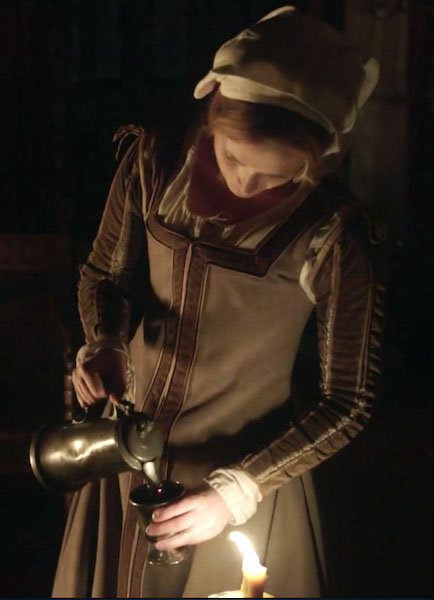
The kirtle doesn’t have a wist seam, which is unusual for the period. Looking at some typical middling-class dresses of the 1520s, you can see that there are somewhat looser gowns with no front closure or kirtles that lace up the front. Liz’s brown kirtle is a like a combo of these.

While I appreciate that she’s wearing a pinned cap of a sort, like a lot of this headgear, it’s a bit sloppy. Go rewatch that Tudor Tailor hair-taping video and see how close and neat a coif can fit over properly styled hair. You’d just pin a larger square of cloth over that coif to get the effect here, and it’d look much cleaner.

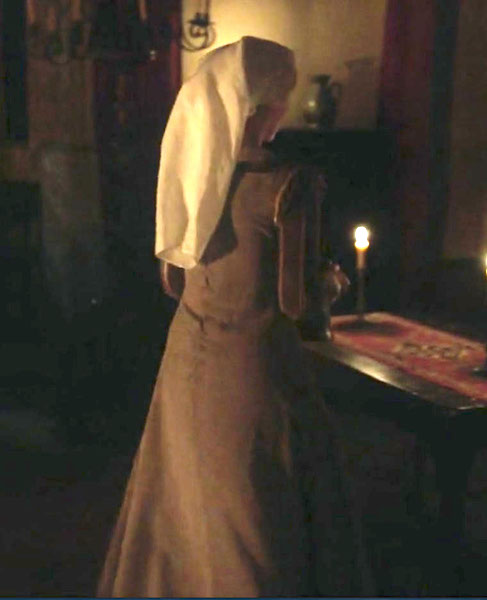
The dress she appears in more often is this black wool gown with wide sleeves and a front lacing over a red kirtle. I’ve grown to love this dress, especially since the Tudor Tailor came out with a lovely pattern for it, which I made up recently and highly recommend.


This is a common style, worn for convenience as a woman’s size changed due to pregnancy, and for fashion to mix and match different gowns and kirtles. It shows up in a number of Holbein’s sketches and paintings.

And here’s what the same type of gown looks like worn by a more lower-class woman, from the back, and with delightful contrasting lining!

Another of Liz’s cap arrangements — it’s just OK. I think that peasant woman dancing has a tidier cap.

With her daughters, who get “Es” for the effort of wearing caps, but their hair should be up!

Johane Williamson’s Costumes in Wolf Hall (2015)
When Liz is dying, her sister (played by Saskia Reeves) comes to her bedside. We can only surmise that she ran over quickly in the middle of getting dressed? It’s a little weird and unclear why we first see her semi-stripped down to this underlayer. And as Sarah pointed out, the 1520s is well before any documentation of English women wearing corsets (or a stiffened pair of bodies, as the garment would have been called). I could generously say this is a very simple kirtle because in the back view there are wide-set straps and laced closures at the low side backs. It’s definitely some kind of stiffened garment, and the plain, unbleached wool/linen look of it seems very undergarment-like.
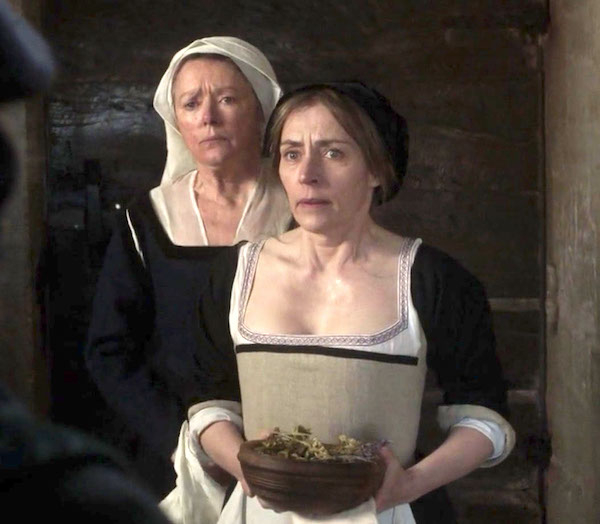
I guess those black sleeves are pinned on to the very narrow “kirtle” straps?

She’s wearing a black petticoat over the unbleached “kirtle” thing, and I’d imagine that she’s wear a gown or at least a jacket with this.

In episode 2, we see that Johane is staying with Cromwell and taking care of him, and eventually they begin an affair. Around the house, she wears a fur-trimmed loose gown made in a diamond-weave fabric.

Nice, thick, and cozy, also while it looks like she’s made herself at home, it’s also not like she’s putting on airs or pretending to be the lady of the house. This is practical clothing.

Their relationship continues through episodes 3 and 4 (although Cromwell sometimes flashes back to Liz and calls Johane by his dead wife’s name). She wears this grey dress and a simple black velvet French hood.

And Johane adds a white partlet when Holbein is painting Cromwell’s portrait.

This costume is seen on display in one interview with the costume designer:

Joanna Eatwell told British Heritage about these costumes:
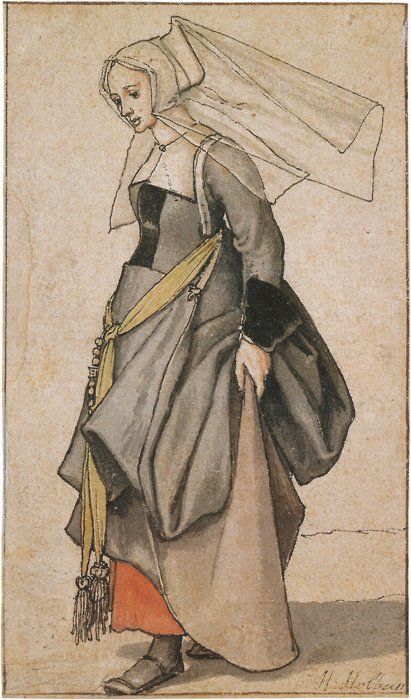
“We started with the art of the period. It was pre-photography so one has to go straight to art. We were incredibly lucky because Hans Holbein the Younger was an amazing painter who specialized in portraiture of the court. He also did something that was rare: He did one or two paintings of the merchant class which was incredibly important in this case, because of Thomas Cromwell and his family. There was one particular painting he did of a merchant’s wife which shows the construction of her clothing. That was the key for Cromwell’s family — particularly Johane, his sister-in-law, because there really is so little known about what the emerging merchant class wore at that time. He also painted one or two paintings for people who actually worked for King Henry VIII — I think they were servants — and that’s something that was incredibly hard to find out about. There is so much on Henry and Anne Boleyn, but with Wolf Hall it was very much about Cromwell.”
Yep, that’s the one!
Other Women’s Costumes in Wolf Hall (2015)
Alice More
There are a few other women who have interesting costumes. Thomas More’s wife Alice (played by Monica Dolan) appears once at her home and later visits Cromwell, and both times she wears this ensemble straight out of Holbein.

A full view of her outfit:

Not quite as much jewelry, but the gable hood, the perfectly fitted gown in black with red sleeves, it’s all there in the portrait.

Alice Williamson
Alice (played by Kerry Ingram) is Johane’s daughter and therefore Cromwell’s niece, whom he asks to sit in with the men interviewing Elizabeth Barton, the “Holy Maid of Kent,” in episode 4. In her review, Sarah suggested that the black satin gown with silver damask petticoat are a sign that Alice’s family’s fortunes have risen due to Cromwell’s influence. I’m just glad to see how much neater her headgear arrangement is than her mother’s or aunt’s.

Lady Margaret Pole
Cromwell interrogates Pole (played by Janet Henfrey) for her possible support of Elizabeth Barton and for being against the king’s marriage to Anne Boleyn. Margaret Pole has a pretty wild history in her own right, being a Plantagenet relation to the throne, a peer in her own right as Countess of Salisbury, a lady-in-waiting to Katherine of Aragon, and godmother and governess to Mary Tudor. She returns in The Mirror and the Light, but is played by Harriet Walter. I like this scene because that gable hood is SPOT ON.

This is where I wonder WTFrock happened with the millinery on Wolf Hall because they got these more complicated gable hoods so very right! But the French hoods are terrible. The two are related — they’re both built up in layers, only the “French” style (it wasn’t just worn in France) lays closer to the head, while the gable style has a three distinct points in the front that frame the face. Both have a white cap layer underneath and a black veil / hood in the back. The French style can show some hair on the forehead, while the gable often has fabric wrapped over the forehead in the front that covers any hair from showing. Lady Margaret Pole’s hood resembles this portrait:

Lady Exeter
Also being grilled by Cromell over the Elizabeth Barton incident, Lady Exeter (played by Sarah Crowden) wears another very fine gable hood.

The black hood and all that gold trim round her face are reminiscent of many period images, such as these:

Other Men’s Costumes in Wolf Hall (2015)
Thomas Cromwell
None of the men’s costumes are as grand as the king’s, of course, but every character wears highly detailed costumes that suit their station. I have to mention the man around whom the story really centers, and the influence that Mark Rylance had on Cromwell’s costume. Designer Joanna Eatwell said in the BBC media pack:
“Because of Mark’s background at The Globe theatre, he works in a certain way which isn’t a way we often work in television which is ‘getting back to original practise’ and making it how it was made at this time. Everything has been handmade for him, hand dyed, all the fastenings are correct.”

Cromwell does have a subtle variety of costumes through the series, starting in basic wools and moving on to finer silks. But they’re almost always in black, which is ridiculously hard to screencap, and a little boring, so I’m not going to catalog them all. Trust that these little details help build the world, even if they don’t stand out individually.
Yet I couldn’t help pointing out that he wears an unfortunate biggins in the episode 1 flashback with his wife. All comfy and derpy at home!

When he gets his portrait painted by Holbein, not only is he wearing an exact reproduction of the outfit in the portrait, the setting is recreated, down to the woodwork and items on the table.

See for yourself:

Not a costume thing, but I love the moment when Cardinal Wolsey shows Cromwell the black kittens that are hiding under his bed. Because Mark Rylance with a tiny black cat is ADORABLE!!!

Thomas More
Another portrait repro is that of Thomas More (played by Anton Lesser). Although he gets a bit more extravagant furs, but as costume designer Joanna Eatwell said in the BBC media pack:
“If you start to look again at all the paintings, there is a great bulk and a great weight to everything. Even if you look at the clergy, everything is heavy and lined and you know then it’s not just a fashion. It is a sign of wealth and status. There are all these amazing paintings from when the Thames froze over at this time, so you suddenly realise it was cold.”
Need all that fur and bulk for warmth and to show off!

Compare with the portrait:

As a lifelong glasses-wearer, I was impressed to see More using accurate scissor-folding eyeglasses in a couple episodes.

This style is seen in images of scholars and clerics from the middle ages through the 16th century, when they slowly become replaced by the wire-framed glasses (still a pince-nez style without arms on the sides, which wouldn’t come into use till the 1720s).

What do you think of Wolf Hall‘s costumes? Are you excited about The Mirror and the Light too?
Find this frock flick at:


Can you please make the second The Buccaneers 2024 post available, since it was posted on this date a year ago?
It’s coming tomorrow, don’t worry!
Having already seen THE MIRROR AND THE LIGHT to the bitter end, I would like to say how shocked I was by that sex scene between Cromwell and Lady Mary.
…
No, no, you’ll just have to watch the show and find out for yourselves!👹
You’re thinking of “The Tudors,” right?
No, I’m thinking “Well I could give a serious, thoughtful summary of my
opinion on this series OR I could make some mischief.”
Guess which option I went with.😉
On a more serious note, I’ll take this opportunity to say that if you liked WOLF HALL then you’ll enjoy this production for exactly the same reasons (Though for my money it felt a little too much like ‘More of the same’, even down to using actual footage from the original series).
I’m also a little sad the production didn’t do anything especially interesting with the non-white actors cast in this series: given the themes of ‘New men vs Old blood’ and ‘England against the World’ throughout the novels, entirely colour-blind casting strikes me as a waste when a more tactical deployment could have helped sell Thomas Cromwell as a quietly subversive influence.
Also, the re-casting of Eustace Chapuys absolutely hurts this series: the new actor is nowhere near the equal and opposite to Cromwell that the production needs him to be: this is, however, the only one of the re-castings that actively Does Not Work and some of the others are active improvements (Mr Timothy Spall somehow manages to be even better as Norfolk than the late, great Mr Bernard Hill).
Also, this is the series where Mr Damien Lewis REALLY sold his Henry VIII, so we have that to thank it for.
All in all I’d call THE MIRROR AND THE LIGHT a solid sequel that fails to be outstanding because it seems to merely continue, rather than build upon what the first series did so well.
My abiding impression might well be that it sticks too close to Cromwell and leaves quite a lot of the most interesting business offscreen as a result (But then I’m not this series’ target audience, so spending more time with Cromwell is not my idea of a Good Time, especially when the series politely ignores quite a bit of the pettiness he shows even in the novel itself).
I’m so torn as whether to fire up VPN & try to watch Mirror now or wait till it’s on PBS! VPN tends to be flakey & I don’t want this messed up, so I’ll prob. wait. But it’s going to be hard
Clearly the only sensible way to resolve this doubt is to practice some good old-fashioned Sortes (It worked for Brother Cadfael and might even work for you!).
…
Curse you, lack of Ecclesiastical smileys!