

How can you not love Blackadder II (1986)? All editions of Rowan Atkinson’s comedic romp through British history are hilarious, but this one’s my fave because, of course, the 16th century is my happy place. The whole series is proof you can take the piss out of history and still wear wonderfully accurate historical costumes, and to me, this one is the peak. The costumes are so gorgeously detailed and several are clearly inspired by period imagery. It doesn’t much matter that each character basically wears the same outfit throughout all six episodes. Even with this small wardrobe, there’s enough detail that I feel a deep-dive is in order.
This second series was released on the BBC three years after The Black Adder (1983), which had the main character set in an alternate history of the War of the Roses time period. The showrunners had a little trouble getting the go-ahead for #2 from the BBC, with co-writer Ben Elton saying:
“Look, I know exactly why you cancelled it, but we knew that too! That’s why we’ve done Black-Adder II. This is the new thing. It’s different. It costs half as much. It’s three times as funny. You’re gonna love it.”
The first series was filmed on many expensive outdoor locations, using horses, more props, and more extras. The subsequent series were required to make do with less, and they often used the same, simple interior sets for every episode. Likewise, each character typically wore the same costume, sometimes with small additions to emphasize a joke.
Series 2’s director Mandie Fletcher also liked this arrangement, suggesting it kept the action spontaneous when they didn’t have to stop for elaborate costume and set changes — making it “a bit like doing Shakespeare in front of an audience — it’s not at all like doing sitcom.” The unchanging costumes also play into theatrical concepts like commedia dell’arte, where stock characters are depicted wearing certain masks and costumes, like the greedy, status-obsessed Pantalone wearing red and black (which so does the greedy, status-obsessed Blackadder!).
While the Beeb was budget-conscious overall, this was still an era when its costume shop seemed to pour time and detail into anything historical. This was one of costume designer Annie Hardinge first credits, and she’d go on to design for Blackadder the Third (1987) and Goes Forth (1989), plus Austenland (2013) and Nolly (2023), among others. In a Behind the Seams video interview, she said that on Blackadder they custom-made everything (they weren’t pulling costumes from rental stock), and while they were working fast, they didn’t have a strict budget. For example, people from the Royal School of Needlework did the snake and dagger embroidery on Blackadder’s sleeve plus all the embroidery on Queenie’s gowns.

There’s some publicity material that suggests the episodes of this season take place in 1560, 1561, 1562, 1564, 1565, and 1566, but neither the events of the episodes nor the costumes really make sense for those dates. Sir Walter Raleigh didn’t start his non-European voyages until the 1580s, but in episode 3, the court is celebrating his tour around the world. In episode 7, Blackadder’s wealthy relatives, Lord and Lady Whiteadder, are extreme Puritans, which wasn’t really a thing until the 1570s at the very earliest. Most characters’ costumes are pretty indicative of the 1570s, and Queenie’s gowns are very 1590s. But hey, that’s me, picking the nits, it’s what we do here!
I’ll take a look at the main character’s costumes, plus a few of the more interesting guest characters. Let’s do this first by gender and then rank accordingly.
Costumes for the Men of the Court in Blackadder II
We don’t usually focus on menswear, but this is one of the rare times when the fella’s outfits are more interesting in a frock flick, plus there are are more of them. Four of the six main characters are male, starting with the title character.

Edmund, Lord Blackadder (Rowan Atkinson)
Perhaps technically he’s not the highest status male at court, but he’s always angling for that position! And his name’s on the show.

He always wears the same thing in every episode: a black leather doublet and matching trunkhose, both slashed to show red, and all trimmed in metallic piping. The doublet sleeves are adorned with an elaborate design of a snake and dagger — his namesake icon. While we often rail against contractually obligated leather pants in frock flicks, what that means is the theatrical trend of substituting modern men’s leather pants for historical breeches / hose / bottoms that men would wear in historical outfits (see also, my Snark Week rant about pants). Wearing all black leather wasn’t typical for a courtier, but I’ll give this a pass because the shape and style is generally accurate for the period.

Blackadder also wears a suit of ruffs (meaning a ruff at both neck and wrists), and the white linen appears to be edged in black embroidery, as often seen in 16th-century images. He wears a heavy chain medallion, ring, and a drop earring, and his beard is trimmed in a rather period fashion, although his hair is a bit more modern.


The description of this costume from Bonhams Auctions says it includes:
“a leather tunic, having slashed detailing to front and back revealing red silk detail, edged with black beads, silvered jewel effect buttons to front, the jacket underneath of quilted black fabric, embroidered with snake and sword motif, with further bead highlights, having laced fastening front; the hose being of matching slashed leather, one revealing red silk brocade lining, the other with red silk lining embroidered with gold thread, both edged with beads, with laced back and hook and eye fastenings, one pair with leggings of embossed leather, the other without, together with a Blackadder insignia medallion, of plaster molded with sword and snake motif, on leather effect strap.”
He always wears tall leather boots, which, as we’ve said before, aren’t historically accurate for a courtier. In 16th-century England, boots were worn for riding horses, while shoes were worn indoors. But TV’s gotta TV, and because Blackadder’s the main dude, he gets leather pants AND boots to show he’s butch or something!

Outdoors and for formal occasions, he also wears a velvet short cape across one shoulder, and this cape has elaborate trimming.

The cape is described on the auction site as:
“black velvet, with red silk brocade lining, heavily embroidered with silvered thread and black and red beads, with rope tie to neck, together with a doublet (unknown if used in series), with black brocade body edged with black braid, with brass buttons and red silk sleeves, decorated with a geometric pattern.”
The costume designer has a fantastic drawing of her concept for Edmund on her website — all the elements are there, and I think the red is only toned down because one is a sketch and the reality was filmed in dim studios.

Interesting to see a hat included in her design because Blackadder almost never wears a hat in the series! Only in the first episode, “Bells,” does he briefly wear this hat (which looks nothing like her drawing):

But it’s right for the period, like this soft bonnet:

The only other costume changes for Edmund Blackadder during the series is a couple times he removes his doublet. Underneath, he’s wearing a black shirt, as you’d expect of this character (although typically in the period, shirts would be white linen).
Lord Percy Percy (Tim McInnerny)
As the heir to the Duchy of Northumberland, Percy presumably has higher status and more money than Blackadder. But Percy is a complete dolt, dumb as a bag of rocks, and he’s a poncy twit too. But he gets the most interesting wardrobe of all the men, IMO.

He wears a orangey-rust-colored suit with elaborate slashings and puffs, all trimmed in gold. He wears dark reddish tights with gold garters and his matching latchet shoes have large rosettes on them. Percy wears a suit of ruffs, of various sizes (and sometimes one trimmed in red or gold), and he often carries a lace-trimmed handkerchief.

Percy frequently wears a dark reddish short cape over his shoulder, and the cape has elaborate trims.

He also wears a collar of state with what looks like the insignia for the Order of the Golden Fleece hanging at the center — which is an odd choice because that order was Spanish. Compare with:

Percy’s costume is described by Bonhams Auctions as:
“the doublet and hose of salmon coloured suede, edged with gold, both with slashed detail revealing red and orange coloured brocade, with applied pyramid shaped studs, having brass shaped buttons, hose labelled inside and stamped “BBC,” the cape of burgundy coloured velvet, with red and orange brocade lining, heavily embroidered with gold thread.”
This wonderfully detailed outfit must have been influenced by one or both of these portraits of Robert Dudley (Queen Elizabeth’s favorite). The color and trims are similar, the curved sleeve tabs from the first portrait are there, the slashing pattern from the bottom portrait are there. Percy’s costume isn’t an exact replica, but you can see where it comes from.


In some of the later episodes, Percy’s costume looks like it’s green! I don’t know if this is some weird thing going on with the display between Amazon / BritBox and my TV and also my computer (because I saw it both when watching and when taking screencaps), or did they make a version in “salmon coloured suede” AND an identical version in a green suede but also using the same red and orange brocade puffs? Someone please either confirm they see this or just let me know I’m going mad, kthx!


Because Percy is a stupid, silly character, he often gets costume bits added for more jokes. In the first episode, “Head,” he swaps out his usual neck ruff for this GIANT millstone ruff, only to get mercilessly mocked by Edmund.


Ruffs did get bigger toward the end of the 16th century, though they wouldn’t be at their biggest until the early 17th century. Compare with this fashionable young fellow:

In episode 4, “Money,” Percy helps Blackadder blackmail the baby-eating Bishop of Bath and Wells. Again he’s wearing an oversized ruff (this time in black) but the rest of the outfit takes the cake! It’s a sort of bondage renaissance underwear thing, which I love and wish I could get better screencaps of!

There’s a red corset, and while it’s hard to see, I think the corset has the basic conical style of late 16th-century stays, and it’s front-fastening.

Although the lovely tabs, trimmed in black (probably with studs), remind me more of later corsets like this:

I think he’s wearing a black (with red trim) wheel farthingale support, and I wonder if that and maybe the whole ensemble was inspired by this image?

Then for the fancy dress party in episode 6, “Chains,” Percy wears this elaborate costume, though he doesn’t say what he’s dressed as.


The costume is described by Bonhams Auctions as:
“a gold brocade tunic, with orange brocade and embroidered braid fan motif to front, having quilted detachable sleeves, in matching orange and gold brocade, heavily embroidered with gold braid, with silk cuffs, together with a crown, of gold coloured leather, taffeta and braid, heavily decorated with amber coloured jewels, sequins and pearls.”
While others at the party have specific characters (Henry VIII, a cow), I think Percy is the most historically accurate in wearing a 16th-century masque costume. These were often allegorical and used as part of a play put on by courtiers to entertain each other. To me, it looks like Percy’s costume takes elements from Inigo Jones’ famous designs…

And combines that with some ideas of the even better-known Sun King ballet costume worn by Louis XIV of France:

Lord Melchett (Stephen Fry)
Angling with Blackadder to be highest ranking at court is the Queen’s Lord Chamberlain. He’s appropriately dressed but doesn’t have any changes of clothes in the series.

He’s got all the proper signs of an upper-class court advisor — hat with coif underneath (thus not unfortunate), big chain of state, long furred robe, all black outfit. Compare with this portrait:

Melchett wears proper shoes (not boots), and he has my favorite 16th-century accessory — a fancy man-bag!

In fact, he has THE best fancy man-bag, this black one trimmed vertically with gold! It shows up in a couple fella’s portraits. Very cool.

Baldrick (Tony Robinson)
At the lowest rung of society is Blackadder’s servant. His main costume is nothing much to talk about, but it serves the purpose.


The auction site has these notes:
“a large Elizabethan style suede hat, labelled inside “BBC” and inscribed “Baldric-Blackadder”; a doublet, of beige coloured canvas, with stripe pattern to body and diamond pattern to sleeves, having laced front and lined with green cotton, labelled inside and stamped “BBC BALDRICK, BLACK, ADDER”; a cream coloured cotton shirt, with laced front; a canvas neck tie and a pair of distressed effect hose, of brown coloured suede and canvas, laced to front, bearing label inside inscribed “Black Adder, Baldrick.”
But that’s not his only outfit! Baldrick is dressed up as a bridesmaid for Blackadder’s almost-bride in the first episode, “Bells.”


Bonhams describes this costume as:
“An Elizabethan style dress of blue coloured brocade, decorated extensively with a floral and bird motif, having boned bodice, with stomacher decorated with gold braid, pearl type beads and ribbon, with rosettes applied to sides.”
The floating ruff is unfortunate, but I can see the floral pattern / brocade as a reasonable attempt at period patterns. Not perfect, but I’ve used similar things! And the overall shape of the dress works for the period — too bad Baldrick didn’t get a more accurate open ruff like this:

Costumes for the Women of the Court in Blackadder II
Only two women are part of the main cast, and they don’t have much costume changes. But their small wardrobes are still fabulous.
Queenie aka Queen Elizabeth I (Miranda Richardson)
Obviously the highest ranking of all at court! She has two subtly different gowns in the series, and both are very elaborate.

The first is in cream white tones with a solid damask bodice, over skirt, and hanging sleeves. Her petticoat, stomacher, and sleeves are in a paler tone and all are absolutely COVERED in embroidery and beading.


This first gown at Bonhams seems to be missing the hanging sleeves, and it’s described as:
“An Elizabethan style ‘Spanish Farthingale’ type gown, of gold coloured brocade, heavily embroidered with gold braid, pearl and amber effect plastic beads, with applied brooch detail, with detachable boned bodice, having hook and eye fastenings to front, with lace edged sleeves and ruff cuffs, together with a matching gold brocade kirtle (underskirt).”
The costume designer also has a beautiful drawing of her Queenie concept on her website — the design most resembles this first gown, but the pattern in this drawing makes me think of the second gown.

Clearly, the general shape of this costume is inspired by the iconic Ditchley portrait, showing Queen Elizabeth in a huge wheel-farthingale gown with hanging sleeves, plus an open ruff.

She appears to wear the same open ruff and crown headpiece with the second gown.


This one is the same shape, without the hanging sleeves, and the bodice, overskirt, and sleeves are made from a floral brocade. The petticoat and stomacher are decorated in a diamond pattern of embroidery and beading.


The auction site describes this as:
“An Elizabethan style ‘Spanish Farthingale’ type gown, of floral multi-coloured brocade, heavily embroidered with gold braid, pearl and amber effect plastic beads, with applied brooch detail, with detachable boned bodice, having hook and eye fastenings to front, with lace edged sleeves and ruff cuffs, together with a matching gold brocade kirtle (underskirt).”
While Queenie usually wears her crown, in episode 3, “Potato,” she tries out this headpiece to impress Sir Walter Raleigh (he also inspires her to wear an eyepatch).

That weird headpiece looks right out of Rainbow portrait!
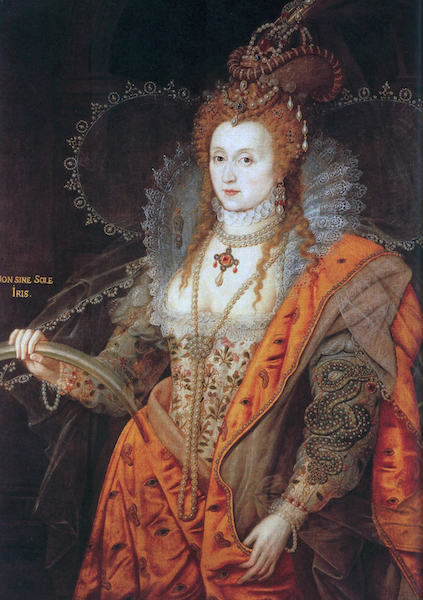
The one time the queen wears something totally different is for the fancy dress party in episode 6, “Chains.” Although her costume is hilariously spot-on — she dresses as her father, Henry VIII!


This costume isn’t a strict recreation of any one Henry VIII portrait, but the pale color and overall style seems to harken towards the classic Holbein:

Nursie (Patsy Byrne)
At Queenie’s side is her childhood nursemaid, “a sad, insane old woman with an udder fixation” (according to Blackadder).

Her gown is pretty straightforward Elizabethan, and I’ll just note that the contrasting stomacher is something found in the period. While for a costume, this was done with woven fabric, at the end of the 16th century, the stomacher would have been embroidered, as shown in this miniature.

Nursie’s cap is a little over-engineered as typical for theatrical productions.

But it’s aiming for the correct historical style!

Costumes for Those Visiting Court in Blackadder II
In order of appearance, let’s take a look at the more interestingly attired folks who pop up at court and in Blackadder’s life.
Kate (Gabrielle Glaister) & Lord Flashheart (Rik Mayall)
In the first episode, a woman named Kate disguises herself as a boy to get a job as Blackadder’s servant. They fall in love, and she reveals herself as a woman, so he proposes they marry. Thus, she gets this wedding gown (and Baldrick becomes her bridesmaid). White wasn’t a standard wedding gown color until the Victorian era, but it’s a TV trope, so she’s wearing ivory damask trimmed with gold.

Lord Flashheart is supposed to be Blackadder’s best man, but he takes off with the bride. One-off characters in this series get just as fully realized and elaborately detailed costumes as the regulars!


Interesting that the overall style and especially the short cape Lord Flashheart wears must have been inspired by a portrait of Sir Walter Raleigh (yet Raleigh shows up in a later episode wearing something very different).

Flasheart’s doublet is pale, like the portrait, although the details are different. But his trunkhose and belt are black and trimmed in the same fashion. And of course the cape is very similar.

When Flasheart takes off with Kate, they switch clothes — she gets a version of his outfit, and he’s wearing her wedding gown. Bonhams had both masculine-style outfits and described them as:
“The Flashheart outfit comprising doublet, hose and cape, the doublet of cream coloured brocade, edged with gold braid, decorated extensively with pearl type beads, with flower shaped button detailing, having hook and eye fastenings to front. Kate’s doublet being identical in smaller size; the hose, of black velvet decorated with braid and pearl effect beads in linear motif, with slashed effect revealing black brocade fabric; the cape of black velvet with pearl beads in linear design, with rope tie to neck and fur trimmed collar.”
Kate’s doublet has the same trims as Flashheart’s but is cut in in a more feminine shape:

Flashheart’s wedding gown is the same style as Kate’s, but made to fit him (given that he’s a lot taller).

Lady Farrow (Holly De Jong)
In the second episode, “Head,” Blackadder temporarily plays the Queen’s executioner, and Lady Farrow tries to plead for her husband’s life. Her gown is similar to Baldrick’s bridesmaid gown, except the fit is better and she wears a larger ruff.


The costume is described on the auction site as:
“An Elizabethan style dress, of heavily embroidered pink brocade, decorated with braid, sequins, pearl effect jewels and rhinestones, having lace edged sleeves, with boned bodice, with different patterned fabric to underskirt, labelled inside with BBC codes.”
The overall costume shape and the floral pattern of the fabrics remind me of this sort of portrait, which shows embroidery patterns of the period.

Sir Walter Raleigh (Simon Jones)
In episode 3, “Potato,” the court is very impressed by the exploits of Sir Walter Raleigh (except for Blackadder).


Bonhams has these details about the costume:
“Sir Walter Raleigh’s doublet and hose, of gold coloured brocade, edged with gold coloured braid, with small ruff type collar and matching cuffs, with slashed detail, revealing dark green coloured brocade, having hook and eye fastenings to front.”
While this one doesn’t seem to be inspired by a specific portrait (at least not by a contemporary image of Raleigh), the style is accurate for the era, especially the elaborate slashings. Compare with:

Mr. & Mrs. Pants (Barry Craine & Lesley Nicol)
In “Money” (episode 4), Blackadder briefly tries to sell his house to Mr. & Mrs. Pants, who are a nicely dressed well-to-do couple.

Mr. Pants wears a smart green suit with a coordinating tall pleated hat — those were very fashionable at the end of the 16th century.

Mr. Pants wears an excellent doublet, skirt (or kirtle), and loose gown. This combo is so practical and lovely!

Here’s a Flemish example with a black loose gown worn over a rust-colored doublet and black skirt, and similar styles would have been worn in England too.

Leonardo Acropolis (Philip Pope)
In the same episode, Blackadder hires a painter to help with his blackmailing scheme. I just like to see a good men’s 16th-century doublet and trunkhose, what can I say?

Prince Ludwig the Indestructible (Hugh Laurie)
In the final episode (“Chains”), the evil Prince Ludwig kidnaps Blackadder and Lord Melchett.


The auction house describes this as:
“Prince Ludwig’s Elizabethan style leather doublet and hose, of brown leather, both parts with panelled strips, having red suede edging and patterned silk lining, the doublet with silvered buttons and stud fastenings, the hose with laced back, both labelled inside and inscribed ‘Blackadder II, Hugh Laurie.'”
Like several of the other men’s suits in this show, Ludwig’s costume has lots of the slashing popular in the period. And I guess the leather is to show he’s a bad guy ;)
So come to Blackadder II for the comedy, stay for the historically accurate costuming! You won’t be disappointed.
Are you a Blackadder fan?
Find this frock flick at:


I remain deeply sad that the BLACKADDER II/UPSTART CROW crossover remains limited to a cameo appearance by a certain cross-dressing ‘gentleman’ of the Law (One would have loved to see Edmund Blackadder do his best to wriggle out of paying Master Will for … well, anything and everything … not to mention doing his best to outlive Good Queen Bess*).
*Bonus points if we can smuggle in the suggestion that Blackadder absolutely brings out the Worst in ‘Queenie’ (Not sure whether to to bring back Dame Emma Thompson and let her cut loose a little or show Ms. Miranda Richardson go from Gloriana to despot in an instant … ideally one could get them both and switch between them, depending on Edmund’s proximity, but I suspect that might rather break the bank).
Hah! Refreshing my memory of the last BLACKADDER II episode, it now occurs to me that having Master Will bump into Blackadder while the latter is cooling his heels over a small misunderstanding – you know, the sort of thing that happens when you claim Queen Elizabeth is actually King Ludwig – and the former is having kittens over being caught up with the Earl of Essex’s folly might be best of all.
Especially if the punchline involved Queen Elizabeth showing up as played by Mr Hugh Laurie.