

This is a Top Five list that I’m kind of surprised we haven’t done yet (though I did one on riding habits some years back — but that post covered more than just the 18th century), since everyone here at Frock Flicks loves a good redingote. But before I talk about all the awesome ones in film and television, I am going to do a brief overview of what a redingote is, just in case there are those who are unfamiliar with the term (we never assume everyone who stumbles across this blog has a well-versed background in costume history, after all). Please forgive me as I’m going to be very reductive in my exceedingly brief explanation of this garment, because I’m not trying to write a Patreon post about it. Or, you can also check out the article Kendra wrote on her own blog about riding habits in female fashion in the 18th century for more detailed discussion than what I’m throwing out here.
We interrupt this throw-away post for a brief art history lesson – What is a redingote?
The term “redingote” is a French corruption of the English term “riding coat” that originated in the 18th century. A hot minute later, the English re-borrowed the term and it became the catch-all descriptor of a style of fashion that evolved from the frock coats (and tangentially, military uniforms) worn by men in the 18th century.
That said, the kind of redingote we’re obsessed with isn’t menswear, it’s actually womenswear. By the mid-1700s, the redingote was appropriated by women, first as actual riding gear and then, later on, as strictly a fashion style that more or less had nothing to do with riding. The “riding habit” became the female sporting equivalent while the redingote eventually faded from fashion by the turn of the 19th century. So, it’s a very specifically 18th-century style that had a few brief revivals over the ensuing centuries but really, when a fashion historian starts talking about redingotes, they almost always mean the 18th-century women’s fashion.
While the fashion for upper-class women wearing menswear for sporting activities pre-dates the 18th century, the trend for what evolves into the redingote really doesn’t start building steam until the early 1700s. There is a fair amount of scholarship focused on the ways that the 18th-century obsession with naturalism was a reaction against the artificiality of the baroque styles that came to dominate the previous century, and the redingote is theorized to be one of those pathways in fashion whereby women could shed some of that restriction and artifice in a socially acceptable manner by engaging in “sport” (usually taken to mean hunting, or at least riding).
Below is a portrait of Marie-Adelaide of Savoy, mother of Louis XV, wearing a very ornate and structured riding habit, but still — she’s depicted in “nature” and she’s posed very similarly to the type of poses most often associated with men (which in itself is another extremely fascinating rabbit hole to go down).

Moving ahead a few decades, the redingote begins to evolve into a more casual garment. This extant redingote is in the collection of the Victoria & Albert Museum. They have an absolutely phenomenal webpage dedicated to extremely high quality, high resolution photos of this garment which you really should just take a minute to check out and ogle.

One of my favorite examples of a riding habit/redingote in art history is the portrait of Marie-Antoinette, as Dauphine, who commissioned a portrait of herself wearing a salmon-y pink redingote for her mother. This portrait caused one of the earliest kerfuffles associated with Marie-Antoinette and her use of fashion and art in asserting her self-image against the strictures of the Versailles system. It shows her relaxed, in a neutral outdoor setting, with clothes a little rumpled, casually leaning on a marble pillar, her cheeks a little flushed as though she had just plonked down after a good brisk ride. As she wasn’t yet Queen of France, and this portrait was a gift to her mother and destined for the Austrian court (therefore the French didn’t have to look at it), it generated minor grumbling about the lack of formality befitting a Dauphine of France, but nowadays it’s seen as the art historical equivalent of heavy foreshadowing of the scandals to come relating to her utilization of her private self as her public image.

A decade later, we really start to see the fashion aspect of the redingote overtaking the functional. While portraits such as the one below of Marcia Pitt in a buff-colored riding habit enjoying a ride with her brother around their family estate continued to be a popular trend in art, neoclassicism was beginning to dominate the tastes of the fashionable elite, as was a burgeoning sense of patriotism that was gaining a foothold in the wake of the American war of independence. This led to military uniforms becoming a popular way for women to show their support for the military, particularly in England.

This fashion print from the early 1780s depicts a fashionably dressed woman kitted out in a frock that is directly inspired, if not outright copied, by the officer she’s depicted chatting with. The intersection between military wear and equestrian wear and women’s fashion is yet another rabbit hole that I don’t have the time to delve into, but if you’re interested in it, try getting your hands on a copy of the journal article, “Walking Amazons: The Development of the Riding Habit in England During the Eighteenth Century” by Cally Blackman.

Since this is already veering on the longish side for a Top Five Friday post, I’ll just wrap it up with a quick overview of where the redingote landed by the end of the 18th century.


By the 1790s, the redingote becomes obsolete. The last gasp seems to have been around the time the above sketch was done and afterwards the extremely stripped down Directoire styles overtake fashion on both sides of the Channel. Though the portrait of Countess Tyrconnell is interesting for the way that she is echoing the masculine incroyable fashion that was starting to blossom around this same era, so clearly women weren’t entirely ready to stop stealing from men’s fashion, even if the silhouettes were changing drastically.
And now, back to our regularly scheduled post topic!
So, now that we all are on the same page about what a redingote is, let’s take a look at some of our favorite redingotes in cinema!
The Affair of the Necklace (2001)


La Révolution Française (1989)

Brotherhood of the Wolf (2001)


The Madness of King George (1994)

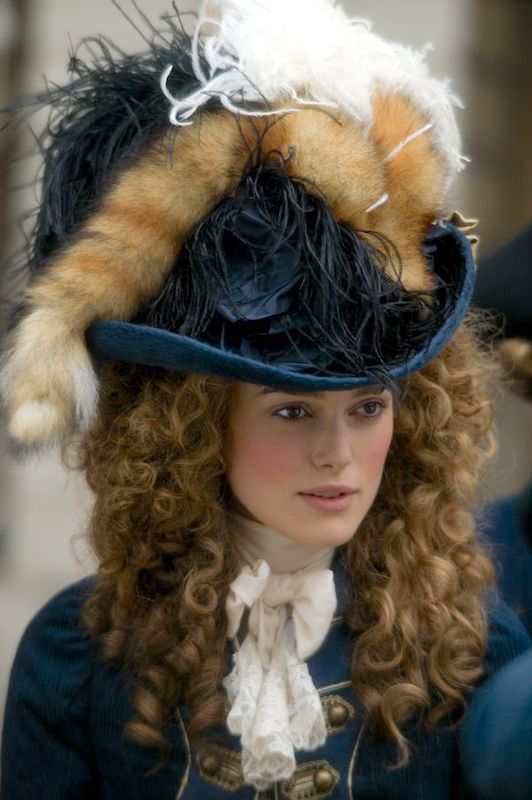
The Duchess (2008)


A word about other outfits that are sort of redingote-esque but didn’t fit my personal definition:
There are A LOT of outfits from films that I excluded on this list because they’re only redingote-adjacent. I mentioned a few times that the military styles started to blur the line between being a fashionable outfit that evolved from a riding costume to being a fashionable outfit that evolved from a military outfit, and honestly, there is some argument to be made that the distinction is minimal and both styles count as a “redingote.” I did include some militaria outfits on this list, but it didn’t feel 100% right to me to throw them in the same category as a redingote because the military-inspired outfits were almost always making a political and/or patriotic statement, whereas a redingote was just fashionable.

Another style I excluded from my list are what are usually referred to as “traveling costumes”; i.e., outfits that would be worn while traveling by carriage but bear some resemblance to a frock coat.


What’s your favorite redingote on film? Do you think I’m being too strict in separating the military-inspired outfits from the redingotes? Let’s discuss in the comments!


A designer managed to combine a redinggote with tits out. I don’t know what to think.
I suspect quite a bit of the audience – Seventeenth, Twentieth or Twenty-First Century – would just road HUZZAH!
Some of them might even be sober.
Probably “brotherhood of the wolf”- thanks for turning me onto that awesome movie
Are the images on the few most recent posts smashed for anyone else or is this a me problem?
Very much so – some are really hard to work out what I’m seeing. I was worrying it was my laptop/browser.
A decade ago I was at a fair in Germany which sold cured animal hides, including fox tails and badger skins. I was ready to buy several after finding out that it was okay to bring them back into the US, but my friends talked me out of it. After seeing the hat worn by Keira Knightly as the Duchess of Devonshire, I want them EVEN MORE.
Thanks for including a portrait of Marie Adelaide of Savoy – she’s one of my favorite lesser-known denizens of the Sun King’s court.
That portrait of Marie Antoinette is ADORABLE and conclusive proof that talking heads generally deserve a clip ‘round the ear, whatever the century.
As for the rest of the article, Ms Dormer and Ms Deaquenne (RIP) take the prize.
Thanks for this post–I don’t know how to ride a horse, but I would LOVE a riding habit! The V&A has a gorgeous red wool 1740s one, and a fave from film/TV is Jane Seymour in The Scarlet Pimpernel; she looks fabulous in a cocoa-brown redingote that I would wear every day if I owned it.
There used to be a website where you could view a bunch of the costumes from The Duchess and even get a 360 degree view by rotating them, but I can’t seem to find it. There’s a screengrab from it here: https://fr.pinterest.com/pin/435723332677470515/