

Portrait of Marguerite d’Angoulême, 1572-75, Livre d'heures de Catherine de Medicis, Bibliothèque Nationale de France
Our occasional series about history’s most interesting people and events that have been overlooked by Hollywood. See also our articles about revolutionaries, travelers, scientists, queer people, writers, artists, Renaissance women, Medieval women, 18th-century people, pirate women , journalists, Tudors, and suffragists who need movies made about them, plus overlooked moments in time. We’ve also nominated Rose Bertin and several of Henry VIII’s wives for specific screen treatment.
This post was inspired by reading an interesting dual biography of Joan of Arc and Yolande of Aragaon, the dauphin’s mother who was pivotal in his political dealings/Arc’s involvement. But then I went to look her up for a WCW and was shocked to realize she’s barely been on screen! So I thought I’d better flesh out Aragon with some other underrepresented-on-screen French women!
Christine de Pizan (1364 – c. 1430)
Christine de Pizan is still renowed today for her writing, including The Book of the City of Ladies and The Treasure of the City of Ladies — a female author this early? So it’s kind of shocking that, according to what I can find, Pizan has NEVER APPEARED ON SCREEN.
Pizan was from Italy; her father was an astrologer who took Christine with him when he was appointed court astrologer to Charles V of France. She married a Frenchman and had three children, but after her husband died, she had to support herself and her family. Luckily, girl was SMART so she wrote novels, poetry, biographies, as well as literary, historical, philosophical, political, and religious works. Her City of Ladies books are a response to a popular poem with misogynistic undertones, Roman de la Rose (Jean de Meun), and create an allegorical city in which a number of famous historical women are collected. Their stories demonstrate women’s contributions and value.

This badass proto-feminist is an EXCELLENT example of a true woman exercising her power and would be an amazing character to see on screen!
Yolande of Aragon (1381-1442)
Yolande was, you guessed it, born in Aragon (modern Spain). The daughter of the king and granddaughter of a king of France, she married Louis II, Duke of Anjou and Count of Provence.
During the Hundred Years’ War, Yolande supported the French. She married her daughter, Marie, with the dauphin (aka heir to the throne), the future Charles VII of France. He’s the legendary “dauphin” of the Joan of Arc story, so of course Yolande supported his claim. But more than that, she essentially became a parent to Charles, who lived with her; she surrounded him with her chosen advisors and removed those she wasn’t so into. And according to Nancy Goldstone’s entertaining book, The Maid and the Queen, she was likely the person who allowed Joan to be introduced at court and then supported her joining the dauphin’s entourage.

Yolande HAS been seen on screen, but not enough. Apparently she was played by Elspeth March in a French TV adaptation of The Lark (1957), a play about Joan of Arc, as well as Mary Ward in an Australian version (1958).

She was also played by Martine Pascal in Joan the Maid 1: The Battles (1994), but again, I can’t find pics!
Here’s the few I can find:
Geneviève Casile in Catherine, il suffit d’un amour (1986)
A French TV adaptation of a series of historical fiction novels about a medieval woman. She falls in love with an Armagnac captain and ends up in Orléans for the famous battle.

Faye Dunaway in The Messenger: The Story of Joan of Arc (1999)
Really the only real screen time given to Yolande was this feature film. Sadly it’s been too long since I’ve watched the film to remember how she’s portrayed, but I found a review in which she’s described as a “pragmatic atheist” which is better than the Evil Conniving Woman I assumed she’d be.


Marguerite de Navarre (1492-1549)
I probably shouldn’t bore you by telling you how I had to write a paper in high school French class and was all set to write about Marie-Antoinette, but found Marguerite de Navarre near her in the encyclopedia, and my French teacher was SO IMPRESSED I KNEW ABOUT THIS AMAZING FEMALE INTELLECTUAL even though it really was total chance. I don’t know, I guess go with it? (I did!)
Her father was the Count of Angouleme, and she was given a strong classical education at his court. She married the duke of Alençon, who was apparently illiterate. As her father was a descendant of a previous French king, and given complicated things happening in the French line of succession, Marguerite’s brother eventually became king of France as François I. When THAT happened, Marguerite took full advantage, starting a salon at court and becoming one of France’s foremost intellectuals. She wrote poems and plays and is best remembered for the short story collection, Heptaméron, which was inspired by The Decameron.

After her first husband died, Marguerite married the king of Navarre (then still a separate kingdom), Henry II. She got involved in diplomacy, negotiating the release of her brother when he was prisoner in Spain. She was a reformist (ie proto-Protestant), and as a patron of the arts, hosted Leonardo da Vinci at her chateau at Amboise (where he died).
Marguerite’s daughter Jeanne became queen regnant of Navarre as Jeanne III, and was mother to Henry IV of France.
Okay, so Marguerite HAS been on screen, but only twice and at least one of those was a pretty cheesy production:
María Hervás in Charles, Emperor King (2015-16)
I haven’t seen this Spanish TV series about king Charles V, but apparently Marguerite turns up in at least one episode, where she’s played by Hervás (The Cook of Castamar).

Jeanne Balibar in The King’s Favorite aka Diane de Poitiers (2022)
Marguerite also appears in the French TV series about the famous mistress of Henry II, where she gets ONE DRESS and urges Diane to convert to Protestantism.


Olympe de Gouges (1748-93)
So I may be stretching to say de Gouges has NEVER been on film, because she recently had a TV movie made about her that I plan to watch very soon. But still, only twice??
De Gouges was born Marie Gouze in the south of France to a wealthy family. After being forced to marry and her husband’s death, she changed her name, shacked up with a wealthy businessman, and moved to Paris. She arrived right as all the intellectuals were heating things up in the lead-up to the French Revolution, and Olympe dug right in, publishing a novel, writing plays, and signing her name “citoyenne” (the female version of “citizen”). She was an early supporter of the abolition of slavery, writing an anti-slavery play, and when the Revolution broke out, she got super involved. She joined a club devoted to gaining equal rights for women, and wrote a still-famous response to the Declaration of the Rights of Man and of the Citizen called Declaration of the Rights of Woman and of the Female Citizen.
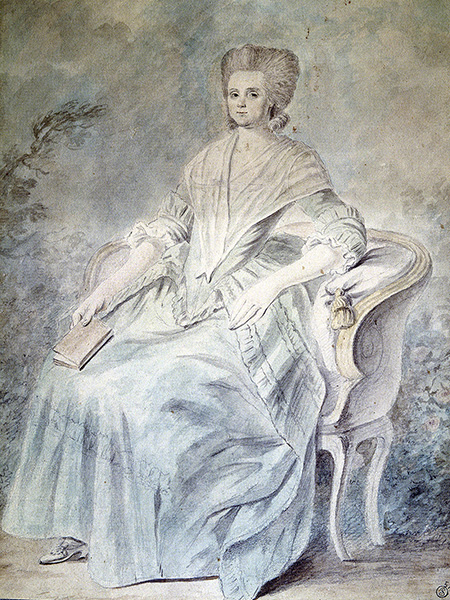
As a supporter of constitutional monarchy (and opposing the execution of the king), de Gouges came under fire herself. Tragically, she was arrested for promoting “Federalism” and executed. Today, there’s a feminist movement to have her ceremonially buried in the Panthéon, which is where France’s “great men” — and VERY few (only six) women — are buried (ceremonially because like so many killed during the Revolution, her remains are lost).
Olympe has been on screen in two productions:
Sylvie Testud in Flashback (2021)
This time-traveling French comedy features a modern-day female lawyer who defends a rapist, then is magically sent to various periods in time through which she witnesses key moments in women’s history. The lawyer arrives at a salon where de Gouges is arguing for women’s rights.
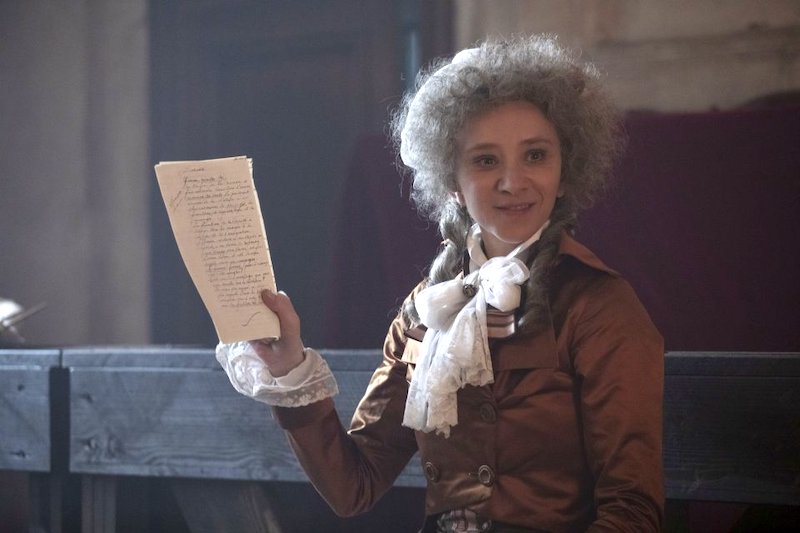
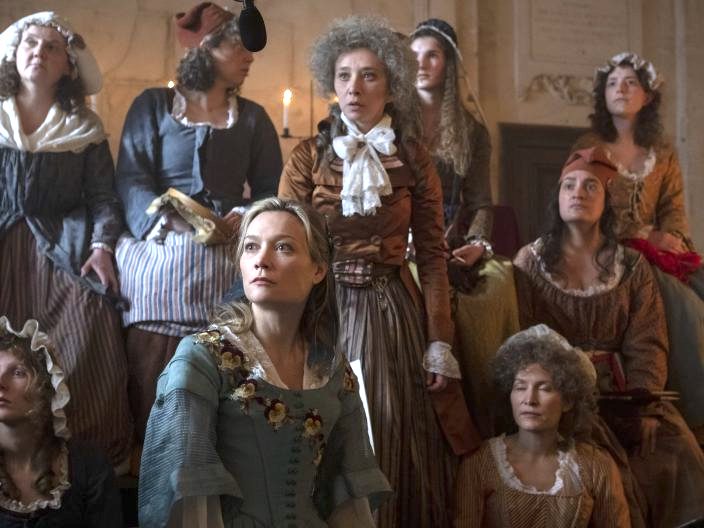
Julie Gayet in Olympe, une femme dans la Révolution (2025)
This French TV biopic just came out last year, and it’s at the top of my list for a watch! I promise to report back.


La Belle Otero (1868-1965)
I had a really hard time coming up with a fifth French woman! And honestly, given the theme here has been “female intellectuals,” I really should have been able to think of a fifth. But instead, I’m going with Carolina Otero, famed 19th-century French courtesan. Because given how famous she was in her day, how the hell has she not been on screen more?
Carolina was Spanish by birth. She grew up poor and by 14, she was performing in Lisbon as a singer and dancer. A patron supported her move to France, where she invented a new identity for herself as an Anadalusian Romani woman for that exotic appeal. She was a hit, performing for the Folies Bergère in Paris, which launched her career as a courtesan. She’s been associated with (although I can’t guarantee whether or not she was a lover of): Prince Albert of Monaco, Nicholas I of Montenegro, Kaiser Wilhelm II, King Edward VII of Great Britain, Peter I of Serbia, King Alfonso XIII of Spain, as well as numerous other famous men of her era.

Carolina retired after World War I. She had made an immense fortune, which she spent gambling in Monaco, but lived the end of her life in poverty.
Otero has only been shown on film ONCE:
María Félix in La Belle Otero (1954)
This French-Italian film was a biopic and based on its era, I’m guessing it’s pretty loose with the facts?


Which other historical French women need to be on screen more? Got any depictions of these five that we missed?


I’d like to see a movie on the life of the real (not the Dumas version of) Alphonsine Plessis (also known as Marie Du Plessis) also known (by Dumas) as the Lady of the Camelias. There are a couple of blank spots in her life where historians don’t actually know what was going on with her life at the time, but they can kind of figure what happened (for example, she married a French Count which took place in England but then it appears the couple split up shortly after – why? we have no evidence to say exactly why they split up)
All I know is “died of consumption.” I’ve never read the books or seen the films!
She was famous claiming that lying kept her teeth white.
It’s the same story as “Moulin Rouge” and Verdi’s opera “La Traviata”. The real woman was rather more interesting.
I’d love to see a dedicated Eleanor of Aquitaine movie. I know she reigns supreme in The Lion in Winter, but ever since I read A Proud Taste for Scarlet and Miniver, I feel her whole life deserves a more detailed treatment.
Oh yes! Especially the French years!
And the Crusade :)
YES! And the maybe-affair with her uncle!! (And I would love to see someone try to interpret how she felt about leaving her daughters behind when she left France?)
I want to see movies about Jeanne Hachette. She earned the “Hachette” nickname when Burgundian troops invaded her town, Beauvais. When a soldier planted the Burgundian flag on Beauvais’ battlements, she planted a hatchet into the solider, pushed him into a moat, and rallied the townswomen to help fight back.
I also want another movie featuring Marie van Goethem, the model for the statue “Little Dancer, Age 14.” While there’s not much information about her, I’d like to see her life, not just in the shadow of being Degas’ model.
ooo, I need to read up on Hachette!
Well you’re in luck. Le Miracle des loups ( The Miracle of the Wolves ) is a silent epic and one of the absolute best depictions of the Late Middle Ages.
There’s an excellent siege scene which does feature Jeanne Hachette.
That said, if you’re really not a fan of silent films haha… ::Shrugs::
I would give my entire patrimony to see a film about Christine de Pizan. She didn’t hesitate to speak up!
I really love characters who were peripheral to what was going on but were in the room when it happened. A lady in waiting at court, Rose Bertin, someone like that.
I would have said Alice Guy, one of the very first filmmaker, but there’s actually a movie being made right now. Louise Michel, an important figure of the Paris Commune and of feminisme deserves more than one movie, especially since it is only a fraction of her life. There are probably a lot more, but it’s not coming up to me right now!
It’s important to remember that legal disabilities and social limitations didn’t mean that women were passive victims throughout history. How they negotiated these obstacles and even made them work for them is fascinating history.
Marguerite Steinheil : deadly mistress of the president, then accused in the murder of the century (of her husband and her mother), then peeress of England
You know, it occurs to me that showing Madame de Pizan wrangle all those famous historical women into edifying form for her COTY OF WOMEN (Literalising a metaphor, as it were) might be an entertaining way to spend a film (and a useful way to show the challenges the messiness of historical figures presents to any historian seeking to learn from their examples).
Also, I simply cannot be the only one who took one look at Marguerite of Navarre and thought “Do I detect a resemblance to Ms Anjelica Huston?”
There is an italian movie about Christine de Pizan (Christine Cristina, 2009) and it is the only film directed by Stefania Sandrelli (yes, the actress). The lead role is played by her daughter (Amanda Sandrelli) and the costumes are by Nanà Cecchi (Ladyhawke, First Knight). As it was a low-budget production, I believe it was never released abroad.
Cheers from Italy.
ps: love your blog, accuracy and bright snark.
I can’t decide if that casting call counts as mere nepotism or as actual child labour…
So unfortunately there IS another depiction of Marguerite de Navarre that I can recall. I say “unfortunately” because this depiction of her is about three minutes in one of the earliest episodes of the “Tudors” and boy did they do her dirty. There is literally nothing about her intellectual achievements or her political acumine, she is literally only there to flash her cleavage at Henry VIII and then screw him in the next scene so that we can see that Henry is pettily trying to one-up King Francis by doing his sister.