

Given the new feature film adaptation of Jane Austen’s novel Sense and Sensibility, I thought I should take one for the team and rewatch the 2008 miniseries since we only have a short review. This BBC mini-series was adapted by Andrew Davies, who got a TON of positive press when he took on Pride and Prejudice in 1995 (he’s adapted MANY things, but the other Austen-y ones include Emma, Northanger Abbey, and Sanditon). While that production hewed very closely to the Austen novel, this one tries to introduce more sex/sexuality with mixed results. The costumes by Michele Clapton nicely evoke the 1790s setting in which Austen wrote her first draft of the novel. Because of being a miniseries, it’s able to include a few more characters and scenes than the now-classic feature film adaptation from 1995. But overall, it pales in comparison (and you can’t help comparing the two)!
The series stars Hattie Morahan as Elinor Dashwood, eldest daughter of a wealthy family that falls on hard times right as the story opens. She’s the mature, calm, measured sister; Charity Wakefield plays Marianne, who is younger and All About Romance (but more in the “romantic poets” vein than the “romance novel”). Both do a solid job with their performances. Dominic Cooper plays Willoughby and David Morrissey is Col. Brandon; both are fine, although I didn’t love how there were SEVERAL scenes added that were The Guys Doing Guy Stuff (i.e., Brandon confronts Willoughby early on about his intentions, and while they don’t reveal specifics, it tips you off far too early that Willoughby isn’t a stand up guy; plus in the opening scene, we’ve already seen Willoughby seducing Brandon’s ward — that’s actually the only sex in the production) — Austen didn’t tend to write from men’s perspectives, which makes sense, given she wouldn’t really understand them except through a female lens. Dan Stevens plays Edward Ferrars, and I didn’t dislike him as much as I did on Downton Abbey, so that’s something?
Claire Skinner EATS UP EVERYTHING as Fanny Dashwood, and I was left to wonder if it was a great performance and/or if Fanny is just SUCH a scenery-eating character? I liked the inclusion of her and husband’s (Mark Gatiss) son, as it does explain Fanny’s motivations for being such a mega-bitch. Anna Madeley plays Lucy Steele, but best of all Daisy Haggard is HILARIOUS as loudmouth sister Anne, who spills the beans as she properly should. Janet McTeer plays Mrs. Dashwood, Lucy Boynton is youngest daughter Margaret, Jean Marsh is Mrs. Ferrars, and Linda Bassett is Mrs. Jennings which should amaze you as much as it amazes me because Bassett plays Nurse Crane on Call the Midwife!


Costume designer Michele Clapton hadn’t yet done Game of Thrones so hadn’t yet been launched into the stratosphere, and she collaborated with assistant designer Alex Fordham, who worked with Clapton on The Devil’s Whore, Game of Thrones, The Crown season one, and The King’s Man. Unlike Many Other Productions, Clapton’s goal was “keeping it really correct” (Sense and Sensibility 2008 Behind the Scenes: Costumes). According to The Telegraph, “The costume and set designers spent hours touring art galleries and the Victoria & Albert Museum in search of inspiration.” And yes, within reason, I’d say this production — while it didn’t blow me away by any stretch of the imagination — kept things relatively Regency.
Where Clapton did try to “improve” was in terms of color and naturalism. In a behind-the-scenes interview originally posted on the BBC website but now available on YouTube, her focus was,
“The idea of playing with colour and the personalities. To actually use colour, more than I think is often used in this period … because it was used, and so we did, probably more as highlights and accessories.”
I don’t know if the end result screamed COLOR WAS A THEME here, but Marianne at least wears pale yellows and pinks — while Elinor is pretty dishwater, and of course Mrs. Dashwood is in mourning.


Clapton also tried to bring naturalism to the production, instead of the put-together looks generally seen in paintings and fashion plates. She said,
“They’re living in this quite cold cottage and it’s windy and cold outside. Rather than when you’re wearing the shawls around the elbows which classic where you see fashion plates… they put them around their neck and they clamp bonnets down or they take their bonnets off. So it was an idea of just being quite free with the costumes although actually keeping very much to the costumes of the time.”
We see Marianne with her hair down frequently, especially in the first episode and particularly whenever Willoughby is around — a nod to her Romanticism and “wild” nature:

And overall, the main goal seems to have been a more casual, “natural” effect. Clapton told the Telegraph,
“Ten years ago, female characters in 19th-century dramas would all have their hair done in very precise ringlets, all neat and perfect just like in the portraits. Now we’re trying to achieve a more believable, natural look, especially when the Dashwoods are at home. The director [John Alexander] wanted the characters to feel more human.”
Which means that, unfortunately there isn’t that much to get excited about on the Dashwoods:


Even when they go to London, it doesn’t get terribly more exciting:


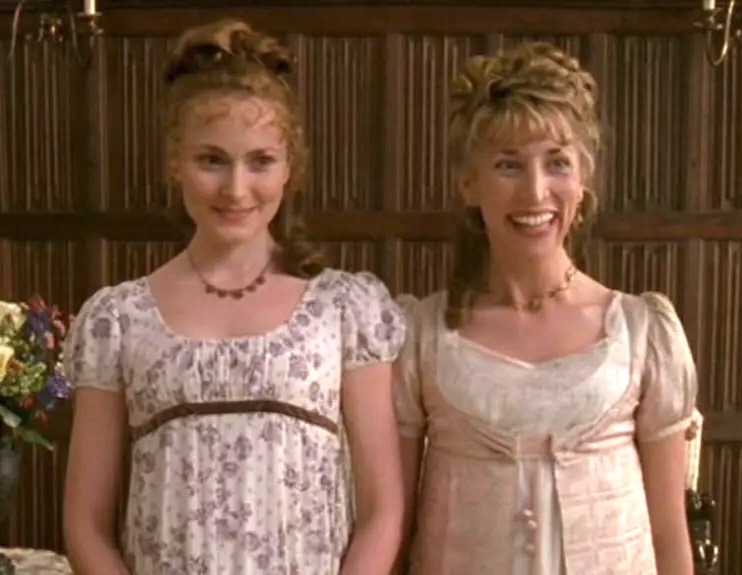
Lucy Steele is a little more Conventional Austen Heroine:


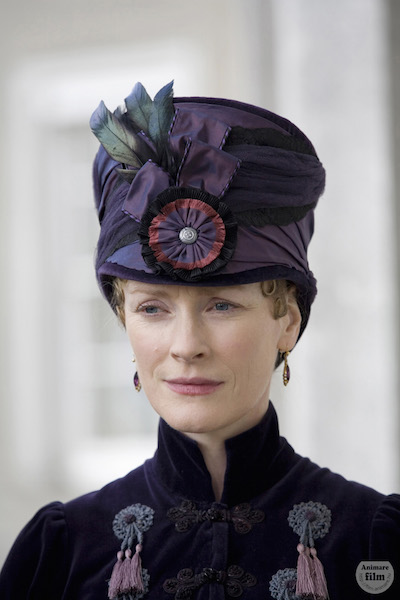
Really the only character to get anything INTERESTING to wear was Fanny, in her strong colors and Actual Trims:


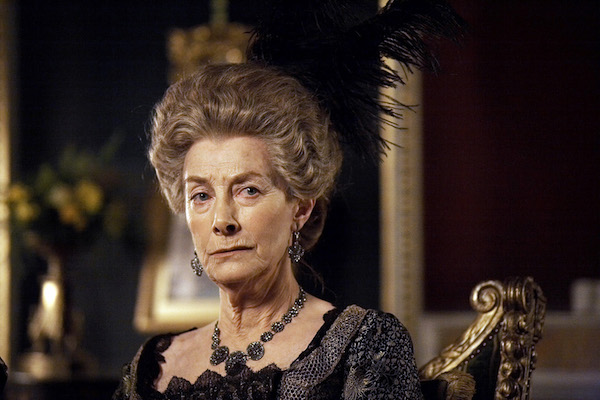
Mrs. Jennings goes with 1780s hair and occasionally slightly earlier styles:

And Mrs. Ferrars is in Full Classic 18th Century, which I suppose is only 10ish years out of date, so not QUITE the “older ladies in older fashions” issue?
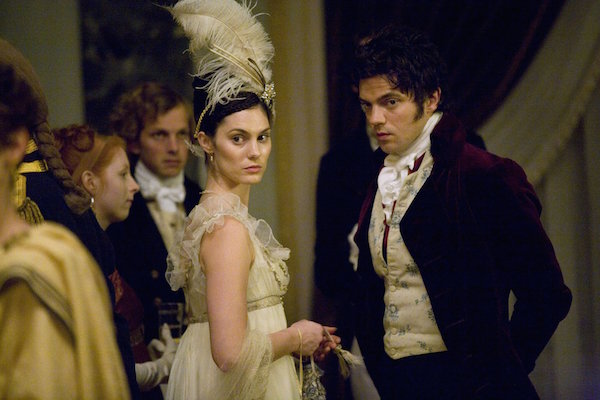
Even Miss Grey with her £10,000 is nice — feathers! Sheer muslin! — but I’m not jumping out of my seat.
Clapton had specific ideas on dressing the male characters:
“You have Brandon who’s the conformist … but with a sort of sense of romance … with his big duster coat which is very practical … Whereas Willoughby … he has this sort of studied romantic attitude with the double waistcoat, he’s all very proper, very high cut. He’s very fashionable … And then we have Ferrars who wants to become a vicar and he’s slightly softer and more conformist … but maybe a little more country than his parents would like him to be… “


You can check out that behind-the-scenes featurette on YouTube:
What’s your take on Sense & Sensibility (2008)? Are there elements you loved (or hated)?
Find this frock flick at:


None of the costumes stood out to me when I watched it. I take this as an improvement over Pride and Prejudice and Muddy Hems.
Miss Grey #needsmoresleeves! Taking after Caroline Bingley, in that pig fiesta, I see!
Actually it’s literally a (Caroline Bingley) P&P&P rewear, a lot of the costumes are, including the lavender dress above. Any weird fitting issues with the lavender dress are due to Keira Knightley and Hattie Morahan having different sets to their frames, even if they’re basically the same size.
Is Miss Grey in the frilly dress that Keri Russell wore in the ball scene in Austenland? That’s what it looks like from the side. I remember seeing this series and not liking it at all. Just like P&P&Pigs, the last scene could be S&S&Chickens. Why?
A lot of the costumes are in stock for sure
I actually really appreciate this version as a companion to the 1995 version. When I was younger I thought the 1995 version was boring, but it grew on me and yes the costumes are lovely.
This one, I like that the ages of the actors are more in line with the book (Morahan and Wakefield are both in their mid-late twenties), particularly Morahan’s performance. Emma Thompson is WONDERFUL but they literally had to write a line talking about how she was a spinster because she was in her thirties.
Obviously this Brandon can’t touch Alan Rickman, but he’s fine (and a lot of the action portrayed here is implied in the novel, ymmv on whether it should be made explicit but it’s there), they get to include Willoughby’s visit to Elinor to make his case (and his inherent selfishness) while Marianne is recovering, and they include Mrs. Ferrars, which a lot of adaptations leave out!
It’s a really good adaptation.
Oh and of course Greg Wise was an IMMENSELY appealing Willoughby, but this one is both appealing and Byronic. He smolders, he’s a bad boy, and that tracks with the opinion a lot of people had of Byron at the time, which Austen did not share.