

Not having much ELSE exciting to watch, I did indeed continue watching the new Outlander spin-off/prequel, Blood of My Blood (2025), which just had its season finale. I did a deep-dive review of the first two episodes, so now, my thoughts on the remainder of season one. Again, this is set in 1714, right before a Jacobite rising, in the Scottish highlands; and the costumes were designed by Trisha Biggar (Moll Flanders, Da Vinci’s Demons, Ordeal by Innocence, Outlander seasons 5 and 7).
My random thoughts, before we get to the costumes:
- I’m glad they’ve gone back to Scotland, as the American frontier setting of the original Outlander totally lost my interest.
- Just like older Dougal, young Dougal is a total jerk but totally pings my “god dammit yes I would shag him” weakness (it’s the height, facial hair, and bad boy energy)

- I’m increasingly finding Murtagh cute, character-wise. When he told Brian “if anyone is going to kill you, it’s going to be me”! 😍

Now, let’s talk costumes, including hair and wigs! Note there will no doubt be spoilers throughout.
Women’s Hair
I know they’re doing the stupid, anachronistic/made-up trope of “unmarried women wore their hair down, married women wore their hair up,” but watching Ellen wander around sans hairpins just kept making me twitch. She looks like they ran out of time getting her into costume! Or she’s just escaped from Bedlam?

I knew not to get my hopes up for her bridal hairdo, and they definitely did not fail to disappoint:


We had one brief moment where we saw what a real-life 1714 Scotswoman would most likely have looked like (except for, possibly, very formal occasions) when Ellen adds a cap for her servant disguise:


Women’s Dresses
These mostly continued to be fine: mantuas and jackets abounded. Colors continued to be muddy; speaking of the men’s dress, and noting that “clan tartan” wasn’t really a thing yet, Biggar told Town & Country magazine,
“They tended to use similar colors because they were dyeing fabrics with plants that were indigenous to their areas. So somebody who had yellow would have yellow in their kilt, and somebody else might have green or red” (Inside the Making of the Costumes on Outlander: Blood of My Blood).
Of course, as we pointed out in our first review, they did indeed have stronger colors than this, but okay, I get the vibe.


As discussed in our previous review, the mantua was introduced in 1670s France as a dressing gown (like, lounge around the house in it) and then became a more formalized dress, spreading to Britain and other countries. It had no waist seam, stitched down pleats, and the open-front skirts were often pinned up high on the hip.


Women’s Dresses: the Hoors
Prostitute Seema spends most of her time in decently cut/embroidered stays, but without any shift to absorb her body oils/reduce chafing:


Women’s Dresses: the Beltane Costume
At the Beltane festival, Ellen and Malcolm Grant are crowned the May Queen and King, and they’re dressed in old-fashioned-by-1714-standards/fantasy ensembles. Town & Country reported,
“Instead of tailoring, the focus was on extensive craft work and logistical coordination. For the moonlight ritual, the team designed animal masks and ethereal headdresses using natural materials collected from gardens and nearby areas” (Inside the Making of the Costumes on Outlander: Blood of My Blood).
I thought what they came up with was GORGEOUS, if awfully “medieval/fantasy elf queen” for Ellen (and also, “let’s put her in a wedding dress without putting her in a wedding dress”). Malcolm’s doublet and breeches count as 17th century styled.


Women’s Dresses: The Wedding Dress
“Every part of the bridal ensemble—from the embroidery on the bodice to the lacework on the veil to the leatherwork on the shoes—was done in-house, guided by the skillful hands of longtime Outlander costume designer Trisha Biggar and senior assistant Kat Tart. The mantua, a structured gown pleated at the back, was rare for that period and required the team to develop their own interpretation. Made in silk and tweed, it was adapted from a 17th-century French court style to fit the Scottish Highlands of 1714″ (Inside the Making of the Costumes on Outlander: Blood of My Blood).
I’d love to know more, because while the dress is lovely, I’m not getting mantua from it?



Nonetheless, the open-front skirt and wide sleeves are right for the era, and the metal thread/spangle embroidery is to die for (although putting it on the gown back is a modern aesthetic):


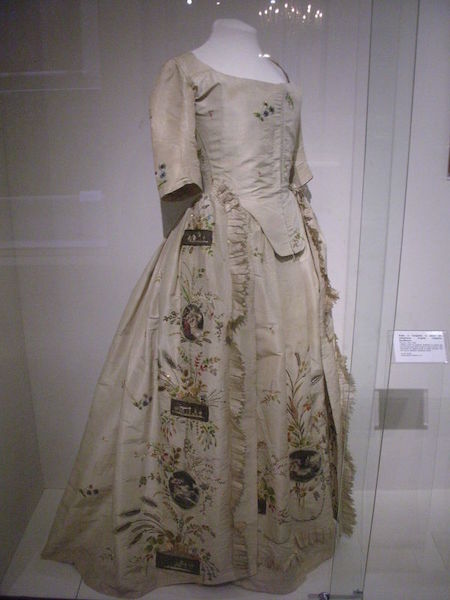
Compare it to these two examples of 18th-century metal-thread embroidery:


However, WHAT HAPPENED WITH THIS SLEEVE CAP DOES NO ONE OWN AN IRON

Men’s Hair/Wigs
First, I continue to be irritated by the man-bobs, but especially when Brian adds a little pigtail to his front hair:


But what’s really making me twitch are the 20-to-50-years-too-early wig styles! Yes, Western European men started wearing wigs in the late 17th century, but these were long and curly to follow current hair fashions. It’s not til the 1730s that you start to get the short on the sides, long in back look; and not til the 1740s that side rolls come into fashion.
Lest someone want to argue that the Scots were on the cutting edge and leading male hair/wig fashion:

I’m sure they probably raided the original Outlander (set in the 1740s, may I remind you) wig stock and went with these because it reads 18th century, but none of these are appropriate to the era:


You also see queue wigs, which again, don’t come into fashion until the 1730s; the structured buckles (rolls) are a 1740s-50s introduction:


PLUS, the side-curl (buckled) wigs do the thing that annoys me — which, granted, EVERYONE does — which is they miss that these styles have a short portion on top (called the “toupée” or “toupet”):


So every time the Grant uncle showed up, I was thinking “Great! For 1770 and where his toupet?”


Pretty much the ONLY guy wearing an early-18th-century-appropriate hair or wig style was this Jacobite nobleman in his full-bottomed wig:


What worked for you and what didn’t in season one of Outlander: Blood of My Blood?
Find this frock flick at:


Why do I sense Anathema being summoned up from the vasty deep of indignation and pronounced with ringing tones over Bell, Book and Candle?
Wait a minute, ‘Bell, Book and Candle’ is Excommunication, not Anathema.