

I wasn’t even THINKING about watching the new Outlander prequel, Blood of My Blood (2025-), until a friend sent me her adapted Frock Flicks bingo card, which she won via “beachy waves,” “only muddy colors allowed,” “spunky anachronistic feminism,” and “AMPUTATION!” (She also got to check off “villains have terrible teeth,” “tragic hairpin shortage,” “BOOBS,” “fake stomachers,” “chess is metaphor for life,” and “BUTTS.”) So I fired it up, and goddammit, she was totally right AND episode two sucked me in because of “how the FUCK are they going to make this work given everything that happens in Outlander.” So, here we are. It’s my version of “someone on the Internet is wrong” (someone on TV is potentially wrong?).
Other gems from the group chat:
- “I tried so hard to watch it. I did. Everyone looks like they smell.”
- “Every time someone was about to touch a rock I yelled DON’T TOUCH THE ROCK”
- “Ahh, I missed that one on the bingo card. Anachronistically shaved legs!”
- “Is she wearing a Bump-It??”
To which I will add a couple of plot/casting thoughts:
- If Ellen is so anachronistically feminist and has no interest in marrying, why does her mind change after 5 minutes in a barn?
- I was praying that at least one of the time travelers would end up in the Stone Age or something else random. Outlander writers, get on THAT sequel/prequel!
- Both of our time travelers mentally adjust AWFULLY quickly to their situation. Maybe they should have saved some of episode 2 for episode 3?
- I don’t get why Henry is so sure that Julia is in the same time zone as himself.
- Ok, looks-wise Jamie Roy as Brian Fraser totally reads as Sam Heughan‘s (Jamie) father. But also, Claire’s dad (Jeremy Irvine) also looks like a bit like Heughan/Jamie? And yeah, Hermione Corfield as Claire’s mom Julia is a RINGER for Catriona Balfe.
Now, let’s get to the good stuff — the costumes, designed by Trisha Biggar (Moll Flanders, Da Vinci’s Demons, Ordeal by Innocence, Outlander seasons 5 and 7).
Blood of My Blood Costumes: 1714
I’m not going to talk about menswear, sadly, because I know little and we have a long post about the menswear shown in Outlander. Check that one out if you haven’t!
The main dress style worn by most of the Castle Leoch women seems to be based on the mantua:


That makes sense, because the prevailing upper-class style in Britain was indeed the mantua, even if I’m not sure there’s any documentation about how it was adapted in the Scottish highlands. That’s the difficulty: there aren’t a lot of surviving sources for fashion in this era in Scotland, other than portraits where upper-class people often tried to look conventionally British, so we and I’m sure the showrunners had to do a lot of extrapolation.
The mantua was a dress that was initially a loose dressing gown tied with a belt, worn open in front over a stomacher (bodice fill-in) and petticoat (matching fashion fabric skirt). Over time, what was loose pleats created by the sash were stitched down, it became long and trained, and that trained overskirt was pulled back to the back side hip:


Lead character Ellen, who is the daughter of the (now dead) laird of a highland castle and clan, gets at least one in a brown tweedy wool, over a greyish petticoat and stomacher:

But Ellen isn’t the only one! Maid Mrs. Fitz gets a similar style gown in a similar style fabric:


And Ellen’s sister Jocasta wears a similar style, although with the skirts down:

Ellen’s other major outfit is this wool riding habit, which is menswear styled. It buttons down the center front, has a long skirting past the hip, and a matching petticoat:


This too seems perfect, as women wore very menswear-styled riding habits in this era for sports-type activity. Of course, the upper classes would do so in very fancy fabrics:
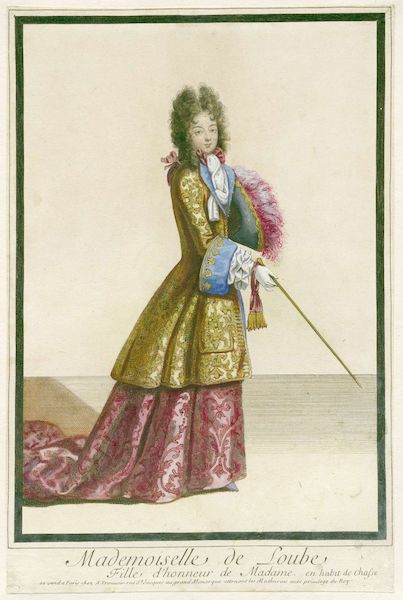
But you also see more wooly versions:

Other characters, including Julia and many of the ladies at the clan gathering, wear short skirted jackets and separate bodices:


This works for me. There REALLY aren’t a lot of sources from the late 17th/early 18th century for what ANYONE was wearing that wasn’t super upper class, so once again, extrapolation. We know fitted bodices worn with skirts made up the basic gown:

And we also know that separate jackets, either matching or not with the skirt, were becoming increasingly popular over the 17th and 18th centuries:

Of course, when we think of Scotland, we think plaid (aka tartan). In the opening scene, we see Ellen being dressed. Mrs. Fitz pleats up her plaid arisaid in a similar method to that worn by men:

The women are shown pulling their arisaids up over their heads to use as cloaks:

This was another touch I loved, because women wearing tartan wool as cloaks is one of the few looks we know about for 17th/early 18th century Scotland:


The main problem I had was the muddy, muddy colors. I picked this screencap in particular because a background woman is wearing red, but a very dull red:

Of course, synthetic dyes didn’t exist in this period, so you may be thinking they’re just going with what would have been the natural dyes existing in the flora around them. Sure, but bright and light colors definitely existed in the period, even if we’re not wearing silk:


But, OH MY GOD THE HAIR. No, taking some hair at the back of the crown and tying it back (oh please don’t let that be an elastic hairband) does NOT COUNT as using hairpins. And, beachy waves that can only be made using a curling iron were a ALSO NOT A THING.
Women wore their hair up, in a bun or braided bun or maybe something more complicated, and covered it with a cap and, if outdoors, a hat:
But Ellen & co. are the laird’s daughters, you’ll say! Well, if they wanted to do a fashionable hairstyle, then they’d go with mainstream British styles, which were UP WITH HAIRPINS:


What particularly killed me was all the times Ellen’s hair would get appropriately wet and lanky from mist and wind, and then she’d suddenly be magically re-beached with perfect curling iron curls.


Ellen’s sister Jocasta is better, given her Actual Updo:

But it loses points for the side part and the long side ponytail of beachy waves:

Someone told me that they read some site was trying to pass this off as a mourning hairstyle, which, no. Remember this rando (who shags Dougal) as well as the bad-dye-job redhead that Brian briefly mistakes for Ellen?

Looking at the men’s hair, only one very upper-class guy (Isaac Grant?) wears a wig, which I’m okay with, but why do so many of the men sport the same manbob that Jamie did season one of Outlander?


This was an era of long, curly, poufy wigs. Sure, I doubt many highlanders wore them, but they’d wear their hair long in SOMETHING of a nod to fashion.

And is it just me, or is Tony Curran as evil Lord Lovat’s hair essentially the male version of Ellen’s crown-ponytail?

Blood of My Blood Costumes: 1917/1922-23ish
Episode two moves us to 1917 and then a few years later. I went back and forth on the 1917 womenswear. On the one hand, they definitely got the look for supporting and background characters. But Julia, despite wearing similar ensembles, just seemed styled very 1930s.
First, let’s look at the outerwear — long coats with wide belts and sailor collars; over just-above-ankle length, A-line skirts:

This is straight out of fashion magazines of the period:


I think part of what threw me was Julia’s lack of hats coupled with her bobbed hair. Look back at that first 1917 pic, and the extra in the hat looks GREAT.

I had a vague memory about the bob (the short, chin-length hairstyle) predating the 1920s, so I looked it up, and yep, it existed and was attributed to the influence of actress Eve Lavallière, dancer Irene Castle, and fashion designer Coco Chanel, who bobbed their hair in 1909, 1914, and 1916, respectively (A Century of Hairstyles, Encyclopedia of Hair).

But the length (and curl) of Julia’s hair just seems very 1930s. More typical would be a low bun, like that worn on her supervisor (see below).

And I know her blouses are buttoned up to the neck and long sleeved, but those also gave me a 1930s-ish vibe:


I was dying to know if she was wearing a proper corset and bust bodice under their, but sadly the one undressing scene skipped over that layer.
So then we jump forward to Julia and Henry in Scotland. They’re discussing baby Claire, who is 5 years old; Claire was born in 1918, so it’s got to be 1923ish. Nonetheless, she’s still wearing 1917 styles:


By 1922-23, waistlines have started dropping and widening, suit jackets have shortened, and skirts have gotten narrower and shorter — none of which we see on screen:


I will sadly be watching to see how Julia and Henry’s plot works out, so you can look forward to more coverage in the future! stabs self in eye
Are you watching Outlander: Blood of My Blood? What’s your take?
Find this frock flick at:


You forgot to add the Patreon tag
On the one hand my indifference to OUTLANDER may well boil over into the absolutely hostile (God save the House of Hanover, they spared us a great deal of historically-romantic but personally horrific strife – especially by comparison with the Stuarts), but on the other that wee red-headed lassie looks mighty fetching…
Having watched the first episode, I think Murtagh is way cuter than Brian-he looks like a young Eddie Vedder
My confusion is if Claire is supposed to be in her 30s in 1945 (since Caitriona Balfe was 35 when Outlander debuted), that would mean she would have been born in the 1910s but her parents don’t meet or get together until WW1 which ended in 1918, meaning the earliest Claire would be born was maybe 1917-1919, which would make Claire mid-20s during the first season of Outlander at the most.
Claire says at one point that she was born in 1918, so that does track.
When I click the link for the patreon full post, it brings me to Angels and Insects. While I love A.S. Byatt, I want the full tea on Blood of my Blood.
Fixed it! Tho if you’re a Patreon subscriber, you should be able to see all the posts at https://www.patreon.com/frockflicks just scroll back thru them :)