

The Pre-Raphaelite Brotherhood was a group of artists founded in 1848 by Dante Gabriel Rossetti, John Everett Millais, William Holman Hunt, William Michael Rossetti, James Collinson, Frederic George Stephens, and Thomas Woolner. They were influenced by the Romantic literature of the time that emphasized connection with nature and emotional self-expression. The painters in the group often based their works on historical, Biblical, and mythical themes.
The actual “brotherhood” only lasted until 1853, but their ideas inspired many artists through the rest of the 19th century. The lives of the original PRB have inspired a few onscreen stories, often emphasizing the artists’ rebellious natures and unconventional love lives. The style of artwork has also inspired a few movies with original stories or by interpreting the visual style.
Here’s five frock flicks where I’ve found Pre-Raphaelites inspiration!
Ophelia (2018)
First up, a Shakespearean story that looks like Pre-Raphaelite paintings come to life. The movie starts out with the main character, Ophelia, recreating one of the most famous Pre-Raph paintings:

See?

The costume designs by Massimo Cantini Parrini hint at a medieval setting, by way of Pre-Raph art.


The long draping gowns in rich colors look like right out of these paintings.

The costume designer even pointed out his Pre-Raphaelite inspiration, telling Vogue: “Most significant were probably the paintings of John William Waterhouse.”


Possession (2002)
The flashback half of this movie is set among fictional Victorian artists, focusing on a poet Christabel LaMotte (Jennifer Ehle), based on Christina Rossetti. This character’s lover, Blanche Glover (Lena Headey), is a Pre-Raphaelite style painter. The studio at their home is covered with Pre-Raph sketches and photos similar to those by Pre-Raph photographer Julia Margaret Cameron.
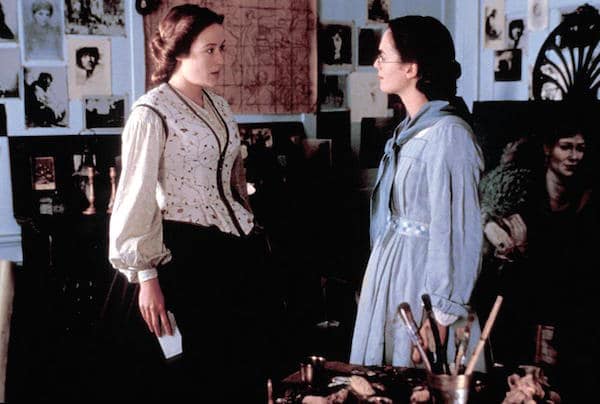
Blanche Glover’s paintings use colors and historical designs that typified Pre-Raph work.

Compare the setting and figures with this Rossetti painting:

Christabel LaMotte is her lover’s muse, showing up in this unfinished painting. Christabel is dressed in a renaissance-ish gown with her hair flowing free as Pre-Raph artist models would do.

Compare that center painting in the film with this unfinished Rossetti work:

More Pre-Raph art can be seen around their home:

And while she often appears buttoned-up like a standard mid-Victorian lady, Christabel dabbles in artistic dress.

Her robe reminds me of another Rossetti painting:

Effie Gray (2014)
OK, finally some frock flicks about the actual Pre-Raphaelites, but starting with one that doesn’t have as much of a Pre-Raphaelite look, IMO. Euphemia “Effie” Gray was unhappily married to art critic John Ruskin, and he was very influential to the Pre-Raphaelite Brotherhood. Effie (Dakota Fanning) has swirly kinda Pre-Raph hair and wearing so much of it down at dinner would be an artsy, rebellious choice in this period.

Pre-Raph art is better represented in the background of this movie.

On the left is a painting by Collins, who had met the Brotherhood in 1850.

On the right is a painting by Millais, who fell in love with Effie. She got an annulment to her unconsummated marriage with Ruskin, so she and Millais could marry in 1855.

In her movie review, Kendra gave this hair “a pass” because Effie’s in Venice and, y’know, the whole Pre-Raphaelite thing.
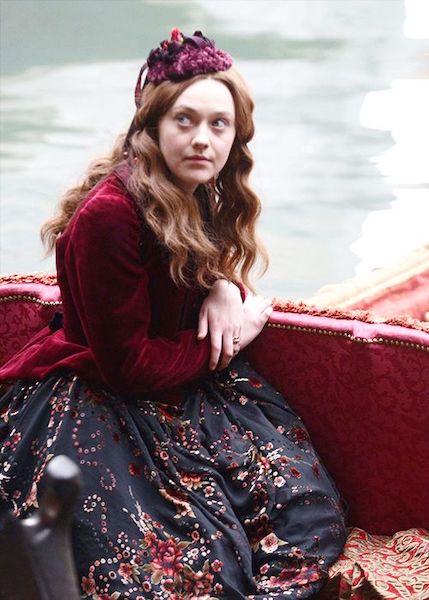
I too can stretch an allusion, so maybe the flowers on her hat are emblematic of the flowers in her hair in this painting?

Then there’s the painter John Everett Millais (Tom Sturridge) himself.

Check out what’s on his easel:

The Love School (1975)
And now, the first big BBC production all about the Pre-Raphaelite Brotherhood — it’s hard to find, not on streaming and only on DVD. I’ve watched some of it via questionable websites and found lots of screenshots, and this looks like a pretty fantastic representation of the lives of the main artists of the group. The six-part series features a TON of their artwork too, beginning with John Everett Millais (Peter Egan) in the studio working on “Cymon and Iphigenia.”

Compare the live models to:

The creation of Millais’ iconic “Ophelia” is shown too, with Elizabeth Siddal (Patricia Quinn) laying in a tub for so long she gets pneumonia.

William Holman Hunt’s painting is shown in the background while he (Bernard Lloyd) and Annie Miller (Sheila White) get it on.


Miller was a frequent model for Hunt’s work, and she puts up with his posing.


Millais takes to the outdoors with paintings like “The Blind Girl.”


But as Millais turns to more traditional portraiture to support his new family with Effie, others of the Brotherhood like Hunt are shown going deep with their historical works.

Queen Victoria actually admires this one!

There’s so much more Pre-Raph art shown in this series, but I’ve got to stop somewhere, and Dante Gabriel Rossetti (Ben Kingsley) is a good spot. After Lizzie Siddal’s death, Jane Morris (Kika Markham) becomes his muse. He’s shown photographing Jane, although it was John Robert Parsons who did so.

Compare with:

Desperate Romantics (2009)
Folks these days might know the Pre-Raphaelite Brotherhood best from this more-recent BBC series. It’s more of a period romp than the ’70s version and much less detailed about the actual art. And yet it’s also 6 hours long. If I had a better version of the first one, it’d be cool to do a more in-depth side-by-side comparison, but hey, this is just supposed to be a Top 5 Friday ;)
Early on, William Holman Hunt (Rafe Spall), John Everett Millais (Samuel Barnett), and Dante Gabriel Rossetti (Aidan Turner) show off their paintings to each other.

Left to right, they are:


The scene where Elizabeth Siddal (Amy Manson) poses in a freezing tub for Millais’ “Ophelia” painting is recreated again.

Rossetti gets a lot of screentime in this series, including at the easel.

Along with the model (who Rossetti found in a bar the night before) posing in costume:

For the resultant painting:

Hunt displays “The Awakening Conscience” with his model Annie Miller (Jennie Jacques) at his side, describing the woman in the painting as a “sad, humiliated, helpless victim.” Miller justifiably slaps him for that.

Later, Hunt is seen painting “The Light of the World,” in front of which he and Miller have another fiesty scene.

And after returning from the Holy Land, Hunt exhibits this new painting:


I like how this series shows Lizzie Siddal as an artist in her own right, not just a Pre-Raphaelite muse. She’s shown sketching and painting in several episodes.

On her easel is this sketch:

At another point, John Ruskin (Tom Hollander) visits Rossetti at the studio but is distracted by Siddal’s painting.

Which appears to be this:

Do you enjoy Pre-Raphaelite art? Are there more movies and TV shows about the PRB worth watching?


Lots of great work was put into this piece.
Brava!
Thanks! I really went down a rabbit-hole :)
I’m a huge Pre-Raphaelite fan as well as the later artists who were inspired by them like Burne-Jones, William Morris and Simeon Solomon. I thought Greg Wise was way too old for Ruskin in Effie Gray. There was only a ten year age difference between the two. I have seen Desperate Romantics which annoyed me in some ways but since it is so hard to find The Love School. And Possession, both the book and the movie, are favorites of mine.
I kind of liked “Effie Gray”–“Possession” not so much (would have made a better posh TV series than a movie)–and would love to see “Desperate Romantics.” The costumes look pretty great for these films Trystan has so carefully brought together. Note: A few years ago, I all but stumbled on Kelmscott House, by the Thames path in S.W. London (Hammersmith), an exquisite little collection of William Morris’s work: https://williammorrissociety.org/our-museum/
One day I will visit Kelmscott House!
Yes, very much appreciated. My husband is a big fan of the PRB and is interested in finding some of the films.
I misread that as “a big fan of PBR” and didn’t know what your husband’s love of Pabst Blue Ribbon had to do with this.
The Doll Factory is a thriller about a fictional PR artist, based on Elizabeth Macneal’s novel of the same name, YMMV.
I’ve heard that but unfortunately I can’t find The Doll Factory on streaming in the US :(
It’s available to watch on the Internet Archive. https://archive.org/details/the-doll-factory/The-Doll-Factory-S01E01.mp4
One of my favorite paintings is Waterhouse’s “Lady of Shalott” – I shall go sit in front of her for a long time when I go to London in a few months. Other than her, I can take or leave Pre-Raph art but reading about these suggestions gives me food for thought.
The only one of these movies/series I’ve seen is “Possession.” Jeremy Northam and Aaron Eckhart are two of my favorite actors and while I don’t think the movie is all that great, the last scene with Randolph Ash and the little girl is so very moving.
There was also Dante’s Inferno (1967 film) a Ken Russell film (shown as part of Omnibus on TV). I remember it as though a dream since it shows Rossetti (played by Oliver Reed) digging up Lizzie Siddal’s grave. I saw it when I was a young teens who knew nothing about the Pre-Raphaelites (though I love them now- it’s the colors I think!). But it stuck to me and I’ve never forgotten it. I saw a number of those b&w British TV films at that time and they made an immense impression on me.
I found a clip of that one when I was writing about Ken Russell, & yeah I’d be interested to see the whole thing.
So much to love here. This was my wheelhouse, as I focused on 19th century British Art in grad school. I’ve got a whole lot of books stacked to my right that were part of my research – can’t bear to put them away. I feel as if I need to see Ophelia just for the costuming. Never heard of it, but it looks amazing. Possession is one of my favorite films, especially for the costumes worn by Jennifer Ehle. Not so much into the modern half of the story, but they nailed the mid 19th century. I saw Desperate Romantics – even would show a clip of Aidan Turner reading Rossetti’s poetry to my students – but there was soooo much wrong with the story. Romp is being polite. The business with Lizzie’s grave – it didn’t quite happen like that. Rossetti wasn’t there; he sent his agent, but it doesn’t make for good television or conflating them with punk rockers. I have to say Effie Gray was one of the most depressing films I’ve ever seen. While the production design and cinematography were beautiful, I read further, and I can no longer read John Ruskin’s writings due to his weird proclivities, champion of the PRB or not. I think I’m going to have to try to find The Love School on DVD. The stills look pretty good. BTW, the most beautiful advert I’ve ever seen was produced by the Tate Britain for their Edward Burne-Jones exhibit. I was over there on a research trip and missed it by a week; didn’t have the right contacts to get it, but this short advert for the exhibit is beautiful. Imagine it in full resolution on your big screen hotel room tv… https://fb.watch/JaUfjSaJky/
Wow that ad really is beautiful! Thanks :)
Golly! That is lush – shame about the typewritten book they’re reading right at the beginning. Or is it all meant to be anachronistic?
That was a fabulous exhibition. Me and my friend Nigel got thrown out because we spent so long looking at everything that we got to the final room at closing time and were sprinting round trying to look at everything when they finally said that we HAD to leave.
I’m so jealous you got to see it! I’m betting the book was one of those things where the people who made the props/budget decision figured no one would note the discrepancy between what looks like a typed page and a movement that produced the Kelmscott Press. I have sat through those kinds of meetings insisting that people will notice the details that are off and the person with the power says, “oh no one will care.” Yet here we are…
Love this!
There’s also a really good adaptation of Tennyson’s “The Lady of Shalott”. Working within its budget, it does a decent job of capturing that Pre-Raphaelite feeling. It’s made by
CrowsEyeProductions, who’ve done some interesting historical work.
Last month I purchased for my birthday an all region DVD player for about $30.00 AND a DVD of the Love School, which was semi-improved by the vendor (can be contacted at: service.us@mplusl.de) but still Region 2. It was amazing and puts “Desperate Romantics” to the shade. First, it’s longer. Second, it covers more artists, including William Morris (my fav – I have Morris Wallpaper in one of my bathrooms) and Edward Burne-Jones. Third, I studied 19th C British art in grad school, and I’m pleased to report that the actors closely resemble the originals (Kingsley as Rosetti really stood out as much more predatory that Turner). Finally, whoever was in charge of the settings knew a great deal about the art of the period — much of the paintings are seen in progress, so the drawings, paintings 1/2 done and their size match the originals. And the set dressing echoed known paintings and photographs of the time — yes, the photo session of Janey Morris for Rosetti is spot on in both productions, but Rosetti’s and Lizzie’s lodging in Battersea closely echo the Whistler portrait of Lizzie by the Thames. A total treat. Now to find Dante’s Inferno.
Yes, in the USA I used a dvd reader for the computer and that worked with the PAL dvd.