

Don’t hate me, but for all that I am a raging Francophile, I find 19th-century French literature totally depressing. So I have never read Alexandre Dumas’s classic novel; I watched the 2002 adaptation, but all I remember is extreme boredom. So it may come as a surprise when I say that I watched the recent French feature film adaptation of The Count of Monte-Cristo (2024) and I was entertained! And on a transatlantic flight to boot! (But I can’t tell you thing one about how close it stays to the source material, so buyer beware).
Set in the 1810s and 1830s, the story is about a poor young man (Edmond) who is falsely accused and imprisoned for over a decade. While in prison, he befriends another prisoner who tells him where a hidden treasure is. Edmond escapes, finds the treasure, and then enters Parisian society as the fictional “Count of Monte-Cristo” where he seeks revenge on those who betrayed him, including the woman he was supposed to marry.
(Side note, apparently there was also a TV miniseries adaptation of this story in 2024. Don’t get confused!)
Overall, the performances are strong, the pacing is good, and the costumes — designed by Thierry Delettre (Flashback, The Three Musketeers: d’Artagnan) — supported the plot and characters and were mostly true to the period (with some inevitable quibbles).
Delettre won a César (the French Oscar) for his designs, which were made at Peris Costumes Group in Lisbon (see their unfortunately brief “This is how we made the costumes for The Count of Monte Cristo starring Pierre Niney“). According to lead actor Pierre Niney (Edmond), Delettre sourced fabrics from around the world and even used some antique pieces (Pierre Niney en «Comte de Monte-Cristo»: «On voulait embrasser la noirceur et le côté tragique du roman»).
Before I get into the costumes in-depth, a couple of random thoughts:


Now, let’s look at several of the major characters and their costumes:
Edmond Dantès’s Costumes in The Count of Monte-Cristo
Edmond starts out in 1815 as a first mate on a merchant ship. He shows back up in his hometown in or outside Marseille dressed for work:

And because all is idyllic, he hangs with his bestie and love interest in super casual, loose cotton clothes:

For his wedding, Edmond wears a pale green linen? suit, which suits the southern French weather. I thought the embroidered waistcoat was EXCELLENT, and I swear it’s either an original or a copy of one:

If I cared enough about menswear/this period, I feel like I could find something 99% similar, but I don’t, so here’s something 75%:

Fast forward to the 1830s and Edmond is now the “count of Monte-Cristo,” all evil and revenge-y, and of course his wardrobe goes black black black:


Mercédès’s Costumes in The Count of Monte-Cristo
Mercédès begins as the ingenue love interest. She’s in love with a man below her station, so she’s clearly down with being casual and that plus the southern setting gives us several moments of her implausibly running around in her corset:


Even at a family meal, her hair is down (with the requisite two bobby pins keeping it out of her eyes). Yes yes, she’s a child of nature (eyeroll).

For her wedding, she finally gets it together in a pretty sheer overgown with standing, Renaissance revival collar:


Fast forward to the 1830s, and she’s married to the wrong guy and living in Paris, so her wardrobe has to go as dark as her soul. Nonetheless, they manage to give her some nice pops in her wardrobe:


But here’s where I start quibbling, because her sleeves — THE defining characteristic of women’s 1830s dress — vary between early-to-mid-decade and late decade:


According to the book, it’s 1838; the film is a little more complicated in terms of title cards, implying that it’s more like 1834 (but there’s math involved so don’t trust me). This dress has post-1836 sleeves, with a bit of sheer fullness on the forearm:


But her black beaded dress (above) and this printed cotton are more 1835-or-earlier:


Haydée’s Costumes in The Count of Monte-Cristo
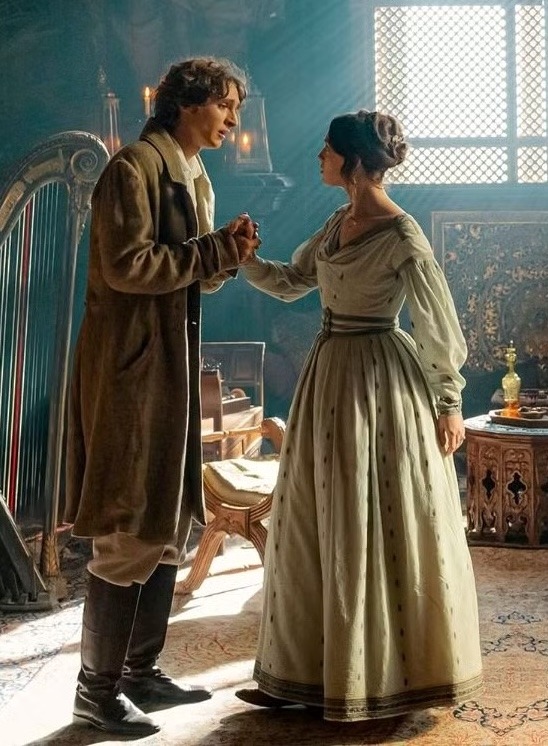
Haydée is Greek according to the film (Albanian in the novel), so her wardrobe has a definite Eastern European/Ottoman element to it (Greece was under Ottoman control until the 1820s, and all of Eastern Europe had historic cultural ties to the Ottoman Empire, which often manifested in dress. Want to know more? Check out my book on turquerie!). According to an interview with actress Anamaria Vartolomei (The Royal Exchange), designer Delettre:
“Scavenges from all over the world, some fabrics came from India, a garment I wear is inspired by the traditional Romanian blouse. There is a great ethnic and cultural richness in the costumes that perfectly fits with my character. We don’t really know where she comes from, who she is, which lands she has traversed… I love this mystery” (The Count of Monte-Cristo press pack).
She starts off in light colors, and even her more typically French clothing has eastern/Ottoman design elements:


Which was, of course, a very fashionable thing at this time — first, to make dresses from shawls:

And then to use similar Indian and Middle Eastern motifs for gowns:

This one is similar and screams sari (in a good way!):

She has a rare more-Western-style evening dress:

In the privacy of her home, she wears even more overtly eastern clothing:


And her dress for the final scene goes dark but keeps those Ottoman references:


And a Few Minor Characters’ Costumes in The Count of Monte-Cristo
Angèle gets a simple dress for 1815 with her hair mostly down, but then she’s just been rescued from a shipwreck:

Despite being rich, Eugènie gets a super fugly wardrobe that I guess is referencing her closeted sexuality?


And Fernan goes through a similar journey to Edmond and Mercédès, starting in light colors and fabrics, and ending much darker and sadder:


Have you seen The Count of Monte-Cristo (2024)? What did you think?
Find this frock flick at:


Maybe the film was not as “boring” as the book because many aspects were very much simplified. Now Edmond Dantes is a great swimmer and doesn’t need any help to cross the sea. He is the best sailor in the world, which helped him to sail alone (!) a ship with two masts although you would normaly need a crew. ;-) We thought that the movie was entertaining and somehow strange but not as much as their version of The Three Musketiers.
Of course 19th century French literature is depressing – France had a fairly nasty Nineteenth century (Blame the Bonapartes: after all, ‘Perfidious Albion’ comes pre-blamed).
I look forward to finding this. Hope it is better than the horrible Jim Cavizell version that so truncated and altered the story. I actually read both The Count of Monte Cristo and Les Miserable in my younger years (don’t we all have those?) and enjoyed both. I understand for some they are a slog but I found them compelling. So I look forward to better renditions of both. Good watching to all.
I’m hoping that the miniseries with Sam Claflin comes out in the US soon. I thought this version was fine – some choices in the adaptation I liked, some I didn’t. Can’t stand the Gerard Depardieu version, though.
You forgot to add the Patreon tag.
The Count of Monte-Cristo is actually one of my favorite books (eventhough some parts about it have not aged well), so I recommend giving it a try, if you ever feel like it. I don’t find it that depressing and compared to Russian literature, it’s straight-up a light-hearted book. I have little experience with movie adaptations of The Count of Monte-Cristo, but I think that the easiest way to make the story boring is to neglect the intricate web that the different characters with their individual personalities and goals form. I’d even argue that Count of Monte-Cristo is not the most interesting part of The Count of Monte-Cristo, if that makes sense.