

Fried Green Tomatoes (1991) — adapted from a novel — was a huge hit back in the early 1990s. While it’s by no means perfect, its interconnected modern- and historical-set stories are satisfying, and the 1920s-30s costuming is gorgeous in an everyday way. In the modern story, Kathy Bates plays a woman struggling with middle-aged life who meets an elderly woman (Jessica Tandy) in a retirement home. Tandy’s character tells stories about her family, focusing on Idgie (Mary Stuart Masterson) and her “best friend” Ruth (Mary Louise Parker). Those stories inspire Bates’s character to change her life, to comic and heartfelt effect.
The costumes for this film were designed by Elizabeth McBride (Driving Miss Daisy, The Shawshank Redemption), who sadly died young from cancer. Unfortunately I’m unable to find any interviews with her about this film; an article in the LA Times did offer this tidbit:
“While she designed Idgie’s and Ruth’s clothes, McBride rented many of the other period costumes, including denim overalls for the men and Sipsey’s housedresses, from 15 rental houses across the country, including Western Costume in Los Angeles.”
Obviously we’ll focus here on the historical costumes, which begin in the very early 1920s, when Ruth is a teenager and Idgie a child. Idgie’s older sister is getting married; Ruth is visiting and in love with Idgie’s older brother (Chris O’Donnell). Because the story is set in the South, there’s a ton of great sheer dresses and hats worn — Ruth’s first ensemble is my platonic ideal of this era:
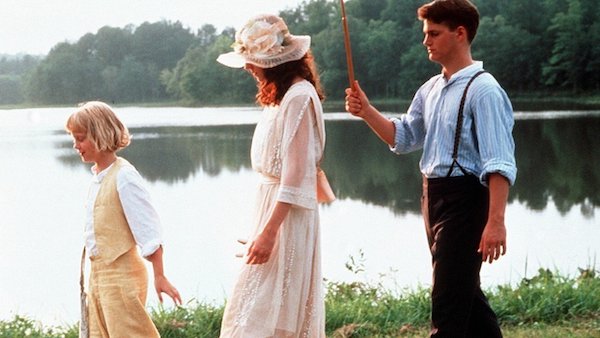


This sheer, layered “lingerie dress” style with its square neckline formed by vertical pieces and natural waistline was SUPER chic in the late 1910s and early 1920s:

The other character with an interesting wardrobe is Idgie’s mother, for whom it will be helpful to look at a fashion timeline from the mid-1910s through the early 1920s:

Because while her dress is also very early ’20s, to my mind it looks a little more mid-1910s:


It just pings this kind of thing in my brain:


Idgie’s sister is getting married; I THINK she’s in her camisole and slip here?


Meanwhile, maid/servant Sipsey (Cicely Tyson) adds an apron for work:

Tragedy strikes, and we only get some shoulders-up shots of the resulting funeral. Mom again seems a little more Edwardian to me:

Of course, there were a range of hat sizes popular in the era:

Ruth sticks with the super wide-brimmed hats popular in this era:


Flash forward to the early 1930s, and mom is still wearing drop-waisted 1920s-style dresses:

Ruth’s first dress could could pass for 1920s:

But the rest of her wardrobe has the curvy bias cut that was new to the decade.


It’s cut similarly to these:


She also sticks with the wider-brimmed hats:

After Ruth gets married, she goes floral:

I’m not going to catalog all her looks, but I spent a lot of time wondering if these were the same dresses with and without the collar?


For the Big Trial that’s the climax of the film, Ruth goes black-and-white polka dots:

And even Idgie has to silk or rayon it up — she spends most of the film in cutoff shorts and barely-there gender-neutral shirts — but I THINK she’s in pants, which is very fashion-forward for the 1930s South!

Pants for women were JUST coming into style, mostly worn for beachwear:

Do you have fond memories of Fried Green Tomatoes‘ costumes?
Find this frock flick at:


I know it’s not period, but my favourite outfit is Cathy Bates’ big TOWANDA! moment when she bashes the car in the supermarket parking lot. I might start wearing that myself.
“Face it girls, I’m older and I have more insurance.”