

Kendra has her 18th-Century Quest to watch every movie ever set in the 18th century, and while I’m not so much on a mission, it’s undoubtedly true that I will gladly sit down and watch anything set in the 16th century. It’s my happy place! Even if the costumes and/or story don’t measure up. Thus, I finally watched all of The Princess of Montpensier (2010), which Kendra already deemed as “good but not great,” plus we’ve used images from this flick for occasional snarking. Hey, I knew what I was getting into, and yet I persevered because the lure of this era for me is strong. Overall the costumes are a solid B, bordering on A- grade, but the look is brought down by sloppy hairstyling and headgear (or lack thereof). Being me, I can’t leave it at that, and thus screecaps aplenty…
Costume designer Caroline de Vivaise won a César Award (France’s Academy Award equivalent) for the costumes, and she’s done a fair amount of lovely period work in addition to this, such as Time Regained aka Le Temps Retrouvé (1999) and The Cat’s Meow (2001). However those were set much more recently, from the late 19th century to the 1920s. The director for this film, Bertrand Tavernier, had specific ideas and wanted that dreaded stripped-down “casual” look for the 1560s costumes. In an interview with L’Express, Tavernier said (using Google Translate)
“Aesthetically, it was essential to avoid the historical reenactment aspect. That’s why I refused to base myself on paintings. In the paintings, people were specially dressed for the occasion. The result didn’t reflect reality. For that reason, I loved La Reine Margot, by Patrice Chéreau, where the heroes were most often in shirts and not in ceremonial outfits. Trying to imitate period ceremonies is comparable to someone who would want to film peasants in the fields based on their wedding photos! That’s why, here, no one wears ruffs, those collars supposedly characteristic of the 16th century.”
While yes, I agree to a certain extent that paintings do reflect the beauty ideal of a historical period, along with a measure of artistic license, and thus you could say they’re not a perfect reflection of reality. BUT when there’s a massive number of similar images of a garment like RUFFS worn by people all over the social strata, plus there are actual, physical, surviving RUFFS, their lace trims, and their supporting devices, all documentable to the 16th century, well, I think it’s pretty safe to say RUFFS WERE CHARACTERISTIC OF THE 16TH CENTURY. There’s nothing “supposedly” about it!
And for what it’s worth, La Reine Margot, aka Queen Margot (1994), did use ruffs on many characters throughout that film! The use was specific to the character and situation, but it was there, FFS Tavernier. The main characters in The Princess of Montpensier aren’t “peasants in the fields” — the story revolves around a PRINCESS, it’s right there in the title! Everyone is landed gentry and nobility with shittons of money and power. They’d dress in what was high fashion for the period, and the ruff wasn’t “ceremonial,” it was fashion, baby, look it up. Ugh, I can’t with these directors and their “vision” when it just means “strip a historical period down to bare bones because the past looks so weird.” Don’t do a historical story if you can’t deal with the fucking history, fella.
Oh wait, didn’t I say I liked the costumes in this movie? Lol, yeah, I generally do, but I still gotta rant about dumbass directors with their anti-frock bullshit! It’s what we do here.
I’ll note some specific issues with the lack of ruffs, hats, and period hairstyles when I discuss each character’s costumes. Because those are the big issues throughout the film. If those don’t bother you, then you’ll be fine. Of course, if you’re like me, you’ll be noticing every omission. Let’s get to it.
Marie’s Costumes in The Princess of Montpensier
The main character, Marie de Montpensier (played by Mélanie Thierry), gets the most costume changes, of course. She starts as a petulant young miss, in love with floppy-haired Henri de Guise. They flirt, and she hikes her skirts unnecessarily.

She wears this orange gown for the early scenes, where her father tells her she can’t marry Guise and instead has to marry Montpensier. That’s actually why she’s crying; her mother’s telling her to suck it up, buttercup, this is how marriages of the nobility work in the 16th century. Marie should be wearing a smock under her gown, and the fit should be better so the sleeve doesn’t fall off, even though her father roughed her up a bit.

Ah, but let’s take a look at her totally 2010’s side part! Obviously she owns no hairpins, but this side-parted hair screams “modern!” and lazy and IDGAF.

But even though she lacks accessories and a hairstyle, Marie’s orange gown is reasonably of the period. The silhouette and materials look right.

For her wedding to Philippe de Montpensier, Marie wears a printed-velvet loose gown in purple-ish and yellow tones.

This gown is spot-on historically accurate in style, and I wouldn’t be surprised if the costume designer referenced Patterns of Fashion. Just look:

Her headgear, however, is a weird concoction that bears only the slightest relationship to what was worn in the period. Am I supposed to be happy that she has a head covering? It’s one of the very few she wears in the film.

Not impressed. Here’s an actual French hood with that lovely point in the front, in pink even.

For the wedding feast, Marie continues to wear the stupid hat, and we can see the dress that was under the loose gown. It’s in the same color tones as the loose gown and the same basic style as her previous orange gown. I like that there’s an attempt at a lace smock/partlet added.

For travel to her new home, Marie wears an elegant dark blue/grey velvet overgown with fur cuffs. Nice tailoring, lovely materials, shitty modern hair.

Put a pin in that terrible hat, I’ll get to it later.

I appreciate how the costumer designer created a mix-and-match wardrobe for Marie. The overgowns are worn with various gowns, and some of the partlet/collar pieces are worn with different gowns. Like this good quality lace collar here.

A different orange gown, here in two patterned fabrics, with the lace neckpiece she wore at her wedding feast, now worn while Marie is being tutored by Chabannes while her husband is off fighting in the Wars of Religion. Also, here’s a better view of the extra-shitty attempt at a hairstyle! Sorry, no, a little pile of random braids is NOT historically accurate for anything other than, IDK, Coachella, and it does nothing but say this character half-asses things.

Need I remind anyone about actual 1560s French upper-class women’s hair?

Another of Marie’s fancy dresses for studying, this one in yellow and green with an embroidered (?) partlet. I wish these two gowns were shown in more than sitting-at-a-desk scenes because they hint at looking really great, both aesthetically and historically.

Another loose gown that Marie has is this brown velvet, and she wears it a lot over everything, including her very first orange gown.

Though I wonder if that’s a panne velvet? It looks rather shiny in some scenes. It’s printed in an random floral, which is distracting to me because 16th-century prints are more symmetrical.

She also wears this brown loose gown over a silvery damask doublet outfit. Ooo, shocking, she actually puts her hair UP for a change.

While the brown one is sleeveless, it reminds me of these period versions:

And here’s a sleeveless extant one from the early 17th-century, but the style was worn earlier too.

This behind-the-scenes shot shows that silvery doublet outfit. Those fabrics are YUMMY and really evoke the period.

The hat offends me. It’s a 1950s pillbox hat. WHY? She’ll wear the exact same thing in another color later in the movie. I do not understand this.
One outfit that isn’t mix-and-matched is this orange and pink gown she wears while boating, where she’s seen by the Duc d’Anjou who just happens to be conveniently riding nearby with Marie’s former boyfriend, Henri de Guise.
Marie demonstrates exactly why you’d want some fucking hairpins at a time like this:

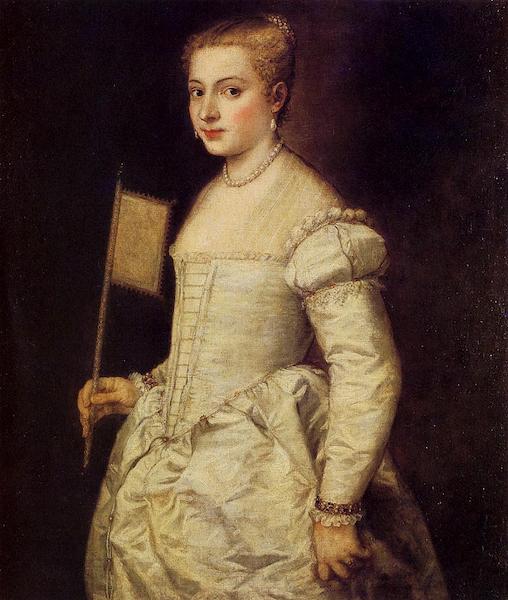
Her dress is pretty, yet also a departure from her other costumes. Note the ladder-lacing up the front — you can even see slight stress wrinkles across the front bodice from this style of lacing. It’s a fashion that was most common in 16th-century Italian states like Venice.

A classic version of this style of gown can be seen in Titian’s portrait:
There’s one undressing scene that shows Marie is wearing a reasonably historically accurate attempt at 16th-century stays (corset).

It’s got that basic conical shape.

But she’s wearing the stays with a boho tank top, not a historical smock.

Should be something like this, doesn’t need the embroidery but sleeves would be nice.

Her best gown is worn at court — she wears a deep blue outfit with a satin overskirt and sleeves and a velvet bodice and loose gown. Her petticoat is in a gold and blue brocade, and she wears a highly decorated gold partlet. She even has some good jewelry and a little jeweled cap on her hair, which is swept back in a modern updo, still with that side part.

I really do like this costume — it’s beautiful all over, great use of materials, the colors are perfect on her, it just looks elegant. I’m annoyed by the off-center line of trim on the bodice (why???), and the blue satin buttons on the loose gown look very ‘modern bridesmaid.’ Those are my only nitpicks though.


After a whole bunch of shenanigans at court that don’t go her way, Marie kinda tells her husband to go fuck himself, then she rides off, while wearing this excellent green riding habit. Love the tone-on-tone green chevron effect on the bodice! Also, the one decent hat in the whole movie!

Full view as she rides away.

Great bodice, I’ll give the hair a pass this time. It should be covered with a coif, but at least this is a legit braid, not those weird little attempts previously.

Marie gets bad news wearing this super-dark blue doublet outfit (almost looks black onscreen). THIS FUCKING HAT. What the hell? You just had a decent one, then you revert to stupid shit like this??? Go home, movie, you’re drunk.

If I were extremely generous, I’d suggest someone was trying to recreate one of these types of caps:

But, if so, it’s a miserable fail. For starters, these are soft linen caps and the structure comes from starch and the hairstyle underneath.
Moving on.
The doublet is nicely constructed, and the outfit is coordinated with a deep blue and gold damask petticoat.

This is the first and only time Marie wears ruffs! A proper suit of ruffs even, meaning she has one at neck and at the wrists, which was perfectly proper among the elite (and notice in that broadside above, even middling-class women wore a suit of ruffs, they’d just be made of plain linen).

These ruffs appear to be edged in gold — not uncommon for her level of wealth and status.

In a fit of passion, Marie rides out one last time, throwing on her wedding outfit, both the loose gown and the dress worn at her wedding feast (there’s some symbolism here).

She does add a couple new elements to the wedding outfit, and each are terrible in their own right.

We’ve said it before, and we’ll say it again: partlets are not kicky shrugs. Not this:

If a partlet is worn over a gown, it’s more like this (yes, this is two decades earlier, but the principle remains the same):

And now the hat. This is the white version of the shitty black version above. Did they literally only have budget to make one new hat for the green riding outfit, so for the others, they just grabbed some 1950s rental stock? UGH.

It doesn’t have to be expensive and it’s not that difficult — just make a little flat cap, like this (I can bang one of these out in an hour, and I’m a slow seamstress; call me next time, I even speak shitty enough French to make it work!):

OK, I said I’d get to it, let’s talk about Marie’s hair. Enjoy this close up of the tragedy:

If they wanted to do uncovered braids for a “casual” look at home, first put the rest of the damn hair up, and then really go for if and make her look pretty. Check out this lovely Italian hairstyle — there’s no hat, instead she gets a sassy little flower. Not fussy and formal but perfectly period.

At court, Marie makes a little effort with all of her hair up in braids and some kind of decorative cap-like thing sitting partly on top of her hair.

But really, curl the front and slap some jewels on there, you’ve got the goods!
Men’s Costumes in The Princess of Montpensier
I love men’s 16th-century costumes almost as much as women’s, and this movie doesn’t disappoint in that realm — other than the same complaints wrt ruffs and hair. Marie’s husband, Philippe de Montpensier (Grégoire Leprince-Ringuet), mostly wears this green suit throughout the film, and it’s a good one.

Like too many men in 16th-cenury frock flicks, he’s incapable of fastening the top part of his doublet. We’ll be addressing that next Snark Week in more detail! His cloak is pretty cool though, especially with all those buttons, which are decorative and a good example of conspicuous consumption.

At court, Philippe wears basically the same suit in fancier fabrics — green velvet and silk. Still looks great! Even better because he managed to button it up!

Lots of appropriate accessories — fancy man bag, fancy sword belt. Not quite ruffs but at least there’s a touch of ruffled shirt at his neck and wrists.


Compares favorably to period portraits:

François de Chabannes (Lambert Wilson) is Philippe’s bestie, so he makes Chabannes the tutor for Marie. I wouldn’t usually mention his costume except I found an image of it on display, and this is another nicely made suit.


Philippe’s father, the Duc de Montpensier (Michel Vuillermoz), is an oaf but one scene shows him wearing an excellent “embroidered” smock.

I’m guessing that’s a printed fabric because no way that whole length is embroidered, even by machine. There does seem to be an edge treatment on the collar (which could be done by either hand or machine), and this furthers the historical style.

Gotta be inspired by extant versions like these:

When Anjou and Guise find Marie boating on the lake, they come back to her place for dinner with Phillipe and Chabannes. Notice how all the men wear flat white collars — that’s a style that was just coming in at the 1560s and wouldn’t be super fashionable until the early 17th century.

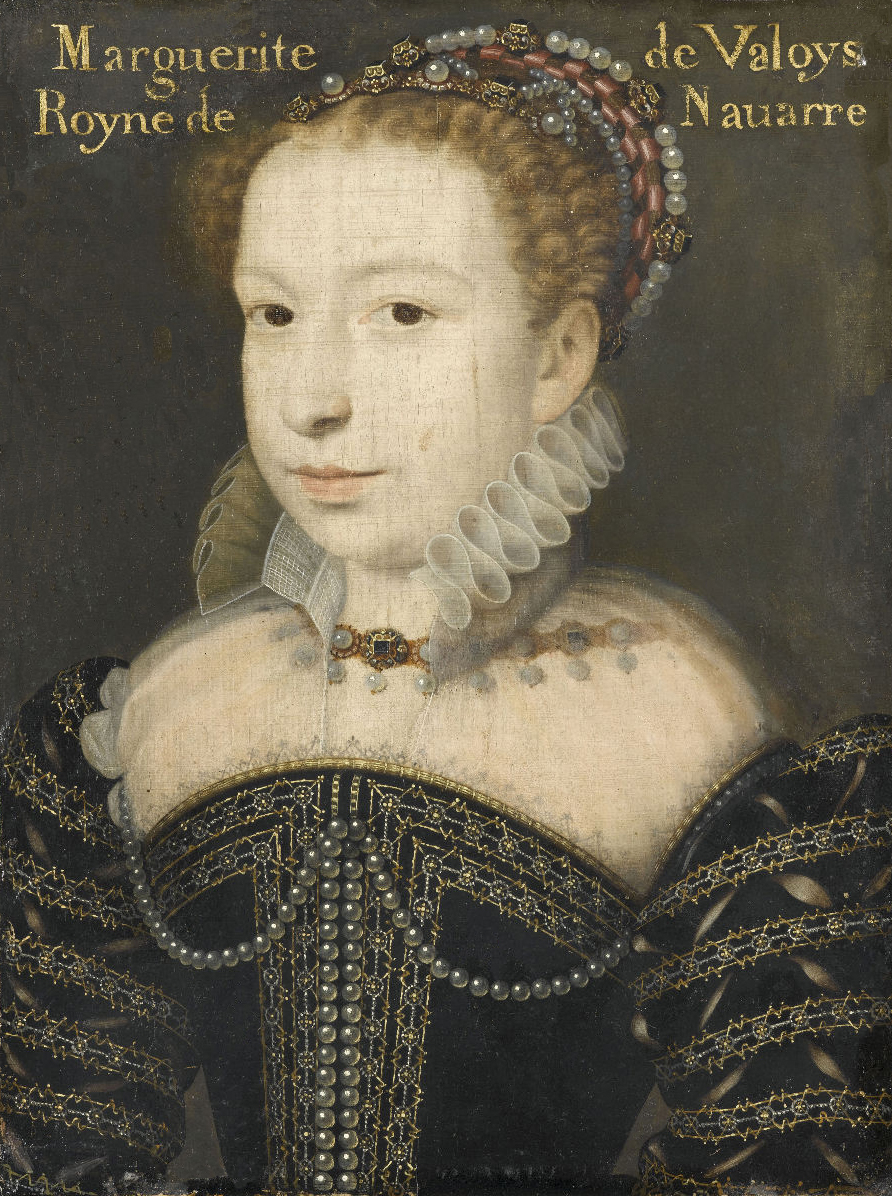
I’ve said it before and I’ll say it again: ruffs were high fashion! Everyone wore them. You wore a ruff or you wanted to wear a ruff in the 16th century. BABIES wore ruffs.

Oddly enough, Marie’s ex-boyfriend, Henri de Guise (Gaspard Ulliel), got the memo and is wearing a bit of ruffled shirt in this scene!

However, his floppy “I’m your romance novel heartthrob” long hair isn’t historically accurate. Compare with an image of the actual Henri:

Let’s check out the other Henri, the Duc d’Anjou (Raphaël Personnaz), who as a member of the royal family, wears fancy garb all the time. Love these lux burgundies, in a tonal stripe and floral damask. He even has a bit of ruffled shirt collar.

But he’s a far cry from the historical Anjou:

Better view of the outfit, appropriately rich.

Kinda gives this vibe, although I believe Leicester’s jerkin was meant to be leather in this portrait.

Anjou really rocks the guyliner. Sexy, just not historically accurate. His facial hair, along with most of the men’s in this movie, is also far too scruffy for the period.

I don’t understand this doublet — that front contrast insert in beige/tan, what’s up with that? I’ve never seen anything like it in 16th-century menswear. Looks like 19th-century womenswear. The double row of center-front buttons, then two rows of decorative buttons is all weird too. Anjou’s necklace is too short and looks like it’s made of Chinese coins. Nice bag and belt though.

Other than the odd contrasting panel, this suit is again giving Leicester vibes.

Other Costumes in The Princess of Montpensier
Early on, at Marie and Philippe’s wedding, the extras show that hairpins and hats are possible in this film! Just not so much for the leading characters.

Her hair isn’t perfect for the 1560s, but it’s a billion times better than Marie’s. These braids are 100% up, symmetrical, and covered by some sort of cap in the back, all valid points for the time period.
These randos in the background have correct ruffs and hats, and the men have much more 16th-century beards and hair than the main characters.

The Marquise of Mézières (Florence Thomassin), Marie’s mom, is trying to channel Helen Mirren in Elizabeth I (2005) and wearing costumes recycled from that series.

This greenish loose gown trimmed in fur is worn open here at the wedding, but was worn closed at the neck with a ruff in the earlier miniseries.

At the wedding feast, the Marquise wears another of Elizabeth I’s gowns, and it’s even more open (probably over the same dress; note the neckline). I wonder if there was a fit issue?

Just has a different collar popped over the gown’s collar in the earlier production.

And I suspect a random character seen at court is wearing possibly the same or a different overgown from Elizabeth I here.

Is it this one? Again, Helen Mirren’s version has a gold collar added on top.

The same court rando is seen full-length on the far right, next to the table.

The court scenes are nicely filed with good-looking rented/recycled 16th-century garb. I feel like I’ve seen this fella’s green suit before.

And that white-and-green patterned gown in the center looks familiar, but I can’t place from where (and can’t find it on Recycled Movie Costumes).

Lots of decent headgear and hairstyles in these court scenes too. We definitely have leading character syndrome going on.

Marie is presented to queen regent Catherine de Médicis (Evelina Meghnagi), who’s surrounded by some of her younger children.

As I said before, yeah, yeah, I should be pleased that she isn’t wearing a stupid hat, but all that gold stuff around her neck looks like she’s trying to be Mr. T.

Doesn’t quite measure up to the real thing:

Henri de Guise’s sister, Catherine (Judith Chemla), shows up at court and is about to get married off to the Duc de Montpensier. Yes, they joke about Philippe having to call her ‘mother.’ She’s also pals with Marie, and they hang out at the masquerade ball that night.

Catherine’s dress is decent, not spectacular. The trim is clunky, but at least it gives the idea of wealth. The super deep “V” front is a bit early for a stomacher and actually reminds me more of this Italian style.

At the masked ball, Anjou and his fellas all dress identically in orientalist garb and masks (and apparently Anjou did everyone’s eyeliner). Do the identical costumes cause problems? You bet your Shakespearean cliché they do.


For this ball, the court ladies’ costumes are all flimsy Grecian gowns (they aren’t identical though).

Oh look, a rando with a really elaborate hairstyle! Why’d she get that fancy ‘do?

Last few costumes worth mentioning — Marie’s maid has a reasonably accurate jacket. The lines are good for the late 16th century.

In general, many of the peasantry wear headgear and look appropriate to the era.

And this behind-the-scenes shot sows that plenty of extras got hats, ruffs, and attempts at historical hair. But y’know those leading characters, they gotta be relatable (gag).

Have you seen The Princess of Montpensier?
Find this frock flick at:


