Skip to content
Frock Flicks: Costume Movie Reviews & Podcast - Bitchy Is Our Brand

Frock Flicks

There are no spoilers in history

Primary Menu
  • About
    • The Original Broadway Recording Cast
    • Frock Flicks FAQ
    • What They’re Saying
    • Support Frock Flicks
    • Advertise on Frock Flicks
    • Contact Us
  • Articles by Era
    • Ancient HistoryAncient Greece & Rome, etc.
    • MedievalThrough the 14th century
    • Fifteenth CenturyEarly Renaissance
    • Sixteenth CenturyTudor & Elizabethan
    • Seventeenth CenturyBaroque, Restoration
    • Eighteenth CenturyRocco, Georgian
      • 18th-Century QuestKendra’s mission to watch every movie set in the 18th century
    • Nineteenth CenturyRegency, Victorian
    • Twentieth CenturyThrough the 1960s
    • Forgotten HistoryThat deserves screen time
    • Sci-Fi & FantasyWith historical crossovers
  • Articles by Theme
    • Man Candy Monday
    • Woman Crush Wednesday
      • Screen Queens
    • Throwback Thursday
    • Top 5 Friday
    • Snark Week
    • Frock Flicks Guide
    • Frock Flicks POV
    • Trailers & Previews
    • Tangential but Interesting!
  • Upcoming Movies & TV
  • Podcasts
    • Collect Them All
Light/Dark Button
  • Home
  • Articles by Era
  • Eighteenth Century
  • TBT: Aristocrats (1999) episodes 3 & 4
  • Eighteenth Century
  • Throwback Thursday

TBT: Aristocrats (1999) episodes 3 & 4

Kendra March 13, 2025
4168
Aristocrats (1999)

Aristocrats (1999) is a BBC miniseries adaptation of the non-fiction biography of the four Lennox sisters: Caroline Fox, 1st Baroness Holland (1723–1774), Emily FitzGerald, Duchess of Leinster (1731–1814), Lady Louisa Conolly (1743–1821), and Lady Sarah Lennox (1745–1826). All four were descended from an illegitimate son of King Charles II and the daughters of the Duke of Richmond, and so highly placed in mid-18th century English society. And three had very interesting lives, as the mini-series demonstrates: Caroline defied her parents and married leading politician Henry Fox, Emily married the rich Irish Duke of Leinster, while Sarah was rumored to be married to the heir to the throne, the future King George III, but didn’t and went on to have a turbulent life.

Most important, the costumes, by James Keast, are very close to spot-on for the period, covering the 1740s through the 1780s, with some obvious budgetary limitations (in that many costumes are worn for “decades”). I had hoped that this post would be short, because didn’t I discuss everything I needed to when covering episodes one and two? Well, five million screencaps later, apparently no I didn’t. These episodes cover from 1759ish to 1769ish, and there’s plenty of interesting things to talk about, especially court dress!

Once again, let’s focus on the four main characters, and then discuss some other aspects of these two episodes!


Sarah Lennox

We really only saw her as a toddler previously, with a brief glimpse of grown-up Sarah (Jodhi May) at the end of episode two. Well, now she’s off to London to enter society under her elder sister Caroline’s wing, get entangled with the Prince of Wales, and then things get complicated.

To show her naiveté, Sarah starts off in tepid colors and hairstyles that make her look young. She’s pretty much always team sacque gown (aka “robe à la française” in French), which tracks as this was one of the most fashionable/popular styles of this era. First in blue:

1999 Aristocrats
A nice shot of the back of the sacque, which is fitted in the bodice front through the side back, then has stacked box pleats that hang from the neck to the floor.

1999 Aristocrats

And then the same fabric, but in beige?

1999 Aristocrats
I would have sworn this was the same dress but in different light, but the stomacher trim is different.

However, she has a flair for acting, and plays the “rural ingenue” in these exposed stays and printed cotton petticoat:

1999 Aristocrats

She later is dressed in “rural simplicity” by her family in order to attract the Prince of Wales:

1999 Aristocrats

Both outfits call to mind the romanticized, stylized “peasant” dress worn in paintings by François Boucher:

Dreaming Shepherdess by François Boucher, c. 1763, Residenzgalerie Salzburg
François Boucher, Are They Thinking about the Grape? 1747, Art Institute of Chicago

As well as this fancy dress costume worn by the real life Emily Lennox:

Emily FitzGerald, Duchess of Leinster via Wikimedia Commons

However, the big guns come out when she’s presented at court. There are several court scenes, and at first I didn’t realize that she wears a different gown at this first one, because her elder sister Caroline doesn’t. But, she’s in a white damask sacque/française with embroidered stomacher, metallic lace cuffs, tiara, and giant feathers:

1999 Aristocrats 1999 Aristocrats

1999 Aristocrats

And here’s where I went down the rabbit hole, because, DID English people wear sacques at court in this era? The short answer I can give you is, I’m not sure; they did in the 1780s and beyond, but no source is clear about the 1760s. The longer answer is, the English were known for wearing a stylized version of the mantua at formal court functions. The late 17th/early 18th-century mantua was a fashionable gown that started as a dressing gown with looped-back skirts (for more orientation to all of these styles, see my rant about back-lacing):

Aqualate Hall Mantua, c.1708-9, Shrewsbury Museum & Art Gallery

As the mantua went out of fashion for everyday, it hung around for court wear with increasingly wider hips and that looped-back train pulled as far back as it could go and stylized into a carefully folded train:

Court dress, British, c. 1750, Metropolitan Museum of Art http://www.metmuseum.org/art/collection/search/82426
Court dress, British, c. 1750, Metropolitan Museum of Art
Court dress, British, c. 1750, Metropolitan Museum of Art http://www.metmuseum.org/art/collection/search/82426
Court dress, British, c. 1750, Metropolitan Museum of Art

I checked my main sources for this period, including Aileen Ribeiro’s Dress in Eighteenth-Century Europe, where she talks about mantuas being popular for court wear in England but never specifies about whether sacques were eventually worn; and Anne Buck’s Dress in Eighteenth-Century England, in which she writes that in 1761, “For these ceremonial occasions the usual court wear was a mantua and petticoat.” Sacques certainly became fashionable mid-century for “full dress,” but there’s a difference between formal wear (parties, weddings, etc.) and Actual Court Functions.

I did some poking around in primary sources, and found in The Lady’s Magazine (the very first substantial English fashion magazine) wrote in 1770 (its first year of publication):

  • “Account of the Ladies Dresses on his Majesty’s Birth-Day” frequently refers to “petticoats,” occasionally to “mantua” or “train.” This interests me, because the focus is on the skirt (petticoat = underskirt, train = overskirt) with very few references to the actual gown! A mantua would indeed be the actual gown, FYI.
  • “Account of the principal Ladies’ Dresses on the Queen’s Birth-Day at St. James’s” refers more frequently to “mantuas.”

Fast forward to the 1780s, and I can find sources for sacques worn at court in several key diaries — but these are twenty-plus years later:

  • Charlotte Papendiek was a lady-in-waiting to Queen Charlotte. Her diary records an evening musical performance benefitting the Royal Society of Musicians that took place around 1784: “Evening dress [was worn], with the exception of feathers, which were forbidden. The Queen wore the same character of dress as that in which she appeared at the ancient concerts — a sacque, which had a bodice to fit… The part of the gown that denoted the sacque was the fulness required for the back breadth which was laid in deep double plaits between the shoulders, and only once confined about an inch below the original tack, and hung loose from there…” (Court and Private Life in the Time of Queen Charlotte). It’s interesting that she’s bothering to describe the back pleats of the sacque as though they are novel; the gown certainly was worn in England since the 1730s, but maybe it’s new as court wear? That being said, I’m not sure this event counts as a Formal Court Event.
  • Fanny Burney’s (Assistant Keeper of the Wardrobe to Queen Charlotte) diary and letters make several references to sacques worn at formal court functions, including, in 1788, “At St. James’s [palace] I can never appear, even though I have nothing to do with the Drawing-room [a formal court event], except in a sacque : ’tis the etiquette of my place” (The Diary and Letters of Madame D’Arblay [Frances Burney]). Again, however, this is decades later.

That digression over (we’ll talk more about court dress when we get to Caroline), Sarah gets a much more gorgeous sacque that she wears to two more court functions. It appears to be embroidered all over with silver beads, and has a beautiful embroidered stomacher.

1999 Aristocrats
Note the bow with hanging miniature portrait at the side neckline, and the powdered hair.

1999 Aristocrats

1999 Aristocrats

Now, my next rabbit hole is, did they indeed wear giant feathers at court like these in this period? I had thought of them as a Regency (1790s onwards) phenomenon. According to Buck, discussing lady’s headdresses, “Feathers appeared with the lace and jewels from the 1750s and perhaps earlier, but according to Lady Louisa Stuart the Queen expressed such dislike of the towering plumes of the fashionable head-dresses of the 1770s that ‘for two or three years no one ventured to wear them at Court, except some daring spirits either too supreme in fashion to respect any other kind of pre-eminence, or else connected with the Opposition and glad to set her Majesty at defiance.'” Buck does confirm that by the 1790s, high feathers had “become the orthodox head-dress.” Got any input?

1999 Aristocrats
HUGE feathers!

Otherwise, Sarah gets a NUMBER of sacque gowns, not all of which I have the fortitude to capture, and her hair mostly improves:

1999 Aristocrats

1999 Aristocrats

1999 Aristocrats
I don’t LOVE this stomacher trimming – I wish the ruches were gathered in the middle, not at the top. It’s an aesthetic quibble!
1999 Aristocrats
An exception to the “improved hair.”
1999 Aristocrats
Great shoe close-up!
1999 Aristocrats
All these sacques have such a gorgeous line from the side and back; it’s really one of the best dress styles ever!
1999 Aristocrats
I wish I could see more of that embroidery?

Sacques were indeed The Most Popular dressed-up dress, as demonstrated by this etching of the real Sarah (bottom) and her relation Lady Susan Fox-Strangways (in the window) with Caroline’s son, Charles James Fox:

Ladies Sarah Lenox and Susan Strangeways, with Charles James Fox by Joshua Reynolds, 1762, British Museum, https://commons.wikimedia.org/wiki/File:CharlesJamesFox_ByJoshuaReynolds.png
Ladies Sarah Lenox and Susan Strangeways, with Charles James Fox by Joshua Reynolds, 1762, British Museum

That image also demonstrates the very simple hairstyles worn in this era by Englishwomen. They’re usually close to the head, and MAYBE get the added bonus of a twist of curls up the side of the head:

Print made by William Pether, ca 1738–1821, British, Countess Natalia Petrowna Czernichew, 1762-1767, Mezzotint on moderately thick, moderately textured, cream, laid paper, Yale Center for British Art, Paul Mellon Fund
Print made by William Pether, ca 1738–1821, British, Countess Natalia Petrowna Czernichew, 1762-1767, Yale Center for British Art
Lady Sarah Bunbury Sacrificing to the Graces by Joshua Reynolds, 1763-65, Art Institute of Chicago, https://commons.wikimedia.org/wiki/File:Lady_Sarah_Bunbury_Sacrificing_to_the_Graces_by_Joshua_Reynolds..jpg
The real Sarah in this era | Lady Sarah Bunbury Sacrificing to the Graces by Joshua Reynolds, 1763-65, Art Institute of Chicago

Sarah also has a riding habit in a patterned fabric with velvet — I discussed riding habits in my last post:

1999 Aristocrats 1999 Aristocrats

And a quilted jacket with a hood:

1999 Aristocrats 1999 Aristocrats

That jacket reminds me a lot of this Danish ensemble:

c. 1775 dressing gown National Museum Denmark
The museum calls this a “dressing gown,” as in an ensemble to be worn while styling your hair and makeup, or receiving morning guests | c. 1775 dressing gown National Museum Denmark

Her hair starts to improve as things go on, in that it feels less “romantic” and more historically accurate:

1999 Aristocrats
I don’t actually love this, but the roll is spot-on and presages the height that will start happening in hair in the later 1760s.

When she goes to France, her hair gets even higher – I hope this is meant to be 1766 or later:

1999 Aristocrats

Compare to the real Sarah several years later in what I think is a misdated portrait:

Lady Sarah Lennox by Joshua Reynolds, 1762 (?? I’d say more like late 1760s), via Wikimedia Commons

And compare to Queen Charlotte’s hair over the years — it’s really only in 1766-67 that height starts happening:

Queen Charlotte of Great Britain hair timeline
Queen Charlotte of Great Britain’s hairstyles from 1760ish to 1782.

And finally, that last dress gets clunky criss-cross lacing which annoys me — read more about why in my Snark Week spiral lacing rant:

1999 Aristocrats


Caroline Lennox

Caroline is meant to be aging in these episodes, so she gets various touches to make her look more fuddy-duddy. Her gowns often have fur trimmings:

1999 Aristocrats

1999 Aristocrats

Which was absolutely A Thing, especially for winter wear:

The Four Seasons: Winter by François Boucher, 1755, The Frick Collection, https://commons.wikimedia.org/wiki/File:The_Four_Seasons,_Winter_-_Boucher_1755.jpg
The Four Seasons: Winter by François Boucher, 1755, The Frick Collection

I frequently got excited about her hair, as it’s often VERY tête de mouton/bichon frisé, the two most popular French hairstyles (also worn in Great Britain) that are close to the head with structured curls:

1999 Aristocrats
Those horizontal back curls…
Bust of Mme. Brigitte François Elisabeth de Lansire, née Garnier d'Isle; Jean-Baptiste Pigalle (French, 1714 - 1785); France; 1750s; Marble; 53 × 28.5 × 26.5 cm (20 7/8 × 11 1/4 × 10 7/16 in.); 98.SA.169.1. Getty Museum.
Look like the “bichon frisé” (yes like the dog) hairstyle: Bust of Mme. Brigitte François Elisabeth de Lansire, née Garnier d’Isle; Jean-Baptiste Pigalle (French, 1714 – 1785); France; 1750s; Getty Museum.

She’s often shown wearing more accessories than the other ladies, I think to age her:

1999 Aristocrats

Those kind of frilly accessories are spot-on for the real Caroline, but also very fashionable:

Portrait of Caroline Fox, 1st Baroness Holland (1723-1774) by Joshua Reynolds, 1757-58, via Wikimedia Commons

They also start aging her by giving her caps, near the end of the episode adding lappets, the long lace streamers:

1999 Aristocrats

Lappets were indeed fashionable in this era — here’s Marie-Antoinette with black ones:

Marie Antoinette by Jean-Martial Frédou, 1774, Christie's
Marie Antoinette by Jean-Martial Frédou, 1774, Christie’s

Of course the big guns come out for Caroline’s silver court gown, which she wears in all the court scenes. It looks like a sacque from the front:

1999 Aristocrats

1999 Aristocrats

But in back, it’s actually fitted and laced:

1999 Aristocrats

Now, before any of us freak out and yell “HISTORICALLY INACCURATE BACK-LACING!” (which is, honestly, what I think this is… but let’s give some benefit of the doubt) — there WERE a very few women who, for a very few occasions, wore French-style court dress which indeed was cut like a corset and laced closed in back. Kimberly Chrisman-Campbell has done some research on an extant English court bodice at the FIDM museum that was worn at George III’s coronation, and she writes,

“Although the English stiff-bodied gown was worn much less frequently and by fewer people than the French grand habit (the less formal mantua being the preferred court dress), its construction and ornamentation seem to have been virtually identical. Technically, it was not a gown at all but a three-piece ensemble consisting of a boned, back-fastening bodice, with bare shoulders and very short sleeves, to which were affixed ruffles of lace; in addition, a petticoat and a train were attached at the waist, all heavily embellished with metallic trimmings designed to sparkle in candlelight and enhance the effect of the copious jewels worn with or, often, sewn onto the gown. While grands habits of all colours could be seen at foreign courts, royal women typically wore cloth of silver or gold on important ceremonial occasions. The chief difference was one of semantics, for in England, instead of the grand habit, this costume was known by several related names: the stiff-bodied gown, the corps de robe, the robe de cour, the ‘court robe’, or the ‘royal robe’, so-called because it was, in general, reserved for use by female members of the royal family. But there were rare circumstances in which lesser mortals were allowed to don England’s royal robe: specifically, when they served as bridesmaids or train-bearers at royal weddings and coronations” (“Diagnosing the Dress of the Queen’s Train-Bearers at the Coronation of George III.” Costume, vol. 47, no. 2, 2013, pp. 145–60).

Here’s that surviving bodice – note how it has short sleeves and waist tabs:

Court Bodice, 1761, ASU FIDM museum
English Court Bodice, 1761, ASU FIDM museum
Court Bodice, 1761, ASU FIDM museum
English Court Bodice, 1761, ASU FIDM museum

And we can see what this type of ensemble would have looked like on the real Queen Charlotte:

Coronation portrait of Queen Charlotte of Mecklenburg-Strelitz by Allan Ramsay, 1762, Royal Collection

I do quibble with the not-court-style sleeves on Caroline’s bodice, but the overall effect IS gorgeous and I think Caroline won the tiara lottery:

1999 Aristocrats

Otherwise, we get more sacques:

1999 Aristocrats

1999 Aristocrats
I liked the lace effect from far away!
1999 Aristocrats
But not so sure in closeup.

I was liking this green dress, which I assumed was another sacque:

1999 Aristocrats

Until horror of horrors, she turned around and we’ve got not just historically inaccurate back-lacing but also misaligned spiral lacing!

1999 Aristocrats


Emily Lennox

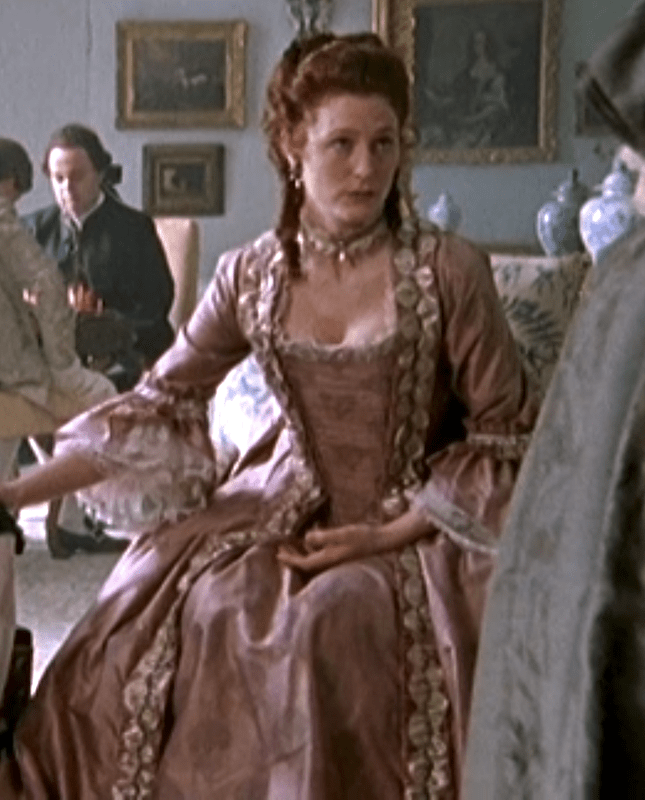
Emily is portrayed as a mature woman, focused on her children. At court, she too brings out the big guns with a gorgeous gold embroidered gown, which we never see from the back:

1999 Aristocrats

1999 Aristocrats

She also gets many, many sacques:

1999 Aristocrats
I like the yellow and green stripes!
1999 Aristocrats
Don’t love that the bodice meets edge to edge center front.

You really don’t see edge-to-edge bodice closures until the mid-1770s:

Sack, 1775-1780 (embroidered), 1775 - 1780 (sewing), 1870 - 1910 (altered), Victoria & Albert Museum, https://collections.vam.ac.uk/item/O74217/sack-unknown/
Sack, 1775-1780 (embroidered), 1775 – 1780 (sewing), 1870 – 1910 (altered), Victoria & Albert Museum

Luckily the rest are great:

1999 Aristocrats
Love the metallic-y sheer trimmings.

1999 Aristocrats

1999 Aristocrats
I think this might be the fancy party dress from episode two? Note how they used lace motifs end to end to decorate the stomacher.
1999 Aristocrats
One thing I love about this production is how many gowns are worn over full hoops instead of pocket hoops, giving them a particular sweep. Pocket hoops are much easier to wear, but a full hoop has OOMPH!

1999 Aristocrats1999 Aristocrats

1999 Aristocrats1999 Aristocrats


Louisa Lennox

We see a LOT more of Louisa in this episode as she forms the linchpin between her sisters’ drama. For court, she wears what could be considered another stiff-bodied gown like Caroline’s:

1999 Aristocrats

1999 Aristocrats
© BBC 1999

1999 Aristocrats

But come on, that bodice doesn’t have tabs:

1999 Aristocrats
More misaligned spiral lacing *sob*. And it’s not quite gaposis, but it’s not great.

She also gets several sacques, and her hair starts listing up into a pompadour that’s sort-of 1780s, sort-of Gibson Girl:

1999 Aristocrats
She wore this in episode two. I don’t love the solid fabric using as robings (the pleated bit that goes from shoulder to waist), it’s just not a period effect – but I do like the fabric!

1999 Aristocrats

1999 Aristocrats
I stared at that side ringlet for too long — it’s a ringlet that’s twisted up on itself, in case you’re a hair nerd like me.
1999 Aristocrats
This fabric is spot-on for the era!

She also gets one of the few nightgowns (the English term for what the French called the robe à l’anglaise, with stitched down pleats in back):

1999 Aristocrats
This embroidery layout isn’t very 18th century, but I can see they were working with an embroidered textile and wanted to lay it out in a way that worked.
1999 Aristocrats
Actual fitted pleats in back! Yay!

The open-fronted, stitched-down-pleats-in-back nightgown was super popular in England (hence why the French called it the “robe à l’anglaise” when they adopted it! Again, see my back-lacing rant if all these style specifics are confusing you):

Robe à l'Anglaise, 1770-75, British, Metropolitan Museum of Art
Robe à l’Anglaise, 1770-75, British, Metropolitan Museum of Art

I’m not sure what this dress is, but I liked the fabric and the multicolor embroidered fichu:

1999 Aristocrats

She’s also got a silver Brunswick-type outfit, which was essentially a short (jacket-length) sacque with a hood often worn for traveling:

1999 Aristocrats 1999 Aristocrats 1999 Aristocrats

Here’s a real Brunswick to compare:

Brunswick, 1765-1775, Victoria & Albert Museum, https://collections.vam.ac.uk/item/O115756/brunswick-unknown/
Brunswick, 1765-1775, Victoria & Albert Museum
Brunswick, 1765-75, France, Victoria & Albert Museum
Brunswick, 1765-1775, Victoria & Albert Museum

And she gets a hooded cloak for traveling:

1999 Aristocrats
It’s a look!
1999 Aristocrats
Better with hood down.

Which she wears over a VERY 1780s, edge-to-edge closed bodice robe à l’anglaise (I guess she too is psychic?):

1999 Aristocrats


Cecilia Lennox

Youngest sister Cecilia is a minor character, but she is finally old enough to wear interesting things — mostly this nightgown with a fitted back that went by too quicky to screencap, but it looks like Louisa’s above:

1999 Aristocrats

She also gets this blue gown, with perfect tête de mouton curled hair:

1999 Aristocrats

The tête de mouton hairstyle was particularly fashionable in France, but worn in Great Britain as well:

Detail from "the Early Breakfast" by Jean-Etienne Liotard, c. 1753-56, Alte Pinakothek
Portrait of a Frenchwoman (detail from “the Early Breakfast”) by Jean-Etienne Liotard showing the tête de mouton hairstyle, c. 1753-56, Alte Pinakothek.


New Duchess of Richmond

Another minor character is the new (3rd) duchess of Richmond, Lady Mary Bruce. She lurks a lot in the background and plays a key role in Sarah’s life.

1999 Aristocrats
She’s got nice, small hairstyles.
1999 Aristocrats
I have questions about this print. It seems awfully like something used for drapes?

1999 Aristocrats

1999 Aristocrats
This green was great, from the stripes to the gathered trims.
1999 Aristocrats
Alright this just SCREAMS “Napoleonic era couch fabric!”

When Sarah goes to France, Mary (who goes with her) gets high, late 1760s hair, which none of the other characters get:

1999 Aristocrats 1999 Aristocrats

Compare to the real Lady Mary in 1770:

Lady Mary Bruce, Duchess of Richmond by Hugh Douglas Hamilton, 1770, via Wikimedia Commons


A Few Other Characters

And, just a few thoughts:

1999 Aristocrats
That’s the back of Louisa’s husband (left) with Caroline’s children. Great wigs on the men… except none of them have the short/turned under “toupet” they should have on top.
1750-55 - Drawing of Giacomo Casanova by his brother, Francesco Giuseppe Casanova, via Wikimedia Commons.
You show me a man’s hair or wig style from 1740 to 1790, and I’ll show you a cut short, possibly turned under section on top (read more in my top 5 18th-century hair movies post) | 1750-55 – Drawing of Giacomo Casanova by his brother, Francesco Giuseppe Casanova, via Wikimedia Commons.
George III by John van Nost, 1764, Yale Center for British Art, https://collections.britishart.yale.edu/catalog/tms:1467
It’s hard to spot when it’s low, especially from the front, which is why I think so many people miss it | George III by John van Nost, 1764, Yale Center for British Art
George III by John van Nost, 1764, Yale Center for British Art, https://collections.britishart.yale.edu/catalog/tms:1467
But turn to the side or back and it’s there! George III by John van Nost, 1764, Yale Center for British Art
1999 Aristocrats
The duke was frequently in this green and yellow outfit shown above with his wife, the duchess of Richmond. But this embroidered waistcoat was great and we should see more of it! (Also, HOW is this actor not related to Colin Firth??)
1760-70 - French waistcoat at the Met.
Comparative example | 1760-70 – French waistcoat at the Met
1999 Aristocrats
I feel like George II spent most of the series in this gray suit with mid-length full-bottomed wig.
1999 Aristocrats
I liked his embroidered garter!
King George II of England by Christian Friedrich Zincke, 1727, via Wikimedia Commons
Compare to the real deal | King George II of England by Christian Friedrich Zincke, 1727, via Wikimedia Commons
1999 Aristocrats
Mr. Fox was usually in a short, bob wig for formal occasions, which was a good method of aging him.
Jean Jacques Rousseau (1712-1778) écrivain by Jean Antoine Houdon, 1779, Louvre
Jean Jacques Rousseau (1712-1778) wearing the bob wig | by Jean Antoine Houdon, 1779, Louvre
1999 Aristocrats
George III wore this burgundy suit a lot.
1999 Aristocrats
Except at this drawing room just after his coronation.
1765 - King George III by Allan Ramsay
Compare to the real George’s coronation robes | 1765 – King George III by Allan Ramsay
1999 Aristocrats
His hair too shows the lack of short toupee on top.
1999 Aristocrats
But those are gorgeous robes!
1999 Aristocrats
Ditzy Lady Susan Fox-Strangways (the real person shown above in that engraving above by Reynolds) basically lived in this pink sacque.
Portrait of Lady Susan Fox-Strangways (1742-1827) by Allan Ramsay, 1761, via Wikimedia Commons
Here’s another take on the real Lady Susan | Portrait of Lady Susan Fox-Strangways (1742-1827) by Allan Ramsay, 1761, via Wikimedia Commons

And Finally…

1999 Aristocrats
Emily’s children are shown being painted. I was hoping this was a take on a real portrait, but I can’t seem to find anything that matches.
1999 Aristocrats
LOVED the shell cottage that Emily, Sarah, and Cecilia work on!
1999 Aristocrats
Detailed screencap – I wonder if they filmed at the real life shell cottage at Carton House, one of Emily’s homes, which the real Emily decorated?

Stay tuned next week, when we’ll look at the final two episodes of Aristocrats!

Got any thoughts on Aristocrats, especially the court dress?


Find this frock flick at:


JustWatch

Like this:

Like Loading...

More Frock Flicks

Tags: 1750s 1760s actual research Anne-Marie Duff Aristocrats (1999) back-lacing dresses court dress George III Geraldine Somerville great hair James Keast Jodhi May mantua men in wigs misaligned spiral lacing Patreon Serena Gordon slightly off hair

Share this:

  • Share on Facebook (Opens in new window) Facebook
  • Share on Bluesky (Opens in new window) Bluesky
  • Share on Threads (Opens in new window) Threads
  • Share on Mastodon (Opens in new window) Mastodon
  • Share on Reddit (Opens in new window) Reddit
  • Share on Pinterest (Opens in new window) Pinterest
  • Share on Tumblr (Opens in new window) Tumblr
  • Email a link to a friend (Opens in new window) Email

Post navigation

Previous Previous post:

WCW: Eleanor Tomlinson

eleanor-tomlinson
Next Next post:

The Sally Lockhart Mysteries (2006-07)

Sally-Lockhart-Mysteries-09

Related Posts

The Testament of Ann Lee (2025)
  • 18th-Century Quest
  • Eighteenth Century

The Testament of Ann Lee (2025)

April 21, 2026 5 1245
Saratoga Trunk (1945)
  • Nineteenth Century
  • Throwback Thursday

TBT: Saratoga Trunk (1945)

April 16, 2026 5 1370

Search the Site

Join Our Patreon

  • ad-patron-bwpic.jpg

Support Frock Flicks

Keep the snark flowing by supporting us with a small one-time donation on Ko-fi.

Connect With Us

  • Facebook
  • Instagram
  • Bluesky
  • Pinterest
  • YouTube
  • 18thCWigs.jpg

Even More Frock Flicks

Gretchen Mol
  • Woman Crush Wednesday

WCW: Gretchen Mol

April 22, 2026 4 651
The Testament of Ann Lee (2025)
  • 18th-Century Quest
  • Eighteenth Century

The Testament of Ann Lee (2025)

April 21, 2026 5 1245
The Forsytes (2025-)
  • Nineteenth Century

The Forsytes (2025), Episode 5

April 20, 2026 14 1299
The Gilded Age (2022-)
  • Top 5 Friday

Top Five Historical Sunglasses, Part 2

April 17, 2026 10 1656
Saratoga Trunk (1945)
  • Nineteenth Century
  • Throwback Thursday

TBT: Saratoga Trunk (1945)

April 16, 2026 5 1370
Marie Antoinette (2022-)
  • Blog

Patreon Post Unlocked: Marie Antoinette (2022) Season 2, Episodes 1-3

April 15, 2026 3 1441
Copyright © Trystan L. Bass, Kendra van Cleave, & Sarah Lorraine Goodman. All rights reserved. | ChromeNews by AF themes.
%d