

Support Frock Flicks with a small donation! During Snark Week and beyond, we’re grateful for your monthly pledges for exclusive content via Patreon or your one-time contributions via Ko-fi or PayPal to offset the costs of running this site. You can even buy our T-shirts and merch. Think of this like supporting public media, but with swearing and no tax deductions!
The shape and silhouette of a costume’s skirt matters — how wide and full a skirt is makes a big difference between decades and centuries.
So when productions skimp on petticoats, it shows! Sometimes it’s really obvious, and other times, it just makes the whole costume look sad, limp, and pathetic. Which is frustrating as a viewer who knows something about costume construction because petticoats are not hard, time-consuming, or expensive to make. A low-budget TV show or movie should be able to borrow or make some basic petticoats, or heck, order some cheap ones on Amazon!
Let’s take a walk through history and see what the right skirt shapes should be, where frock flicks fail, and how they could have gotten a historically accurate look.
16th-Century Petticoats
What Early 16th-c. Skirts Should Look Like:

Frock Flick Fails:
Nobody likes limp Tudors.

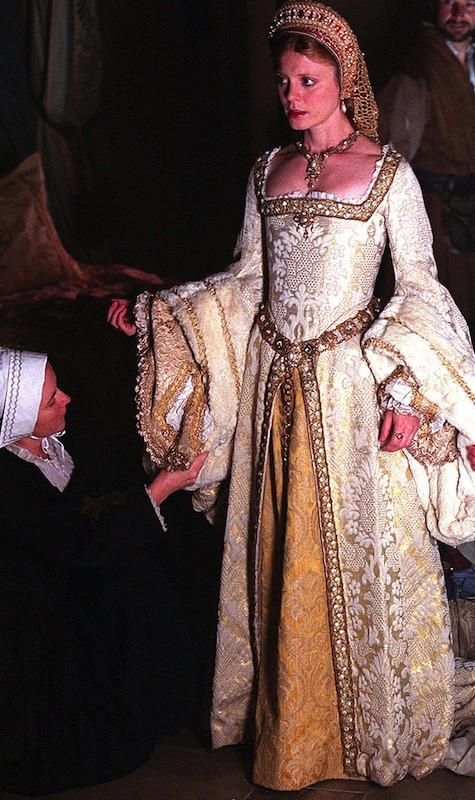
Jane Seymour gets one of the best costumes in this otherwise crappy production, but she’s missing a farthingale.
How to Achieve the Historical Look:
This early image shows farthingale hoops on the outside of gowns, but they evolved into underskirts that propped up heavy skirts with hoops made of cane. Modern hoop skirts can also be finagled into a similar shape.

What Mid 16th-c. Skirts Should Look Like:
The skirt shape stayed mostly conical, maybe a bit more round, and this illustration shows how the farthingale looks underneath women’s gowns (just tucked up out of muddy streets).

Frock Flick Fails:
Alas, Mary wears a totally deflated dress.

This big heavy skirt is just begging for a petticoat.

How to Achieve the Historical Look:
The same farthingale from earlier in the century could work, or hey, there’s always Amazon Prime!

18th-Century Petticoats
What 1760s Skirts Should Look Like:

Frock Flick Fails:
This big fancy dress is just begging for hip supports!

How to Achieve the Historical Look:
Large, fancy gowns require large petticoat structures underneath.

What 1770s Skirts Should Look Like:
Not all 18th-c. dresses need giant panniers though, but they do need some pouf at the hips and/or back. The skirts need to show fullness.

Frock Flick Fails:
This is a really basic attempt at an 18th-c. gown, but if it at least had a petticoat or some hip pads, the shape would be OK.

Hot tip: if the dress clings to the woman’s legs, she needs a petticoat.

How to Achieve the Historical Look:
There were all kinds of petticoats and hip pads used to hold 18th-c. skirts out from the body. Here’s just one example:

What 1780s Skirts Should Look Like:
The fashionable shape for this decade was moving the fullness from the sides to the back.

Frock Flick Fails:
These dresses have a little more pleating in the back, but the skirts just drag on the ground. These ladies need bum pads for the dresses to fulfill their potential.

Ditto every female on the entire series of Poldark.

How to Achieve the Historical Look:
Bum pads of all shapes sizes were the rage!

Today’s ‘bum shop’ is, of course, Amazon, where you can find serviceable versions if you don’t have time / ability to make one yourself.

19th-Century Petticoats
What Regency Skirts Should Look Like:
The 1800-10s is known for a long, sleek columnar fashion, but that doesn’t mean “no petticoats.” A petticoat, often with an edge treatment like pleating, helps hold the gown’s hem out from the body.

Frock Flick Fails:
Of course, a Hallmark attempt at Jane Austen is going to cheap-out on production values and skip petticoats.

But, wow, can you be more obvious?

How to Achieve the Historical Look:
The period option is a bodiced petticoat — meaning the petticoat skirt hangs from a bodice, which has the same high-waisted style as the gown this is worn underneath. Notice how the petticoat’s bottom edge has rows of pleating.

What 1840s Skirts Should Look Like:
Dress silhouettes got gradually bigger throughout the 19th century, using more petticoats and eventually hoop skirts.

Frock Flick Fails:
But just because you’re in a pre-hoop period doesn’t mean dresses should wrap around ladies’ legs!

If you can grab all that skirt, I bet there’s no petticoat underneath.

Sure, Jane Eyre is a poor governess, but she could afford a basic petticoat!

How to Achieve the Historical Look:
Before hoop skirts were patented, petticoats could have rows of cord (like a light rope) sewn in to create a stiffened effect. Modern productions could just use cheap ruffled and tulle petticoats too.

What 1860s Skirts Should Look Like:
This is peak hoop-skirt era! Everybody wore them.

Frock Flick Fails:
But the costume designer for The Beguiled ditched hoops because as “it did look a little more relatable for us today.” headdesk

How to Achieve the Historical Look:
Do I really need to spell it out? Scroll back up for that Amazon hoop skirt! Moving on.
What 1870s Skirts Should Look Like:
Particularly at the end of the 1870s, fashionable gowns moved to the “natural form” bustle shape where fullness was gathered to the lower back and the front was very flat.

Frock Flick Fails:
This gown is actually a pretty nice 1870s natural-form look — but it’s missing any form of historical undergarment!

How to Achieve the Historical Look:
Petticoats with lots of ruffles at the lower back will fill out that gown’s shape beautifully.

What 1890s Skirts Should Look Like, Evening Editon:
At the end of the 19th century, skirt shapes changed constantly! By the mid- to late-1890s, skirts were back to a conical shape, though softer than, say, the 16th-c. style.

Frock Flick Fails:
If you say you’re set in 1895 with the upper-crust in Newport, don’t come at me with these sloppy floppy skirts!

What 1890s Skirts Should Look Like, Daytime Edition:
Much like the 1890s ballgowns, women’s daytime suits would have softly conical skirts.

Frock Flick Fails:
This costume would be pretty good (Battenberg lace parasol notwithstanding) WITH a petticoat.

How to Achieve the Historical Look:
Both evening and daytime fashions were supported by full petticoats with gathered ruffles that fluffed out skirts at the hem.

Now that you know what petticoats go with which costumes, you too can help point them out when they go missing!


I saw a 1950s costume without a crinoline/petticoat on Google Images, it looked limp AF!
The 2005 P&P is the Poster child for missing petticoats!
I get so frustrated with costume designers always going on about wanting their costumes to look “relatable”. It’s a period piece! It’s not going to be relatable!
Also, for The Beguiled, if the excuse had been “well it’s the middle of a war and they don’t have any men around to look good for and they’re doing manual labor to keep things going” I don’t know that it would have been accurate but I would have accepted it as a reason. But not relatability!
Rant over!